Content

BelarusAlert

Sep 15, 2020

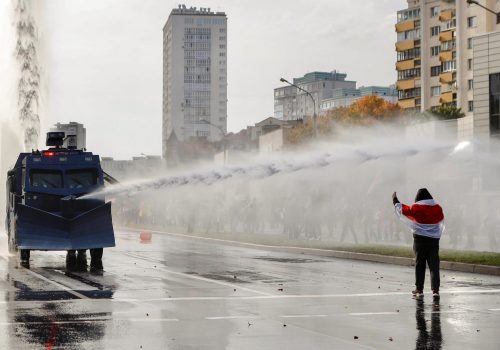
The EU’s “grave concern” will not help Belarus

By Franak Viačorka

The Belarus crisis has exposed the EU's foreign policy limitations, but a tougher European Union response could still succeed in bringing Belarusian dictator Alyaksandr Lukashenka to the negotiating table.

Belarus Democratic Transitions

New Atlanticist

Sep 15, 2020

Mike Pompeo: ‘The tide has turned’ on global perceptions of Chinese threat

By David A. Wemer

Years of US campaigning against China’s unfair economic practices and aggressive diplomacy, coupled with the fallout of the coronavirus pandemic, has “awakened” the world to the threat Beijing poses to international security and the global economy, according to US Secretary of State Mike Pompeo.

China Coronavirus

Five Big Questions

Sep 15, 2020

Five big questions as America votes: South Asia

By South Asia Center

The next US administration will need to confront a slew of regional challenges, including China’s growing political and economic clout; a resurgence of majoritarian politics; strained India-US relations; the impending Afghanistan peace process; and post-COVID-19 reconstruction.

Conflict Coronavirus

EnergySource

Sep 15, 2020

Scaling CCUS: Catalyzing policy and financial innovation

By Emily Burlinghaus, Reed Blakemore, Lee Beck

Carbon capture, utilization, and storage (CCUS) is critical to decarbonizing heavy industry and meeting global climate goals. But significant roadblocks to financing have prevented the ability of industry to scale up CCUS projects. New financing tools and a coordinated approach by policy makers, industry representatives, and financial institutions can help CCUS drive the energy transition.

Energy & Environment Energy Transitions

UkraineAlert

Sep 15, 2020

Ukraine’s reforms remain hostage to corrupt courts

By Diane Francis

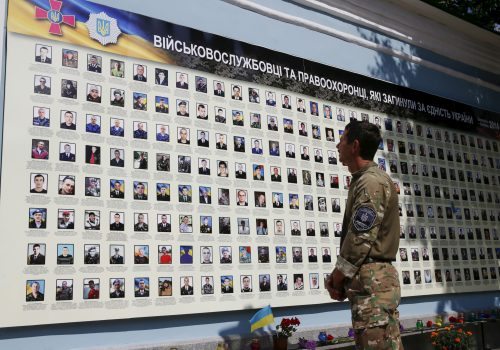
In 2019, political newcomer Volodymyr Zelenskyy and his party won historic election victories based largely on the appeal of promises to eradicate corruption. Just over one year later, these efforts are backsliding and in danger of ending entirely.

Corruption Democratic Transitions

MENASource

Sep 15, 2020

Sistani’s roadmap to the renewal of political legitimacy in Iraq

By Abbas Kadhim

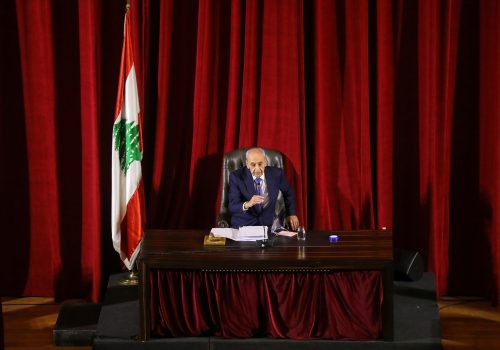
While his statement can be interpreted as a form of support for the current Iraqi government, this support is not unconditional.

Iraq Middle East

New Atlanticist

Sep 15, 2020

Women must be meaningfully included in the Afghan peace negotiations

By Atlantic Council

The long-awaited Afghan peace process finally began on September 12, and Afghanistan’s women must have a seat at the table. While crucial issues such as disarmament, power-sharing, the presence of foreign troops, human rights abuses, and territorial disputes will likely take center stage, leaders from around the world have issued a call to uphold the right of Afghan women to be included in the talks.

Afghanistan Women

GeoTech Cues

Sep 15, 2020

Why data governance matters: Use, trade, intellectual property, and diplomacy

By Pari Esfandiari, PhD, Gregory F. Treverton, PhD

Global data and internet governance represents a scattered, multi-stakeholder, bottom-up, and driven by loose coordination among various players. Data governance can be thought of as incorporating a triangle of individuals and their privacy, nation-states and their interests, and the private sector and its profits. Its current status and prospects might be thought of along several lines of activity, which are interrelated but, for the sake of clarity and with some danger of oversimplification, are discussed in the following different sections: privacy and data use; regulating to police content; using antitrust to dilute data monopolies; self-regulation and digital trade; intellectual property rights; and digital diplomacy.

Cybersecurity Digital Policy

New Atlanticist

Sep 14, 2020

IDB president warns of a looming COVID debt crisis in Latin America, but also highlights opportunities

By David A. Wemer

Actions taken throughout the region to control not only the pandemic, but also “the spread of poverty [and] the spread of unemployment,” have “increased debt to households, to governments, and to businesses,” Moreno explained, while the restrictions of movement and commerce imposed to curb the spread of the virus will make it more difficult for Latin American economies to cope with this debt once the initial phase of the crisis is over.

Coronavirus Inclusive Growth

Feature

Sep 14, 2020

Europe after COVID

By Clément Beaune

A few weeks after the groundbreaking budget agreement adopted by the European Council on July 21, it would be tempting to say that COVID-19 changed everything in the European Union, in line with the oft-repeated principle: “It takes a crisis for Europe to act.” Like all clichés, there is some truth in this statement.

Coronavirus European Union