About the Council

The Atlantic Council promotes constructive leadership and engagement in international affairs based on the Atlantic Community’s central role in meeting global challenges. The Council provides an essential forum for navigating the dramatic economic and political changes defining the twenty-first century by informing and galvanizing its uniquely influential network of global leaders. Through the papers we write, the ideas we generate, and the communities we build, the Council shapes policy choices and strategies to create a more secure and prosperous world.

NATO 20/2020

Twenty bold ideas to reimagine the Alliance after the 2020 US election

More than two decades after NATO’s inspired decision to invite former adversaries to join its ranks, the Alliance is in need of equally captivating ideas. The essays in this volume are intended to push the Alliance to think boldly and creatively in the service of recapturing the public’s imagination.
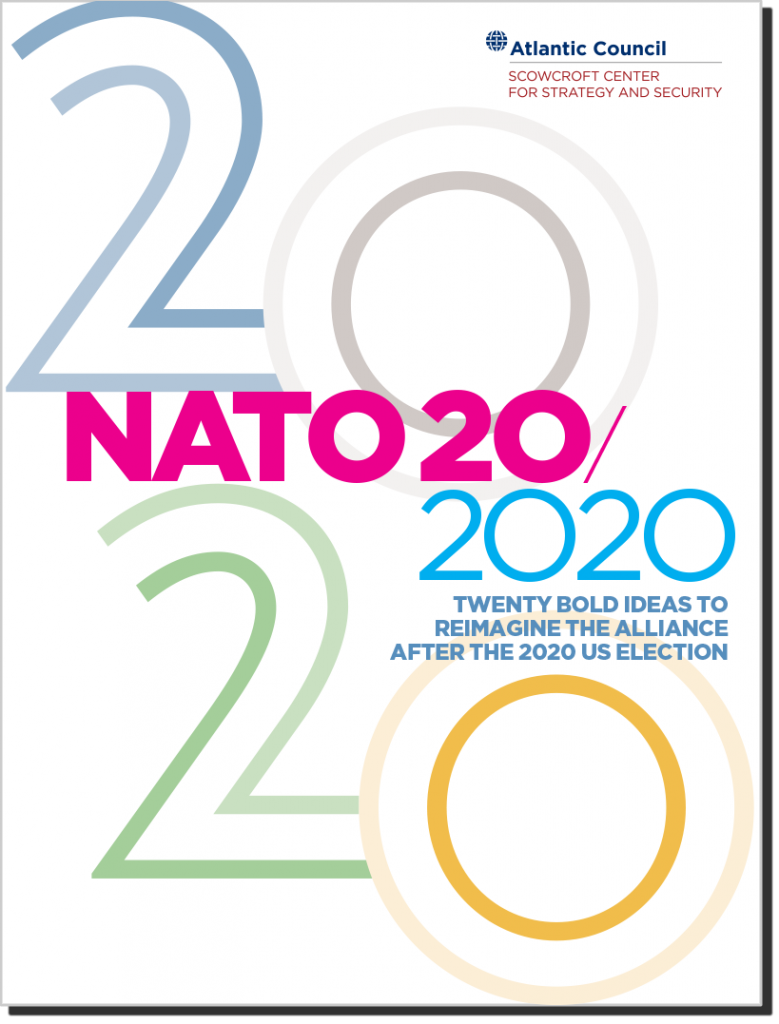
Read our provocative essays on the future of NATO

Explore the podcast series

Making a difference

Learn more about the Atlantic Council’s insights & impact through these stories of how our regional and thematic programs are making a difference not only in shaping how we view global issues but also in shaping their outcome.

Latest commentary and analysis

Latest in-depth research and reports

Content

In the News

Sep 1, 2020

Director Josh Lipsky Quoted in Yahoo Finance on Unemployment Aid

By Josh Lipsky

Read the full article here.

Economy & Business United States and Canada

In the News

Aug 31, 2020

Hasik in DefenseNews: Close the Pentagon and decentralize DoD HQ

By Atlantic Council

Forward Defense Senior Fellow James Hasik contends that the Pentagon office building is a risk to the Defense Department due to its size and immobility as well as its effect on work culture and groupthink.

China Defense Policy

In the News

Aug 31, 2020

Hudson quoted in the New York Times on Sudan’s peace deal with a rebel alliance

By Atlantic Council

Africa Conflict

Insights & Impact

Aug 31, 2020

Wieslander as a panelist with the Free World Forum: Deteriorated security situation around the Baltic Sea

Europe & Eurasia Northern Europe

In the News

Aug 31, 2020

Shaffer in National Interest: Iran’s multiethnic society explains why Tehran fears democracy

Iran faces the democracy conundrum: in multi-ethnic states where one non-majority group prevails over others, democratization entails risk of loss of empire.

Iran Middle East

In the News

Aug 31, 2020

Busch in The Hill: US cheddar cheese in Europe’s trade mousetrap

By Marc L. Busch

Marc Busch writes that a trade debacle between the US and EU over the word "cheddar" is a symptom of a greater contest in trade relations with third-party states.

Economy & Business European Union

In the News

Aug 29, 2020

Younus in his podcast “Pakistonomy”: US-Pakistan relations and the role of the diaspora

By Atlantic Council

Civil Society Pakistan

In the News

Aug 29, 2020

Sparrow discusses General Brent Scowcroft’s legacy on The Slavic Connexion podcast

By Atlantic Council

Politics & Diplomacy Security & Defense

In the News

Aug 29, 2020

Charai in the Jerusalem Post: Can Arabs and Israelis prosper together?

By Atlantic Council

The Arab world was strangely quiet in the wake of the United Arab Emirates’ announcement of peace with Israel. But the announcement is a strategic victory for both Israel and the UAE, with the potential to impact Arab-Israeli relations as far afield as Morocco. Read Atlantic Council Board Director Ahmed Charai's latest in the Jerusalem Post on the prospects for Arabs and Israelis to prosper together.

Israel Morocco

In the News

Aug 28, 2020

Crisis innovation through data trusts: Dr. David Bray

By Atlantic Council

Major global crises like COVID-19 have proven how understanding data quickly and effectively will be essential to our survival; and, to meet that necessity, artificial intelligence will be key. However, without intentional choices to put people at the center of how we collect and manage data, artificial intelligence could spell the end of open societies, replaced instead with surveillance states or surveillance capitalism. “If companies or countries want to succeed in the next decade, we’ve got to figure out a way to do data with people, not to people,” Dr. Bray explained.

Cybersecurity Digital Policy