In-depth research and reports

Our programs and centers deliver relevant, policy-focused research that matters to inform debate and action. Our focus is always on moving debate forward, integrating analysis with active, relevant conclusions throughout our published work.


Atlantic Council Strategy Paper Series

Feb 10, 2026

AI and the future

What does the next year, decade, and beyond hold for AI? We interviewed the Atlantic Council’s tech experts to learn more about AI's future, and whether it can help us better understand our own.

Artificial Intelligence Technology & Innovation

Atlantic Council Strategy Paper Series

Feb 10, 2026

Global Foresight 2036

In this year’s Global Foresight edition, our experts share findings from our survey of geostrategists on how human affairs could unfold over the next decade. Our scholars spot “snow leopards” that could have major unexpected impacts over the next decade. And our tech experts put AI’s forecasting ability to the test.

Africa Central Asia

Atlantic Council Strategy Paper Series

Feb 9, 2026

Six ‘snow leopards’ to watch for in the decade ahead

By Uliana Certan, Nikita Shah, Ginger Matchett, Sarah Wallace, Dominique Ramsawak, Tatevik Khachatryan

Our scholars scan the horizon for the underappreciated phenomena that could have outsize impact on the world, driving global change and shaping the future.

Artificial Intelligence Climate Change & Climate Action

Issue Brief

Feb 9, 2026

Mining without rules: The risky US bet on the deep sea

By Elisabeth Braw

Amid efforts to acquire coveted critical minerals, in April 2025 the United States permitted deep-sea mining within international waters. Elisabeth Braw explores the implications of the Trump Administration's move for global maritime norms.

Economy & Business Energy & Environment

Issue Brief

Feb 4, 2026

A new Arctic strategy for Sweden

By David Auerswald

Sweden has the largest Nordic economy, a defense budget double what it was in 2022 and set to grow more, and cross-party consensus behind the foreign policy shifts that led Stockholm to join NATO in 2024. The government can and should shift its approach in the High North to a singular focus on deterring Russia.

Defense Policy Europe & Eurasia

Issue Brief

Feb 4, 2026

Sweden’s role in countering hybrid threats in the Baltic Sea region

By Justina Budginaite-Froehly

The accession of Sweden to NATO brought the majority of the Baltic Sea under alliance control. Despite NATO's conventional superiority in the region, Russia continues to probe the Alliance's resolve with actions below the threshold of armed conflict. What advantages can NATO’s newest members offer the Alliance as it faces this aggression?

Defense Policy Eastern Europe

Report

Feb 4, 2026

Local and community-driven solutions for development in fragile states

By Elton Skendaj, Peter Mandaville, and Ibrahima Bokoum

This collaborative paper examines community-driven approaches to development from three unique perspectives and highlights the importance of putting local agency at the center of international development work.

Africa Caribbean
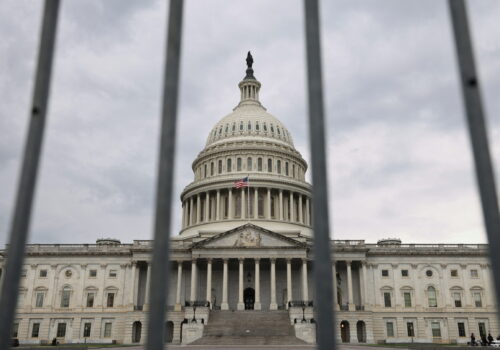
The US Capitol is seen through security fencing as Republican lawmakers struggle to pass US President Donald Trump’s sweeping spending and tax bill, on Capitol Hill in Washington, DC, US, July 2, 2025. REUTERS/Kevin Lamarque

Report

Jan 29, 2026

The US needs a cybersecurity roadmap

By Franklin D. Kramer, Robert J. Butler, and Melanie J. Teplinsky

A national cybersecurity strategy will require an operational road map.

Cybersecurity Security & Defense

Issue Brief

Jan 29, 2026

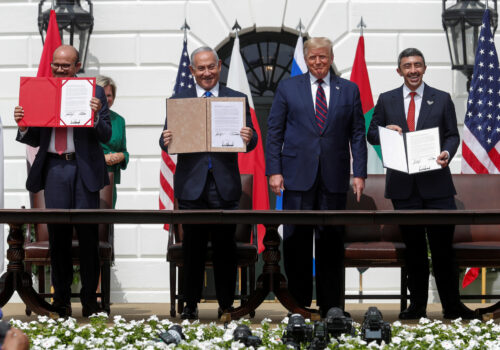
Congress has championed the Abraham Accords. Here’s how it can push them forward.

By Adam Kozloski

This issue brief offers recommendations for Congress to reassert its leadership role in supporting the Abraham Accords.

Israel Middle East

Report

Jan 26, 2026

In Iraq, China’s long game unfolds

By Sardar Aziz and Mohammed A. Salih

As China seeks new markets abroad and energy security at home, Iraq has become integral to Beijing’s plans in the Middle East. Baghdad finds itself caught between its security needs, for which it depends on the United States, and the economic needs of its growing population.

China Energy Markets & Governance

Report

Jan 21, 2026

Countering Russian escalation in space

By John Klein, Clementine G. Starling-Daniels

Current US space policy and acquisitions are inadequate to address the growing threats from Russia in space. The United States needs a more resilient space architecture, able to withstand major-power conflict—and Russia’s designs to place a nuclear weapon in orbit. Here are fifteen recommendations to make that happen.

China Missile Defense

Report

Jan 14, 2026

A three-billion-person challenge: The rising global market for financial leaders

By Ruth Goodwin-Groen

Financial-sector policymakers and financial service providers are facing both a real challenge and unique opportunity to drive economic inclusion for about three billion people and spur growth toward the Sustainable Development Goals (SDGs).

Africa Digital Currencies

Report

Jan 14, 2026

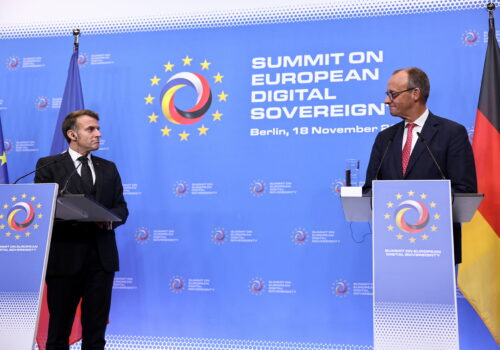
Digital sovereignty: Europe’s declaration of independence?

By Frances Burwell, Kenneth Propp

In Brussels, "digital sovereignty" may be the new "strategic autonomy": a push for Europe to go its own way and depend less on the United States. As US tech companies and EU regulators clash, catch up on a policy debate with consequences playing out online and in the halls of power.

Digital Policy Economy & Business

Issue Brief

Jan 14, 2026

Transatlantic cooperation on protecting minors online

By Michèle Ledger

There is widespread agreement among US and EU officials on the need to protect children online. US-EU dialogue on areas of commonality could facilitate a more efficient rollout of services and technologies to protect users.

Digital Policy European Union

Freedom and Prosperity Around the World

Jan 9, 2026

Singapore must shift from state-led expansion to productivity-led growth

By Linda Y.C. Lim

Singapore’s GDP has tripled since the 1990s. Now the city-state needs a new social compact that matches its high-income status. Creating space for productivity, entrepreneurship, and open debate will decide whether Singapore’s prosperity benefits more Singaporeans—or becomes increasingly fragile.

Economy & Business Freedom and Prosperity

Report

Jan 2, 2026

The evolution of Latvia’s defense and security policy in resilience building

By Armands Astukevičs and Elīna Vrobļevska

Latvia has embraced a broader concept of national resilience encompassing not only military strength but also the resilience of its society, the continuity of government and essential services during crises, the protection of critical infrastructure, and the cultivation of psychological defense among its populace.

Defense Policy Europe & Eurasia

Issue Brief

Dec 23, 2025

Prioritizing Canada’s investment in Arctic infrastructure

By Jason C. Moyer

Canada’s new budget promises a “generational investment” in infrastructure, with a significant amount earmarked for Arctic dual-use infrastructure—improving Canada’s military presence in the north, accessing untapped critical mineral reserves, and offering new economic opportunities. But this is only the beginning of the region’s infrastructure needs.

Energy & Environment Infrastructure Protection

Freedom and Prosperity Around the World

Dec 23, 2025

Serbia’s future depends on rebuilding rule of law and EU credibility

By Richard Grieveson

After a full year of antigovernment protests, Belgrade faces a sustained challenge to the status quo. The corruption that drew protestors to the streets also stifle growth and imperil political freedom in the country. Restoring a credible path to EU accession would be the single most powerful external incentive for change.

Europe & Eurasia Freedom and Prosperity

Issue Brief

Dec 22, 2025

How to equip Canada’s defense industrial base to meet NATO’s Hague summit commitments

By Jason C. Moyer

In 2025 Canada met NATO’s target of spending 2 percent of GDP on defense for the first time and committed to the new target of 5 percent by 2035, but its defense industrial base will struggle to deliver in its current state.

Defense Industry Defense Policy

Issue Brief

Dec 22, 2025

First hundred days: How Kast can accelerate US investment in Chile

By Maite Gonzalez Latorre, Jason Marczak

Chile's newly elected president enters office facing a slew of economic pressures: slow growth, weak investment, stagnant productivity, high inequality, limited social mobility, and regional gaps. What can his administration do to jumpstart foreign direct investment?

Americas Civil Society