Content

Issue Brief

May 6, 2016

Stolen Future

By Diane Francis

Diane Francis’ new issue brief, “Stolen Future,” exposes the depth and breadth of the economic devastation a corruption fueled oligarchy has wrought in Ukraine. In the wake of the Euromaidan Revolution, Ukraine has the opportunity to break the cycle of wealth appropriation which has plagued both Russia and Ukraine since the collapse of the Soviet […]

Corruption
Democratic Transitions

Report

Apr 5, 2016

Ukraine v. Russia and the Kleptocrats

By Alan Riley

In this new report from the Dinu Patriciu Eurasia Center, Alan Riley proposes new legal avenues that Ukraine can pursue to recover asset losses resulting from corruption under the Yanukovych regime and Russian occupation of Ukrainian territory. In this new report from the Dinu Patriciu Eurasia Center, Alan Riley proposes new legal avenues that Ukraine […]

Corruption
Democratic Transitions

Atlantic Council Strategy Paper Series

Mar 15, 2016

Autocracies failed and unfailed: limited strategies for state building

By Stephen D. Krasner

The fundamental challenge for modern wealthy democracies committed to promoting better governance is that their opportunities are hostage to the preferences of national elites in closed-access polities, where political power is exercised in arbitrary ways, and where most of the population lacks access to services, including the rule of law.

Afghanistan
Africa

Issue Brief

Mar 14, 2016

Why the Congo matters

By Gérard Prunier

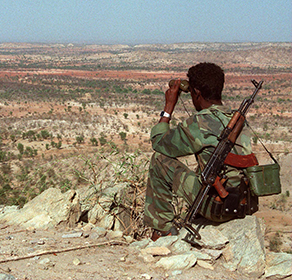
With a population of almost 80 million people and unparalleled natural resources, the Democratic Republic of the Congo (the DRC or the Congo) is a country of tremendous potential—but only that. One of the most violent places on earth, its people suffer from the brutality of armed groups and political instability. Now, President Joseph Kabila’s […]

Africa
Corruption

MENASource

Nov 19, 2015

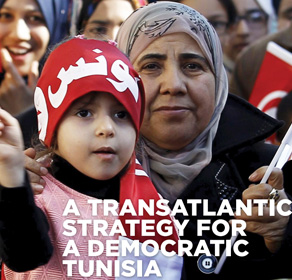
Tunisia’s Ruling Party Crisis

By Katherine Wolff and Elissa Miller

Nidaa Tounes may have to answer to a jaded constituency in the elections for failing its voters. While the current crisis is unlikely to trigger government collapse, it hampers the party’s ability to serve as a unified countervailing force to Ennahda and underscores the fragile nature of Tunisia’s balance of political power.

Democratic Transitions
Middle East

MENASource

Sep 29, 2015

Will Tunisia’s Economic Reconciliation Law “Turn the Page”?

By Elissa Miller and Katherine Wolff

The bill has provoked considerable mistrust at a time when Tunisia, plagued by a spiraling economy and relentless security challenges, desperately needs unity. Trust is needed among the Tunisian people and the country’s political parties as the government prepares to embark on challenging reforms that may be its only hope for economic survival.

Democratic Transitions
Middle East

Issue Brief

Jun 23, 2015

Tunisia: From elected government to effective governance

By Karim Mezran and Lara Talverdian

Tunisia has accomplished significant milestones, from ousting an authoritarian regime in 2011 to ushering in a fully elected government in 2015. Nonetheless, the country is still in a critical phase of its transition, balancing the challenges of governance to address pressing economic and security issues. In their Atlantic Council Issue in Focus, “Tunisia: From Elected […]

Democratic Transitions
North Africa

Issue Brief

Apr 21, 2015

Tunisia’s new constitutional court

By Duncan Pickard

January 2014 became a milestone of Arab democracy when Tunisia adopted the first democratic Arab constitution drafted outside the influence of the military or a foreign power. In “Tunisia’s New Constitutional Court,” Duncan Pickard, a Nonresident Fellow at the Atlantic Council’s Rafik Hariri Center for the Middle East, takes up the next step for the […]

Democratic Transitions
Human Rights

Issue Brief

Feb 17, 2015

False dichotomy: Stability versus reform in the Arab world

By Danya Greenfield and Faysal Itani

To cling to current short-sighted policies and to help sustain dysfunctional states in the Middle East for the sake of short-term security would condemn the region to poverty and further instability, which threaten to have negative consequences for US interests. A new Atlantic Council report rejects the notion that the United States must choose between […]

Democratic Transitions
Middle East

Report

May 5, 2014

Libya’s Faustian bargains: Breaking the appeasement cycle

By Karim Mezran, Jason Pack, and Mohamed Eljarh

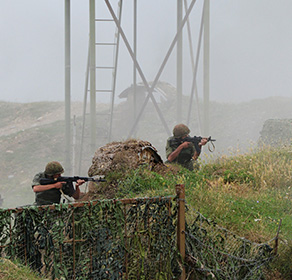
A new Atlantic Council report examines the threats to Libya’s stability, provides a detailed mapping of the militia landscape, and details policy options for the Libyan government and its international partners. In Libya’s Faustian Bargains: Breaking the Appeasement Cycle, the authors attribute the cycle of violence, intractable political stalemate, and weakened economy to the Libyan […]

Conflict
Democratic Transitions

Experts