
Financial Sanctions and Economic Coercion

Financial sanctions and other forms of economic coercion have become policy tools of choice for the US government to deter illegal activity by international actors or to pressure governments into reversing actions that harm US interests. Yet these instruments and their potential pitfalls are often misunderstood. Restrictive economic measures such as financial sanctions, export controls, tariffs, and investment screening can play an important role in advancing certain policy objectives, but they risk being ineffective if misapplied or poorly implemented. Policymakers must also recognize the impact of economic statecraft on the private sector, which bears many of the compliance burdens and operational costs associated with these measures.

Energy Sanctions Dashboard

This dashboard focuses on US sanctions and restrictive measures placed on crude oil from Russia, Iran, and Venezuela—including the unintended consequences and the lessons learned.

Econographics

Apr 17, 2025

Russia Sanctions Database

By Kimberly Donovan, Maia Nikoladze, Lize de Kruijf

The Atlantic Council’s Russia Sanctions Database tracks the level of coordination among Western allies in sanctioning Russian entities, individuals, vessels, and aircraft, and shows where gaps still remain.

Eastern Europe Economy & Business

Recent analysis

Programs

At the intersection of economics, finance, and foreign policy, the GeoEconomics Center is a translation hub with the goal of helping shape a better global economic future.

Content

In the News

Mar 3, 2022

Preble on Net Assessment: Putin’s taunt: what are you going to do about it?

By Atlantic Council

On March 3, Christopher Preble joined his co-hosts on the Net Assessment podcast to discuss the implications of the war in Ukraine, focusing on escalation risks, the use of sanctions, and what the war may do to Europe’s defense posture. “On a somber day, Chris, Melanie, and Zack ponder the implications of the war in […]

Conflict Eastern Europe

In the News

Mar 3, 2022

Ashford in Fortune: Banks are stopping Putin from tapping a $630 billion war chest Russia stockpiled before invading Ukraine

By Atlantic Council

On March 3, Emma Ashford was quoted in Fortune on government reserves of foreign currency. “Foreign reserves are a government’s holdings of gold, foreign debt, and foreign currency, which is usually denominated in the world’s most popular coins—dollars, euros, pounds, yen, and yuan. Although a country can hold foreign reserves in its own banks, governments […]

Eastern Europe Economy & Business

In the News

Mar 3, 2022

Friendlander quoted in CNBC on the unprecedented nature of Western sanctions against Russia

Read the full article here.

Economy & Business Europe & Eurasia

In the News

Mar 3, 2022

CBDC tracker cited in the South China Morning Post

Read the full article here

China Economy & Business

In the News

Mar 3, 2022

Zarazinski in The Washington Post: Crypto industry says it is complying with Russian sanctions, as some policymakers ring alarms

Digital Currencies Financial Sanctions and Economic Coercion

In the News

Mar 3, 2022

Lipsky quoted in CNN Business on the uncertainty business face as a result of sanctions imposed on Russia

Read the full article here.

Economy & Business Europe & Eurasia

In the News

Mar 3, 2022

Our research on the location of Russian central bank’s foreign exchange reserves featured in Axios

Read the full article here.

Economy & Business Europe & Eurasia

In the News

Mar 3, 2022

Chemali quoted in Washington Post on Russian reserves held abroad

Read the full article here.

Economy & Business Europe & Eurasia

In the News

Mar 2, 2022

Lichfield quoted in CNN Business on Russia’s import substitution policies following western sanctions in 2014

Read the full article here.

Economy & Business Financial Sanctions and Economic Coercion

BelarusAlert

Mar 2, 2022

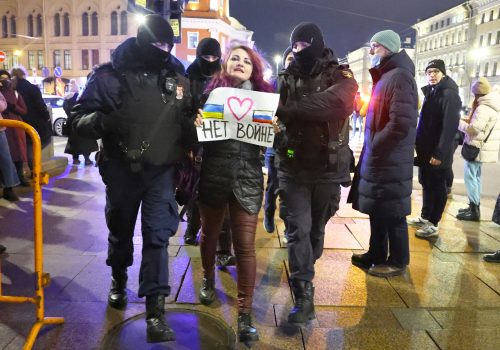
Putin’s Ukraine War fuels protest mood in Russia and Belarus

By Brian Whitmore

Russian President Vladimir Putin's full-scale invasion of Ukraine has sparked the biggest European conflict since WWII and is now fueling a growing anti-war protest mood in both Russia and Belarus.

Belarus Civil Society

Experts