The Cyber Statecraft Initiative works at the nexus of geopolitics, technology, and security to craft strategies to help shape the conduct of statecraft and to better inform and secure users. This work extends through the competition of state and non-state actors, the security of the internet and computing systems, the safety of operational technology and physical systems, and the communities of cyberspace. The Initiative convenes a diverse network of passionate and knowledgeable contributors, bridging the gap among technical, policy, and user communities.


Our work

The Atlantic Council Technology Programs comprises five existing efforts—the Digital Forensic Research Lab (DFRLab), the GeoTech Center, the Cyber Statecraft Initiative, the Democracy + Tech Initiative, and the Capacity Building Initiative. These operations work together to address the geopolitical implications of technology and provide policymakers and global stakeholders necessary research, insights, and convenings to address challenges around global technology and ensure its responsible advancement.

Team

Fellows

Publications

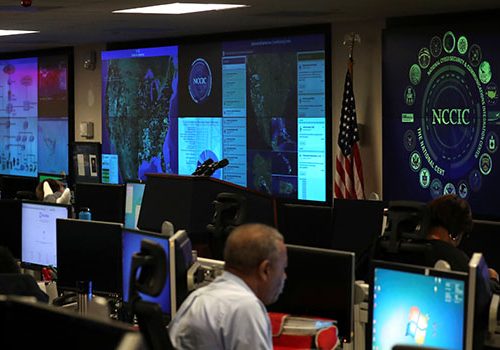
Cyber security official

Conflict, Risk, and Tech

Sep 17, 2019

The American way of cyber warfare and the case of ISIS

By JD Work

The Cyber Vault collection shows the complexity in design and executing offensive cyber operations which help distinguish an ‘American way’ of cyber warfare—one that is no doubt closely mirrored by many of our allies.

Cybersecurity

Press Release

Aug 6, 2019

Atlantic Council Statement on the Appointment of Christopher Porter as National Intelligence Officer for Cyber at the Office of the Director of National Intelligence

"The Atlantic Council is proud to have one of our own, Christopher Porter, selected to serve as the top intelligence officer for cyber in the US government."

Press Release

Jul 18, 2019

Atlantic Council Announces Trey Herr as Director of the Cyber Statecraft Initiative

The Atlantic Council today announced Trey Herr as Director of the Cyber Statecraft Initiative in its Scowcroft Center for Strategy and Security. Dr. Herr will be central to further strengthening the Initiative’s continued work on cyberspace as a tool of statecraft in an era of expanding great-power competition where geopolitics and cybersecurity increasingly overlap.

Issue Brief

Jul 16, 2019

Collective defense of human dignity: the vision for NATO’s future in cyberspace

By Christopher B. Porter

An alliance under tension, NATO today faces the challenges of burden sharing, a multipolar world full of old adversaries and emerging challengers. In “Collective Defense of Human Dignity: The Vision for NATO’s Future in Cyberspace,” Christopher Porter, a nonresident senior fellow in the Cyber Statecraft Initiative at the Atlantic Council analyzes member states struggling with […]

New Atlanticist

Jun 5, 2019

Dark Web 2.0?

By Jared Zimmerman

We will likely see a smaller dark web orbiting around a sophisticated criminal core using newer, but less user-friendly, anonymization protocols, while other criminals will need to operate in plain sight on the clear web to reach less-savvy customers.

Cybersecurity Digital Policy

New Atlanticist

May 22, 2019

Crossing the cyber Rubicon: Views from both sides of the river

By Jack Watson and William Loomis

Did the IDF’s airstrike ‘cross the Rubicon’ by using lethal force in response to hacking? On the weekend of May 5, a month after a truce was agreed between Israel and Hamas forces in the Gaza Strip, violence again rose to levels not seen since 2014.

Cybersecurity Israel

Report

Apr 24, 2019

Cybersecurity: Changing the model

By Franklin D. Kramer and Robert J. Butler

The need to update the cybersecurity model is clear. An enhanced public-private model – based on coordinated, advanced protection and resilience – is necessary to protect key critical infrastructure sectors

Cybersecurity English

New Atlanticist

Apr 24, 2019

5G access key to competing globally, says Former Homeland Security Secretary Chertoff

By Ashish Kumar Sen

US officials have warned that Huawei’s equipment could create a backdoor for the Chinese government to spy on US networks. But Huawei has repeatedly denied this claim. Even as governments grapple with this challenge, “we also should consider the next generation of technology that is going to support the Internet—and that is 5G,” said Michael Chertoff, who served as secretary of the US Department of Homeland Security from 2005 to 2009.

China Defense Technologies

New Atlanticist

Apr 23, 2019

An ‘increase in clarity’ in US cyber strategy

By Ashish Kumar Sen

The “ability to partner across all of the elements within cyberspace is a critical enabler for all of us," Timothy Haugh says.

Cybersecurity National Security

New Atlanticist

Apr 23, 2019

The United States is adapting to the cyber challenge, says top DHS official

By David A. Wemer

Shifting tactics have prompted federal authorities to change their approach to defense, Krebs says.

Cybersecurity National Security

The Atlantic Council’s Cyber Statecraft Initiative, part of the Atlantic Council Technology Programs, works at the nexus of geopolitics and cybersecurity to craft strategies to help shape the conduct of statecraft and to better inform and secure users of technology.

Licensing CSI Graphics

All original graphics created by the Cyber Statecraft Initiative (CSI) are available for re-use under the following conditions:

  • Written permission must be granted by CSI.
  • Graphics may be copied and distributed in any medium or format in unadapted form only, for noncommerical purposes, and only so long as attribution is given.1Language based on Creative Commons CC BY-NC-ND 4.0
  • The attribution must reference the Cyber Statecraft Initiative and include a link to the content.
  • CSI cannot grant permission for the use of images or graphics licensed from third parties.