Middle East Programs Commentary & Analysis

Our blogs feature thoughtful reflections and opinions on current events in the Middle East & North Africa.
Through our Middle East Programs, the Atlantic Council works with allies and partners in Europe and the wider Middle East to protect US interests, build peace and security, and unlock the human potential of the region.
Meet our blogs

All commentary & analysis

New Atlanticist

May 14, 2019

Attacks on Saudi oil stations raise tensions in volatile Gulf

By David A. Wemer

Drones purportedly flown by Houthi rebels in Yemen attacked Saudi oil pumping stations on May 14, creating a new flash point in a region already on edge over rising tensions between the United States and Iran.

Conflict Energy Markets & Governance

MENASource

May 14, 2019

How climate change could exacerbate conflict in the Middle East

By Sagatom Saha

Global warming will do the Middle East no favors. Evidence abounds it will be the region that climate change will hit hardest. Summer temperatures across the region are expected to increase more than twice the global average.

Climate Change & Climate Action

IranSource

May 13, 2019

On Iran, Europeans caught between multilateral and transatlantic realities

By Tarja Cronberg

Iranian President Hassan Rouhani announced on May 8 that Iran may reduce its compliance with the Joint Comprehensive Plan of Action (JCPOA) if the non-US parties to the deal don’t find a way to provide Tehran with promised economic benefits.

Iran

MENASource

May 9, 2019

Xi Jinping’s promise of an open BRI bodes well for Chinese-Gulf relations

By Dan Katz

Promises made by Chinese President Xi Jinping at the biennial Belt and Road Forum about opening the Belt and Road Initiative to multilateral and third-party investment could bode well for Gulf-China relations and the Middle East more broadly by creating new opportunities for energy and economic cooperation.

China International Organizations

SyriaSource

May 9, 2019

Constant attacks continue to displace thousands in Syria

By Rana Riziq

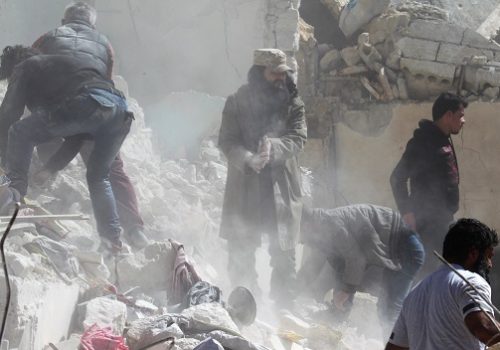
The Syrian government along with its Russian allies launched a brutal assault on Idlib province, the last rebel-held areas, on Monday 30 April. The United Nations said the attacks included the worst use of barrel bombs by the Syrian army in 15 months. It said an estimated 323,000 people have been displaced in northwest Syria since last year.

Syria

MENASource

May 9, 2019

Can there be a peaceful solution for Libya’s conflict?

By Mustafa A.G. Abushagur

If the international community continues to stay on the sidelines, watching and allowing Haftar’s international allies to continue providing him with support, this war will continue with no foreseeable end and at a heavy price

Libya

IranSource

May 9, 2019

Former state broadcaster head does tell-all interview about the IRGC

By Maysam Behravesh

While growing US-led pressure on Iran is helping unify the Iranian polity around the flag of nationalism, it is also exposing fault lines among the ruling elite as they search for the key causes of the Islamic Republic’s failures forty years after its birth.

Iran

SyriaSource

May 8, 2019

Why Europe won’t rebuild Syria

By Eugenio Dacrema

Since the fall of 2018, we have seen increasing signals of disagreement among European Union (EU) member states regarding Syria.

Syria

IranSource

May 8, 2019

Iran withdraws from certain aspects of the nuclear agreement

By Holly Dagres

A year after the United States withdrew from the Joint Comprehensive Plan of Action (JCPOA) and six months after it re-imposed sanctions, Iran has said it would reduce its compliance with the 2015 nuclear agreement in sixty days unless the remaining parties take concrete steps to continue trade with Iran.

Iran

Event Recap

May 7, 2019

Private Roundtable on Iraq with DASD Mick Mulroy

By Atlantic Council

On May 7, the Atlantic Council’s Iraq Initiative hosted US Department of Defense Deputy Assistant Secretary of Defense for the Middle East Michael “Mick” Mulroy for a private, off-the-record discussion on Iraq. Atlantic Council Middle East Programs Director and Rafik Hariri Center Director William F. Wechsler moderated the conversation.