
All in-depth research & reports

Report

Sep 6, 2019

Alternate cybersecurity futures

By John Watts, Ben Jensen, JD Work, Nina Kollars, and Chris Whyte

If the national security community continues to focus on immediate threats and managing current emergencies, it will never escape a cycle of crises, nor manage to impose a strategy to shape tomorrow’s environment.

Cybersecurity
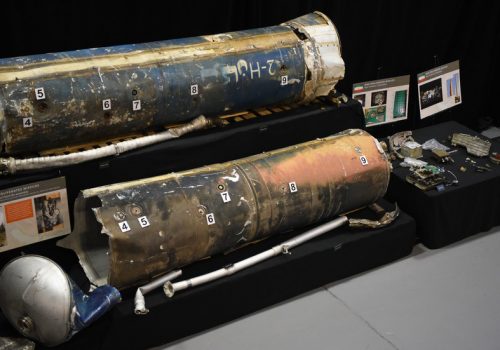
Iranian Weapons Materiel on Display at Joint Base Anacostia-Bolling

Issue Brief

Jul 30, 2019

Avenues for conflict in the Gulf: A matrix game simulation

By John Watts

Iran faces increasing pressure domestically and internationally, while simultaneously perceiving a historic opportunity to reshape regional dynamics through multiple regional conflicts. This convergence creates conditions that could lead to a strategic shock, and which warrant serious consideration.

Conflict
Crisis Management
Forward Defense

Report

Apr 23, 2019

Leveraging the National Technology Industrial Base to address great-power competition

By William Greenwalt

The purpose of this report by William Greenwalt is to promote urgent deliberations over what a modern National Technology and Industrial Base should look like, and to encourage Congress and the administration to adopt measures that will enable access to defense-industrial resources that are more responsive to the needs of the National Defense Strategy.

Defense Industry
Defense Technologies

Report

Sep 19, 2018

Whose truth? Sovereignty, disinformation, and winning the battle of trust

By John Watts

In an era of increasing technological, cultural and geo-political change, the rise of disinformation undermines the institutions that nations rely on to function and creates risks across society. At the heart of the challenge is the battle of truth and trust. In this report, “Whose Truth: Sovereignty, Disinformation and Winning the Battle of Trust, John […]

Disinformation
Media

Report

Apr 24, 2018

A strategy for deterring Russian de-escalation strikes

By Matthew Kroenig

The United States and its NATO allies have not developed a clear strategy for deterring limited Russian nuclear strikes. Specifically, in the event of a limited Russian nuclear attack, how would the United States and its NATO allies respond?

Defense Policy
Europe & Eurasia

Issue Brief

Nov 15, 2016

Toward a more flexible NATO nuclear posture

By Matthew Kroenig

Over the past decade and a half, Russia has placed an increased emphasis on nuclear weapons in its military strategy and doctrine. Moscow’s assertive “escalate-to-de-escalate” nuclear strategy poses a distinguishable threat to NATO nations, and requires greater strategic thinking about NATO’s nuclear posture.

Europe & Eurasia
NATO

Issue Brief

Nov 15, 2016

Toward a more flexible NATO nuclear posture

By Matthew Kroenig

Over the past decade and a half, Russia has placed an increased emphasis on nuclear weapons in its military strategy and doctrine. Moscow’s assertive “escalate-to-de-escalate” nuclear strategy poses a distinguishable threat to NATO nations, and requires greater strategic thinking about NATO’s nuclear posture. After a quarter century of reducing its reliance on nuclear weapons, NATO […]

Europe & Eurasia
NATO

Issue Brief

Oct 5, 2016

Odd couple: The future of the Australia-UAE partnership

By John T. Watts

Considering its geographic distance and lack of formal allies, the Middle East has played an outsized role in the history of Australia’s global engagement. While Australia’s interests in the region are real and increasing, as a middle power with finite resources it must take a smart approach to pursuing them.

Australia
Security Partnerships

Issue Brief

Feb 3, 2016

The renewed Russian nuclear threat and NATO nuclear deterrence posture

By Matthew Kroenig

Over the past decade, Russia has made nuclear weapons a predominant element of its national security strategy and military doctrine, while NATO has consciously de-emphasized its nuclear posture.

NATO
Nuclear Deterrence

Art of Future Warfare

Nov 9, 2015

World War Z Author Max Brooks to Join the Atlantic Council’s Art of Future Warfare Project

By Atlantic Council

WASHINGTON, DC – The Atlantic Council announced today the appointment of Max Brooks as a Nonresident Senior Fellow for the Art of Future Warfare Project, which is an initiative of the Council’s Brent Scowcroft Center on International Security. Brooks is the acclaimed author and screenwriter of works such as World War Z: An Oral History […]

Crisis Management
National Security

Subscribe

Sign up for updates from Forward Defense to hear the latest on the trends, technologies, and military challenges shaping tomorrow.


  • This field is for validation purposes and should be left unchanged.

Forward Defense leads the Atlantic Council’s US and global defense programming, developing actionable recommendations for the United States and its allies and partners to compete, innovate, and navigate the rapidly evolving character of warfare. Through its work on US defense policy and force design, the military applications of advanced technology, space security, strategic deterrence, and defense industrial revitalization, it informs the strategies, policies, and capabilities that the United States will need to deter, and, if necessary, prevail in major-power conflict.