Nuclear strategy project

The Scowcroft Center is proud to play a central role in crafting an effective and nonpartisan strategic forces policy for the twenty-first century.

The Scowcroft Center’s namesake, General Brent Scowcroft, was the chairman of the 1983 Scowcroft Commission that established the foundation for US nuclear deterrence and arms control policy through the present day. As the United States enters a new era of strategic challenges, the Scowcroft Center’s Forward Defense program is proud to play a central role in crafting an effective and nonpartisan strategic forces strategy and policy for the twenty-first century.

The 2022 National Defense Strategy and Nuclear Posture Review caution that the United States will, for the first time in its history, face the challenge of simultaneously deterring two nuclear great powers, each with aggressive revisionist goals. Our Nuclear Strategy Project, within the Forward Defense program, focuses on the role of nuclear deterrence, nuclear strategy and employment, missile defense, and arms control in deterring conventional aggression and nuclear escalation against the United States, its allies, and partners.

Principal research areas

Must Reads
Report

Jan 4, 2025

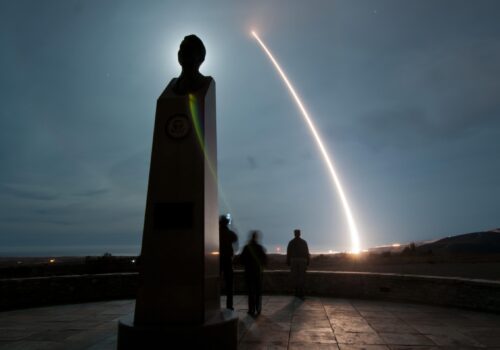
‘First, we will defend the homeland’: The case for homeland missile defense

By Robert Soofer with contributions from Kari Anderson, James McCue, Tom Karako, Mark J. Massa, Alyxandra Marine, and Jonathan Rosenstein

A comprehensive analysis of U.S. homeland missile defense, addressing policies, security challenges, and strategies to counter threats from North Korea, China, and Russia.

China Defense Technologies

Reports & issue briefs

Issue Brief

Mar 12, 2010

NATO’s Nuclear Policy in 2010

Annette Heuser and Walter Slocombe, members of the Strategic Advisors Group (SAG), address the critical issue of NATO’s nuclear policy and offer recommendations for its inclusion into the new Strategic Concept. Download the PDF

NATO Nuclear Deterrence
North Korea Nuclear Weapons

Report

Feb 5, 2009

Achieving peace and security in Korea and Northeast Asia: A new US diplomatic strategy toward North Korea

The Atlantic Council is pleased to release its Final Report of its three-year project on U.S. policy toward North Korea. This report makes clear that unless President Obama adopts a new strategy of seeking a comprehensive settlement in Korea, the U.S. is unlikely to eliminate North Korea’s nuclear program.D Adopting the new diplomatic strategy of […]

East Asia Korea
North Korea Nuclear Weapons

Report

Mar 1, 2008

Perspectives on peace and security in Korea and Northeast Asia

The Atlantic Council of the United States published a report entitled A Framework for Peace and Security in Korea and Northeast Asia in April 2007. The report was the culmination of deliberations of a working group of distinguished American scholars and practitioners with a wide range of experience on Korea and Northeast Asia and chaired […]

East Asia Korea

Report

Apr 17, 2007

North Korean relations: US policies, laws & regulations

This compendium contains the text of major regulations, laws, and other documents governing U.S. interactions with North Korea. Also provided are the text of U.N. Resolutions, agreements, and other documents that represent major policy decisions in U.S. relations with North Korea. Accompanying each major document, law, or regulation is a brief analysis discussing the policy […]

Defense Policy International Norms

Report

Apr 13, 2007

Korea and Northeast Asia peace and security framework

The United States has few more important policy goals than eliminating North Korea’s nuclear weapons program. The risk that the repressive Pyongyang regime could transfer nuclear weapons and materials to rogue states or terrorist groups weighs particularly heavy on the minds of U.S. policymakers. Executive Summary U.S. negotiators in February 2007 achieved a breakthrough in […]

China Defense Policy

Commentary & quick analysis
Past events
In the news

In the News

May 18, 2026

Marine published in the Bulletin of the Atomic Scientists on trilateral arms control

By Atlantic Council

On May 13, Forward Defense Associate Director and Resident Fellow Alyxandra Marine co-authored an article in the Bulletin of the Atomic Scientists, arguing that the United States should pursue trilateral arms-control arrangements with Russia and China. While near-term agreement is unlikely, Marine and her co-author, Matthew Kroenig, contend that negotiations could still advance US strategic […]

Arms Control China

In the News

May 18, 2026

Kroenig and Marine published in the Bulletin of the Atomic Scientists

By Atlantic Council

On May 13, Atlantic Council vice president and Scowcroft Center senior director Matthew Kroenig and Forward Defense associate director and resident fellow Alyxandra Marine published a piece in Bulletin of the Atomic Scientists, arguing that Washington should pursue trilateral arms control.

China Nuclear Deterrence

In the News

May 11, 2026

Kroenig published in Foreign Policy on Iran’s uranium enrichment

By Atlantic Council

On May 11, Atlantic Council vice president and Scowcroft Center senior director Matthew Kroenig published an article in Foreign Policy, arguing that Iran does not have a right to enrich uranium and that Trump should push for zero enrichment in perpetuity as part of any deal with Tehran.

Iran Nuclear Nonproliferation

In the News

Mar 25, 2026

Wilkening quoted in Indo-Pacific Defense Forum on hypersonic threats

By Atlantic Council

On March 25, Forward Defense nonresident senior fellow Dean Wilkening was quoted in an Indo-Pacific Defense Forum article, titled “Indo-Pacific allies join to counter hypersonic threats.” Wilkening discussed the impacts of hypersonic capabilities on air and missile defense systems, highlighting the capability enhancements needed to counter these threats.

Defense Technologies Indo-Pacific

In the News

Mar 16, 2026

Costa in the Washington Post on military readiness in Iran

By Atlantic Council

On March 16, Forward Defense Director Joe Costa published an article in the Washington Post on the impacts of the war in Iran on US military readiness. Writing alongside Ely Ratner of the Marathon Initiative, Costa argues that the threat to readiness runs deeper than depleted stockpiles—deferred maintenance, equipment cannibalization, and broken dwell-to-deploy thresholds threaten […]

China Defense Policy

Subscribe to stay engaged

Sign up for updates from Forward Defense to hear the latest on the trends, technologies, and military challenges shaping tomorrow.


  • This field is for validation purposes and should be left unchanged.

Related experts

Forward Defense leads the Atlantic Council’s US and global defense programming, developing actionable recommendations for the United States and its allies and partners to compete, innovate, and navigate the rapidly evolving character of warfare. Through its work on US defense policy and force design, the military applications of advanced technology, space security, strategic deterrence, and defense industrial revitalization, it informs the strategies, policies, and capabilities that the United States will need to deter, and, if necessary, prevail in major-power conflict.