
Financial Sanctions and Economic Coercion

Financial sanctions and other forms of economic coercion have become policy tools of choice for the US government to deter illegal activity by international actors or to pressure governments into reversing actions that harm US interests. Yet these instruments and their potential pitfalls are often misunderstood. Restrictive economic measures such as financial sanctions, export controls, tariffs, and investment screening can play an important role in advancing certain policy objectives, but they risk being ineffective if misapplied or poorly implemented. Policymakers must also recognize the impact of economic statecraft on the private sector, which bears many of the compliance burdens and operational costs associated with these measures.

Energy Sanctions Dashboard

This dashboard focuses on US sanctions and restrictive measures placed on crude oil from Russia, Iran, and Venezuela—including the unintended consequences and the lessons learned.

Econographics

Apr 17, 2025

Russia Sanctions Database

By Kimberly Donovan, Maia Nikoladze, Lize de Kruijf

The Atlantic Council’s Russia Sanctions Database tracks the level of coordination among Western allies in sanctioning Russian entities, individuals, vessels, and aircraft, and shows where gaps still remain.

Eastern Europe Economy & Business

Recent analysis

Programs

At the intersection of economics, finance, and foreign policy, the GeoEconomics Center is a translation hub with the goal of helping shape a better global economic future.

Content

In the News

Feb 16, 2020

Hudson joins International Crisis Group’s The Horn podcast to discuss US sanctions on Sudan

By Atlantic Council

Africa Democratic Transitions

UkraineAlert

Jan 30, 2020

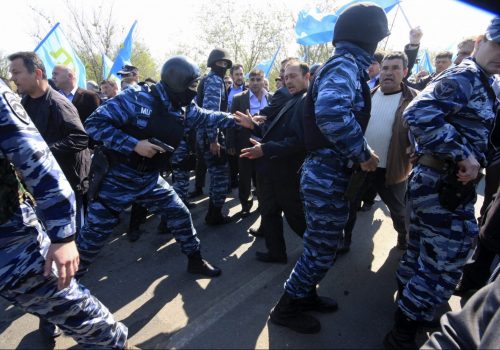
Сегодня Крым, Россия завтра?

By Melinda Haring

С аннексии Крыма весной 2014 года, Россия изменяла Украинский полуостров на темную дырку человеческих прав и огромная военную базу. Эта худшая ситуация может быть переменены в других местах в России и дальше, предупреждает Мелинда Харинг.

Conflict Financial Sanctions and Economic Coercion

New Atlanticist

Jan 16, 2020

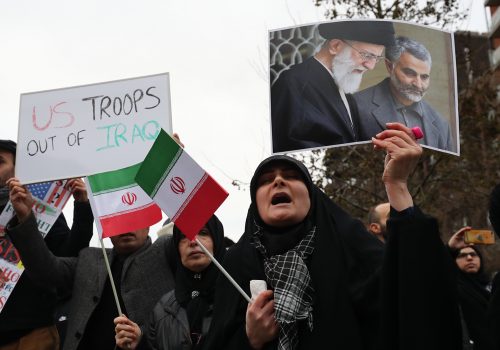
The effect of US sanctions on the Iran-Iraq alliance

By Michael Greenwald

The potential sanctions against Iraq under consideration now could damage the United States’ goals in that country and would only embolden Iran’s position—the exact scenario that US policy has tried to avoid. Economic countermeasures, such as restrictions to Iraq’s Federal Reserve accounts—could not only cede economic clout within Iraq to Tehran but could also have significant impact on the US dollar's global position.

Financial Sanctions and Economic Coercion

Event Recap

Jan 15, 2020

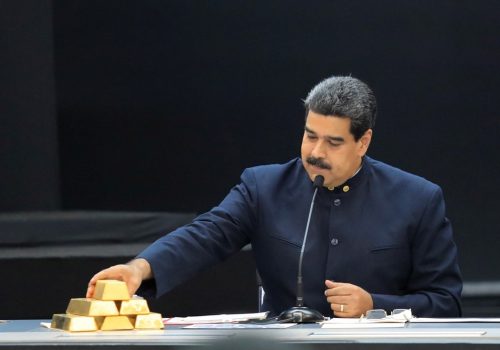
Stemming Maduro’s Illicit Activities: What’s Next After the Jan. 5 Elections?

By Pablo Reynoso

Beyond hyperinflation and human rights abuses, the Maduro regime has diversified its criminal portfolio and profited from a host of illicit activities, from drug smuggling to illegal mining.

Corruption Crisis Management

In the News

Jan 10, 2020

Chemali quoted in CNN on US imposed sanctions on Iran

By Atlantic Council

Financial Sanctions and Economic Coercion Iran

In the News

Jan 8, 2020

Kadhim quoted in PBS on US sanctions against Iraq

By Atlantic Council

Financial Sanctions and Economic Coercion Iraq

In the News

Jan 8, 2020

Hausheer Ali joins Alghad TV (Arabic) to discuss Trump’s confrontation with Iran

By Atlantic Council

Arabic Conflict

In the News

Jan 8, 2020

Slavin quoted in JNS on Trump’s address on Iran

By Atlantic Council

Financial Sanctions and Economic Coercion Iran

In the News

Dec 20, 2019

Morningstar and Fried quoted in Radio Free Europe/Radio Liberty on Nord Stream 2 sanctions

By Atlantic Council

Eastern Europe Energy & Environment

New Atlanticist

Dec 17, 2019

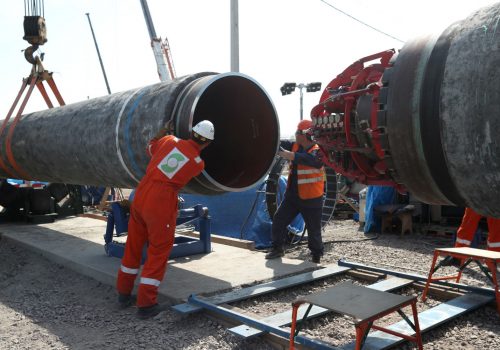
Russia gas pipeline sanctions legislation (PEES Act): A way ahead

By Daniel Fried

Enacting the sanctions mandated by the Protecting Europe’s Energy Security Act (PEES Act), for all its careful crafting, may not actually block Nord Stream II but may instead burden the US-German relationship. Rather than impose sanctions, the administration should waive them for now but prepare even stronger contingency sanctions to be implemented should the Kremlin once again use gas exports as political leverage against Ukraine, Central Europe, or the Baltics.

European Union Financial Sanctions and Economic Coercion

Experts