
Financial Sanctions and Economic Coercion

Financial sanctions and other forms of economic coercion have become policy tools of choice for the US government to deter illegal activity by international actors or to pressure governments into reversing actions that harm US interests. Yet these instruments and their potential pitfalls are often misunderstood. Restrictive economic measures such as financial sanctions, export controls, tariffs, and investment screening can play an important role in advancing certain policy objectives, but they risk being ineffective if misapplied or poorly implemented. Policymakers must also recognize the impact of economic statecraft on the private sector, which bears many of the compliance burdens and operational costs associated with these measures.

Energy Sanctions Dashboard

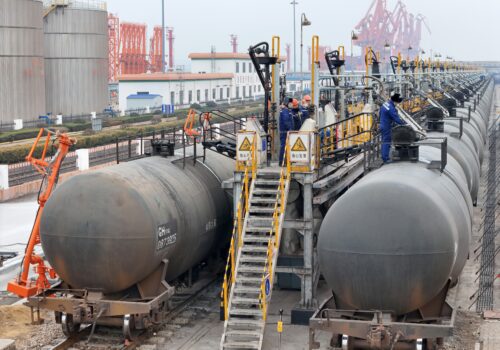
This dashboard focuses on US sanctions and restrictive measures placed on crude oil from Russia, Iran, and Venezuela—including the unintended consequences and the lessons learned.

Econographics

Apr 17, 2025

Russia Sanctions Database

By Kimberly Donovan, Maia Nikoladze, Lize de Kruijf

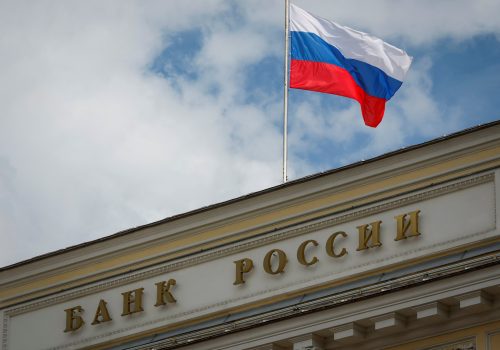
The Atlantic Council’s Russia Sanctions Database tracks the level of coordination among Western allies in sanctioning Russian entities, individuals, vessels, and aircraft, and shows where gaps still remain.

Eastern Europe Economy & Business

Recent analysis

Programs

At the intersection of economics, finance, and foreign policy, the GeoEconomics Center is a translation hub with the goal of helping shape a better global economic future.

Content

Transcript

Sep 22, 2023

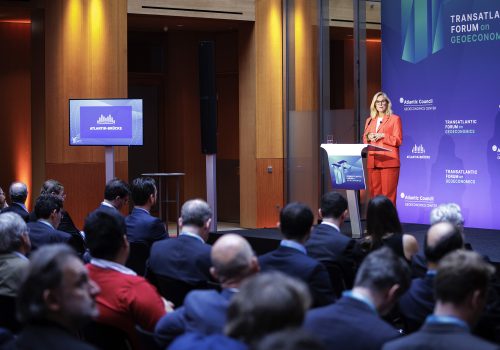
Dutch Deputy Prime Minister Sigrid Kaag on how the EU can use geoeconomic tools to ‘assert itself on the international stage’

By Atlantic Council

At the Transatlantic Forum on GeoEconomics, the Dutch finance minister also laid out the "significant effect" that sanctions have had on Russia's economy.

Europe & Eurasia European Union

New Atlanticist

Sep 21, 2023

The West won’t seize Russia’s reserves any time soon. Here’s what it can do with the funds instead.

By Kimberly Donovan, Charles Lichfield

Frozen Russian assets could be invested profitably, with the goal of creating an annuity for Ukraine of at least two billion dollars a year.

Conflict Economy & Business
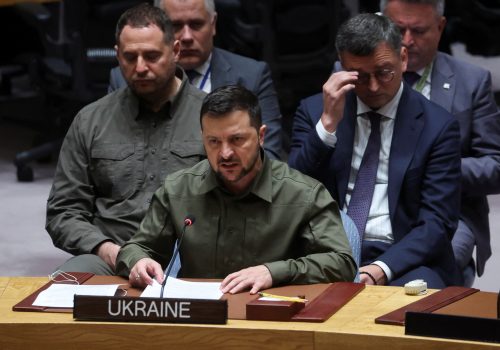
Ukraine's President Volodymyr Zelenskiy looks across the room towards Russia's Ambassador to the United Nations Vasily Nebenzya as Zelenskiy addresses the United Nations Security Council during a ministerial level meeting of the Security Council on the crisis in Ukraine at U.N. headquarters in New York, September 20, 2023. REUTERS/Mike Segar

New Atlanticist

Sep 21, 2023

Russian War Report: Black Sea military operations approach NATO countries’ waters

By Digital Forensic Research Lab

Zelenskyy expresses frustration at the UN, Russia seems unlikely to block YouTube, and the US drops new sanctions.

Conflict Digital Policy
Image of the Oberbaum Bridge in Berlin, during a dramatic sunset. RudyBalasko via IStock

Report

Sep 20, 2023

The US, EU, and UK need a shared approach to economic statecraft. Here’s where to start.

By Kimberly Donovan, Maia Nikoladze, Nicole Goldin, Mrugank Bhusari, Sarah Bauerle Danzman, Ambuj Sahu, and Daniel McDowell

The economic statecraft landscape is becoming more complex as transatlantic partners increasingly leverage the tools to counter transnational threats. There is a growing need to understand how these tools are used, by whom, and when, as well as their intended and real impacts worldwide.

Economy & Business Europe & Eurasia

In the News

Sep 16, 2023

Nikoladze, Meng, and Yin cited in the International Law Studies Journal on China’s assistance to bypass sanctions on Russia

Read the full journal here.

China Financial Sanctions and Economic Coercion

UkraineAlert

Sep 14, 2023

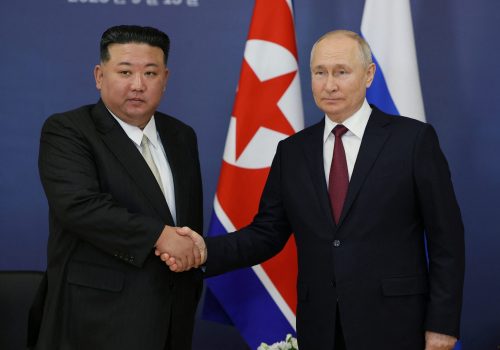
Putin’s North Korean “pariah summit” underlines his international isolation

By Peter Dickinson

Vladimir Putin's recent meeting with North Korean dictator Kim Jong Un was a "Pariah Summit" that underlined the scale of Russia's international isolation as a result of the country's criminal Ukraine invasion, writes Peter Dickinson.

Conflict Defense Industry

EnergySource

Sep 14, 2023

What to do about Russia’s energy trojan horse

By Olga Khakova, Charles Lichfield

The future of Gazprom’s piped deliveries to Europe looks bleak. However, Europe has no binding timeline for phasing out Russia’s growing LNG exports. Reducing these import will be critical to bringing Ukraine closer to victory and for securing Europe’s energy system.

Economy & Business Energy & Environment

New Atlanticist

Sep 8, 2023

Five ways the West might increase pressure on the Russian economy

By Brian O’Toole, Daniel Fried

The crumbling Russian macroeconomy may entice Western policymakers to knock Russian President Vladimir Putin and his power centers further off balance. 

Conflict Economy & Business

In the News

Sep 7, 2023

Lipsky quoted by the Associated Press on the upcoming G20 summit

Read the full piece here.

Financial Sanctions and Economic Coercion G20

UkraineAlert

Sep 7, 2023

Ukraine’s partners cannot remove Putin but they can stop legitimizing him

By Richard Cashman

As long as Vladimir Putin is in power, Russia will remain a rogue state. Western policies that legitimize him through fear of a potential post-Putin Russia are perverse, writes Richard Cashman.

Conflict Defense Policy

Experts