
Financial Sanctions and Economic Coercion

Financial sanctions and other forms of economic coercion have become policy tools of choice for the US government to deter illegal activity by international actors or to pressure governments into reversing actions that harm US interests. Yet these instruments and their potential pitfalls are often misunderstood. Restrictive economic measures such as financial sanctions, export controls, tariffs, and investment screening can play an important role in advancing certain policy objectives, but they risk being ineffective if misapplied or poorly implemented. Policymakers must also recognize the impact of economic statecraft on the private sector, which bears many of the compliance burdens and operational costs associated with these measures.

Energy Sanctions Dashboard

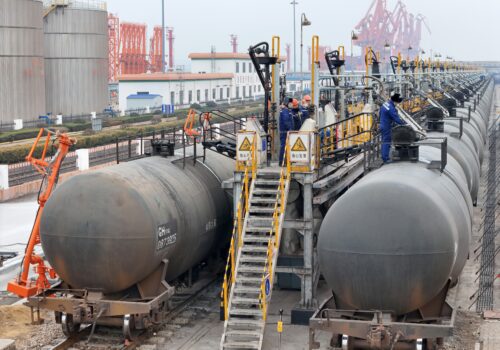
This dashboard focuses on US sanctions and restrictive measures placed on crude oil from Russia, Iran, and Venezuela—including the unintended consequences and the lessons learned.

Econographics

Apr 17, 2025

Russia Sanctions Database

By Kimberly Donovan, Maia Nikoladze, Lize de Kruijf

The Atlantic Council’s Russia Sanctions Database tracks the level of coordination among Western allies in sanctioning Russian entities, individuals, vessels, and aircraft, and shows where gaps still remain.

Eastern Europe Economy & Business

Recent analysis

Programs

At the intersection of economics, finance, and foreign policy, the GeoEconomics Center is a translation hub with the goal of helping shape a better global economic future.

Content

Britain Debrief

Mar 20, 2022

#BritainDebrief – How can Britain fix its corruption problem? A Debrief from Margaret Hodge MP

By Ben Judah

Senior Fellow Ben Judah interviews Margaret Hodge MP, Chair of the All-Party Parliamentary Group on Anti-Corruption and Responsible Tax, to discuss what Britain's next steps are in tackling Russian corruption overseas.

Conflict Corruption

In the News

Mar 19, 2022

Katz in The National: Why Russia Upended the Iran Deal Talks, And Then Backed Down

By Atlantic Council

Conflict Crisis Management

In the News

Mar 19, 2022

Slavin quoted in TRT World on Israel’s position on US-Iran talks and it’s resistance to lifting of sanctions on Iranian forces

By Atlantic Council

Financial Sanctions and Economic Coercion Iran

UkraineAlert

Mar 19, 2022

Putin drank the Kremlin Kool-Aid

By Taras Kuzio

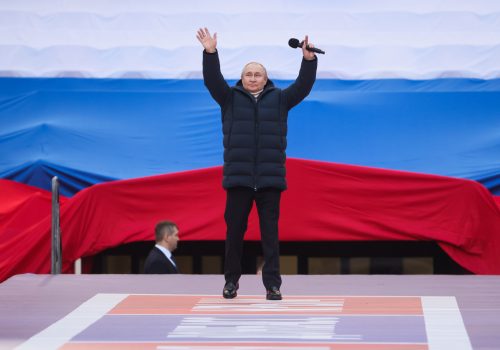
Russian President Vladimir Putin drank the Kremlin Kool-Aid and seems to have sincerely believed his disastrous Ukraine war would be an imperial triumph with minimal costs on the domestic and international fronts.

Conflict Disinformation

Econographics

Mar 18, 2022

US export controls aim to degrade Russia’s military

By Maia Nikoladze

As soon as the Russian military depletes current equipment, they will find it difficult to obtain critical technology for upgrading and maintaining aircrafts, ships, and weaponry used for waging an unjust war on Ukraine.

Conflict Defense Technologies

Econographics

Mar 18, 2022

Economic complexity emerges as a new restraint on wars of conquest

By George Pearkes

Russia’s invasion of Ukraine highlights the economic disincentives countries considering wars of conquest must reckon with.

Economy & Business Financial Sanctions and Economic Coercion

In the News

Mar 18, 2022

Norrlöf in Foreign Affairs on Russia’s economic containment

Read the full article here.

Economy & Business European Union

In the News

Mar 18, 2022

Slavin quoted in L’Oreient Le Jour on Iran’s demands regarding sanctions during JCPOA talks

By Atlantic Council

Financial Sanctions and Economic Coercion French

In the News

Mar 18, 2022

Slavin quoted in the Italian Institute for International Political Studies on how JCPOA talks may be impacted by Russian aggression in Ukraine

By Atlantic Council

Conflict Financial Sanctions and Economic Coercion

In the News

Mar 18, 2022

Slavin quoted in France24 on Iran talks and the lifting of sanctions on the IRGC

By Atlantic Council

Financial Sanctions and Economic Coercion Iran

Experts