Rule of Law

Democracies function on the understanding that all citizens are equal under and subject to the law. Rule of law can often be one of the most difficult areas for countries transitioning to democracy, as the advantages afforded to elites under autocratic systems can be hard to dislodge.  When societies ensure that political leaders, business leaders, and social elites are not offered special judicial treatment, however, they are better equipped to promote equality, provide real chances of economic and social advancement, and attract foreign investment and economic activity.   

Content
UkraineAlert

May 4, 2023

Ukraine seeks more German support on Russia’s invasion and EU accession

By Alyona Getmanchuk

Many Ukrainians have been disappointed by Germany's cautious approach to countering Russian aggression against Ukraine and Berlin's preoccupation with avoiding anything that might provoke Putin, writes Alyona Getmanchuk.

Conflict Financial Sanctions and Economic Coercion

Issue Brief

May 4, 2023

India’s personal data protection act and the politics of digital governance

By Stephen Weymouth

The Digital Personal Data Protection Bill of 2022 aims to balance the interests of Indian consumers seeking enhanced privacy and data security against the business need for unconstrained data flows.

Digital Policy Economy & Business

Issue Brief

Apr 19, 2023

Holding the Islamic Republic of Iran accountable for atrocity crimes

By Celeste Kmiotek, Alana Mitias, Nushin Sarkarati

Under the principle of universal jurisdiction, certain domestic justice systems allow prosecutions in national courts for crimes committed abroad, regardless of the victim’s or perpetrator’s nationality. This manual outlines the universal jurisdiction process in selected European states for those pursuing prosecutions of crimes committed by the Islamic Republic of Iran.

Human Rights International Norms

UkraineAlert

Apr 18, 2023

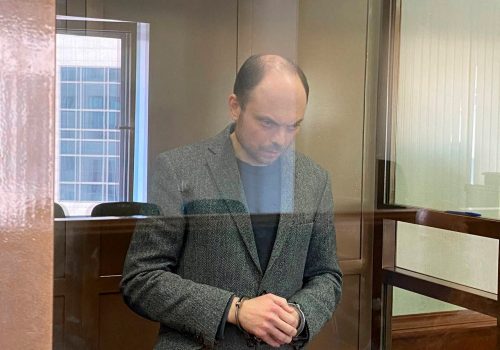
Vladimir Kara-Murza’s 25-year sentence is a verdict against all Russians

By Arseniy Yatsenyuk

Vladimir Kara-Murza's 25-year prison sentence for speaking the truth about the invasion of Ukraine is a major milestone in modern Russia's descent into Stalinism, says former Ukrainian PM Arseniy Yatsenyuk.

Civil Society Conflict
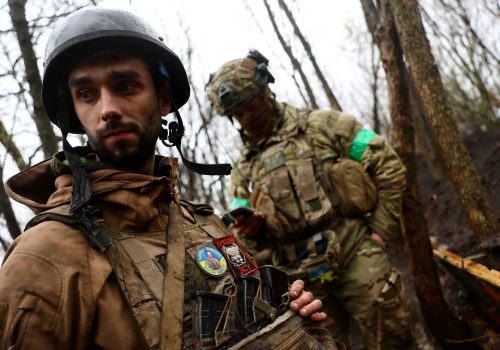
A Ukrainian artillery unit operates from muddy trenches near the frontline during heavy fighting close to Bakhmut, Ukraine, April 13, 2023. (Source: Reuters/Kai Pfaffenbach)

New Atlanticist

Apr 14, 2023

Russian War Report: Russian army presses on in Bakhmut despite losses

By Digital Forensic Research Lab

Bakhmut remains a major conflict zone with dozens of attacks on Ukrainian forces there, despite Russian forces sustaining heavy losses.

Conflict Cybersecurity

UkraineAlert

Apr 4, 2023

Russia’s Wagner Group is a feature not a bug of the Putin regime

By Allen Maggard

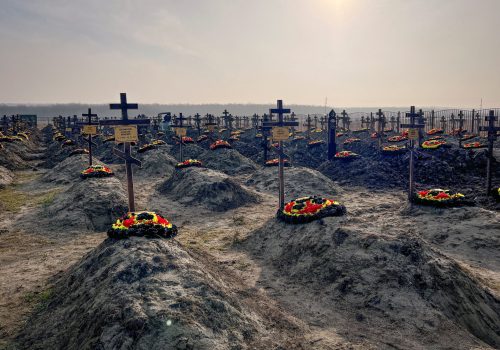
Russian private paramilitaries like the Wagner Group are a symptom of the institutionalized corruption at the heart of Putin’s regime and not just another instrument in Russia’s hybrid warfare toolbox, writes Allen Maggard.

Conflict Disinformation

SouthAsiaSource

Mar 31, 2023

The unfinished efforts against terrorism and militancy in Pakistan

By Shuja Nawaz and other experts

Terrorism is reemerging in Pakistan. To understand how it should respond to this heightened threat, Distinguished Fellow Shuja Nawaz moderated a series of conversations with experts about fighting terrorism and militancy.

Extremism National Security

UkraineAlert

Mar 28, 2023

The real definition of victory for Ukraine

By Victor Pinchuk

Genuine Ukrainian independence will only come with the country as a member of the European Union and NATO, writes Victor Pinchuk.

Civil Society Conflict

In the News

Mar 27, 2023

Episode Seven – Dr. Nasredeen Abudlbari

By Atlantic Council

Arabic Politics & Diplomacy

In the News

Mar 27, 2023

Svetlova in Haaretz: Maidan, Bolotnaya, Tahrir – three things the protest must remember

By Atlantic Council

Corruption Hebrew

Experts