Nuclear strategy project

The Scowcroft Center is proud to play a central role in crafting an effective and nonpartisan strategic forces policy for the twenty-first century.

The Scowcroft Center’s namesake, General Brent Scowcroft, was the chairman of the 1983 Scowcroft Commission that established the foundation for US nuclear deterrence and arms control policy through the present day. As the United States enters a new era of strategic challenges, the Scowcroft Center’s Forward Defense program is proud to play a central role in crafting an effective and nonpartisan strategic forces strategy and policy for the twenty-first century.

The 2022 National Defense Strategy and Nuclear Posture Review caution that the United States will, for the first time in its history, face the challenge of simultaneously deterring two nuclear great powers, each with aggressive revisionist goals. Our Nuclear Strategy Project, within the Forward Defense program, focuses on the role of nuclear deterrence, nuclear strategy and employment, missile defense, and arms control in deterring conventional aggression and nuclear escalation against the United States, its allies, and partners.

Principal research areas

Must Reads
Report

Jan 4, 2025

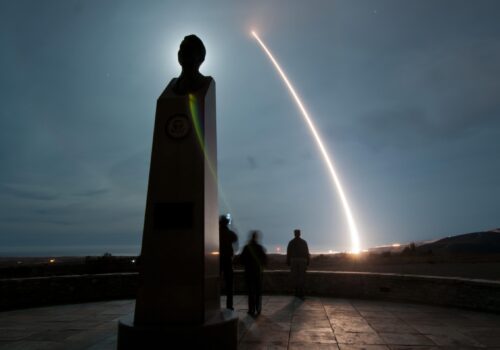
‘First, we will defend the homeland’: The case for homeland missile defense

By Robert Soofer with contributions from Kari Anderson, James McCue, Tom Karako, Mark J. Massa, Alyxandra Marine, and Jonathan Rosenstein

A comprehensive analysis of U.S. homeland missile defense, addressing policies, security challenges, and strategies to counter threats from North Korea, China, and Russia.

China Defense Technologies

Reports & issue briefs

Report

Aug 16, 2023

The United States and its allies must be ready to deter a two-front war and nuclear attacks in East Asia

By Markus Garlauskas

This report highlights two emerging and interrelated deterrence challenges in East Asia with grave risks to US national security: 1) Horizontal escalation of a conflict with China or North Korea into simultaneous conflict; 2) Vertical escalation to a limited nuclear attack by either or both adversaries to avoid conceding.

Arms Control China

Issue Brief

Aug 16, 2023

Biases blind us to the risk of Chinese military intervention in Korea

By Jonathan Corrado

This paper examines the historical record of cognitive biases, focusing on the US intelligence community’s failure to forecast PRC intervention in the Korean War, despite collecting information and evidence indicative of that outcome.

Arms Control China

Report

Jun 15, 2023

US-China lessons from Ukraine: Fueling more dangerous Taiwan tensions

By John K. Culver, Sarah Kirchberger

The lessons that Washington and Beijing appear to be learning from Russia's war against Ukraine could set the stage for a crisis over Taiwan in the next few years.

China Defense Industry

Issue Brief

May 1, 2023

US strategy and force posture for an era of nuclear tripolarity

By Keir Lieber, Daryl G. Press

Keir Lieber and Daryl Press lay out a vision for the future of US nuclear doctrine and strategy under the condition of nuclear tripolarity.

China Defense Policy

Issue Brief

Dec 20, 2022

Arms racing under nuclear tripolarity: Evidence for an action-reaction cycle?

By Matthew Kroenig

Matthew Kroenig argues that there has not been a nuclear arms race since the Cold War—but that China's nuclear buildup might start one.

Arms Control China

Commentary & quick analysis

New Atlanticist

Sep 16, 2025

NATO has a gap in its airborne command and control. Here’s how to close it.

By David Julazadeh

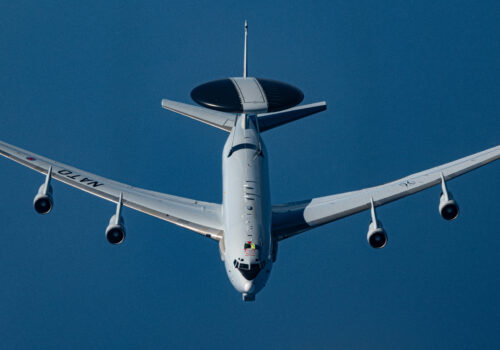
As E-3 AWACS aircraft retire, and with new doubts about and delays with the E-7A aircraft set to replace them, the Alliance must take additional steps bridge the gap.

Europe & Eurasia NATO

New Atlanticist

Aug 26, 2025

Five questions (and expert answers) about where the US-South Korea alliance goes from here

By Atlantic Council experts

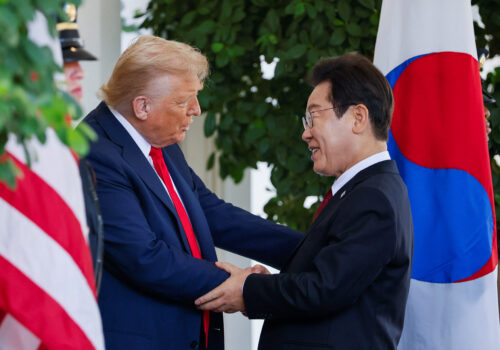
The US and South Korean presidents met on Monday in Washington to discuss a range of bilateral issues, from security to shipbuilding.

Korea Nuclear Deterrence

Fast Thinking

Jun 22, 2025

How will Iran respond to US strikes on its nuclear program?

By Atlantic Council

Following the US strike on Iranian nuclear sites, Iran’s foreign minister said his country must respond. Atlantic Council experts look at Tehran’s options.

Conflict Iran

New Atlanticist

Jun 12, 2025

Experts react: Israel just attacked Iran’s military and nuclear sites. What’s next?

By Atlantic Council experts

Our experts shed light on Israel’s major attack against Iran targeting its nuclear facilities and its implications for the region.

Conflict Defense Policy

New Atlanticist

Jun 6, 2025

Ukraine’s drone strikes offer four big lessons for US nuclear strategists

By Mark J. Massa

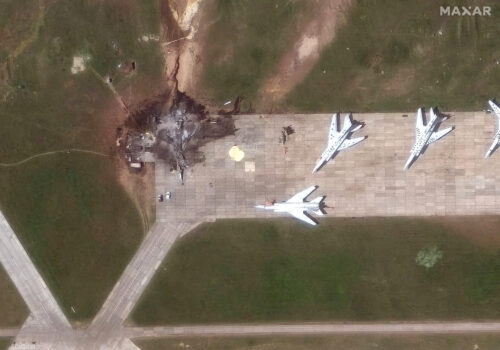
Ukraine’s Operation Spiderweb should spur the US government to address strategic vulnerabilities that nuclear strategists have focused on for years.

Defense Policy National Security

Past events

In the news

In the News

Mar 25, 2026

Wilkening quoted in Indo-Pacific Defense Forum on hypersonic threats

By Atlantic Council

On March 25, Forward Defense nonresident senior fellow Dean Wilkening was quoted in an Indo-Pacific Defense Forum article, titled “Indo-Pacific allies join to counter hypersonic threats.” Wilkening discussed the impacts of hypersonic capabilities on air and missile defense systems, highlighting the capability enhancements needed to counter these threats.

Defense Technologies Indo-Pacific

In the News

Mar 16, 2026

Costa in the Washington Post on military readiness in Iran

By Atlantic Council

On March 16, Forward Defense Director Joe Costa published an article in the Washington Post on the impacts of the war in Iran on US military readiness. Writing alongside Ely Ratner of the Marathon Initiative, Costa argues that the threat to readiness runs deeper than depleted stockpiles—deferred maintenance, equipment cannibalization, and broken dwell-to-deploy thresholds threaten […]

China Defense Policy

In the News

Mar 12, 2026

Costa quoted in AFP article on US interceptor stocks in the conflict with Iran

By Atlantic Council

On March 2, Forward Defense director Joe Costa was quoted in an AFP article on US air defense interceptor stocks. Costa cautioned that a sustained conflict with Iran could impact the availability of these capabilities for other global priorities.

Defense Policy Defense Technologies

In the News

Mar 4, 2026

Costa quoted in The Hill article on resource strains and the conflict in Iran

By Atlantic Council

On March 4, Director of the Atlantic Council’s Forward Defense Program Joe Costa was quoted in an article from The Hill on US interceptor capacity. Costa described the high attrition rate for key missile defense capabilities in the conflict in Iran and expressed concern over the strain to resources as the conflict progresses.

Defense Technologies Iran

In the News

Feb 18, 2026

Kroenig interviewed on NHK Japan Broadcasting on the expiration of New START

By Atlantic Council

On February 13, Atlantic Council vice president and Scowcroft Center senior director Matthew Kroenig was interviewed on NHK Japan Broadcasting about the expiration of New START and implications for the US and its allies.

Nuclear Deterrence Security & Defense

Subscribe to stay engaged

Sign up for updates from Forward Defense to hear the latest on the trends, technologies, and military challenges shaping tomorrow.


  • This field is for validation purposes and should be left unchanged.

Related experts

Forward Defense leads the Atlantic Council’s US and global defense programming, developing actionable recommendations for the United States and its allies and partners to compete, innovate, and navigate the rapidly evolving character of warfare. Through its work on US defense policy and force design, the military applications of advanced technology, space security, strategic deterrence, and defense industrial revitalization, it informs the strategies, policies, and capabilities that the United States will need to deter, and, if necessary, prevail in major-power conflict.