Nuclear strategy project

The Scowcroft Center is proud to play a central role in crafting an effective and nonpartisan strategic forces policy for the twenty-first century.

The Scowcroft Center’s namesake, General Brent Scowcroft, was the chairman of the 1983 Scowcroft Commission that established the foundation for US nuclear deterrence and arms control policy through the present day. As the United States enters a new era of strategic challenges, the Scowcroft Center’s Forward Defense program is proud to play a central role in crafting an effective and nonpartisan strategic forces strategy and policy for the twenty-first century.

The 2022 National Defense Strategy and Nuclear Posture Review caution that the United States will, for the first time in its history, face the challenge of simultaneously deterring two nuclear great powers, each with aggressive revisionist goals. Our Nuclear Strategy Project, within the Forward Defense program, focuses on the role of nuclear deterrence, nuclear strategy and employment, missile defense, and arms control in deterring conventional aggression and nuclear escalation against the United States, its allies, and partners.

Principal research areas

Must Reads
Report

Jan 4, 2025

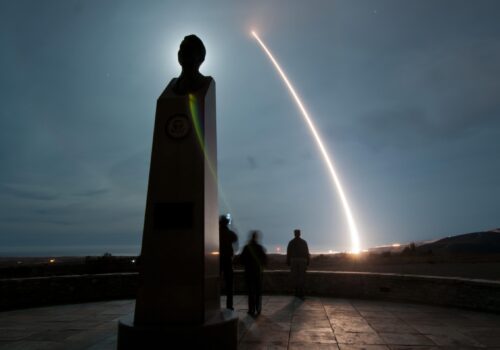
‘First, we will defend the homeland’: The case for homeland missile defense

By Robert Soofer with contributions from Kari Anderson, James McCue, Tom Karako, Mark J. Massa, Alyxandra Marine, and Jonathan Rosenstein

A comprehensive analysis of U.S. homeland missile defense, addressing policies, security challenges, and strategies to counter threats from North Korea, China, and Russia.

China Defense Technologies

Reports & issue briefs

Issue Brief

Mar 27, 2026

Deterrence in a two-peer world requires prudence

By Kingston Reif

Washington faces the challenge of preserving credible deterrence and reassuring allies against two potential nuclear peers—possibly acting together—without fueling dangerous instability or draining resources from other defense priorities. This will require a balanced approach that avoids counterproductive arsenal growth.

China Nuclear Deterrence

Issue Brief

Mar 27, 2026

Why US strategic nuclear forces must expand after New START

By Paul Amato

With the New START treaty's caps on the US nuclear force expired, the United States has an opportunity to increase and adapt its nuclear force to deter both Russia and China. Policymakers should seize it.

China Defense Policy

Report

Mar 9, 2026

Strategy for a new nuclear age

By Michael Albertson, Paul Amato, Henry “Trey” Obering, Ankit Panda, Kingston Reif, Amy Woolf

As it carries out strikes on Iran's nuclear program, the United States confronts a wider and ever more complex landscape of nuclear threats, with Russia, North Korea, and China all boosting their arsenals. In this new nuclear age, how should US policymakers think about force size, arms control, and missile defense?

Arms Control China

Issue Brief

Feb 20, 2026

Four options for arms control after New START

By Amy Woolf

With the last quantitative limit on the world's largest nuclear arsenals now expired, Washington finds itself in a new and uncertain era, with less clarity about Russia’s nuclear forces, plans to upgrade its own, and growing concern about China's. The best option may be trilateral talks—but not about a new arms control treaty.

Arms Control China

Report

Jan 21, 2026

Countering Russian escalation in space

By John Klein, Clementine G. Starling-Daniels

Current US space policy and acquisitions are inadequate to address the growing threats from Russia in space. The United States needs a more resilient space architecture, able to withstand major-power conflict—and Russia’s designs to place a nuclear weapon in orbit. Here are fifteen recommendations to make that happen.

China Missile Defense

Commentary & quick analysis

New Atlanticist

Sep 16, 2025

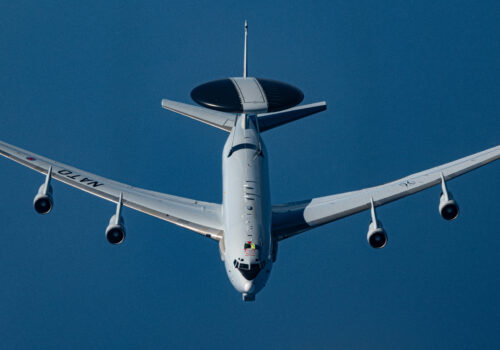
NATO has a gap in its airborne command and control. Here’s how to close it.

By David Julazadeh

As E-3 AWACS aircraft retire, and with new doubts about and delays with the E-7A aircraft set to replace them, the Alliance must take additional steps bridge the gap.

Europe & Eurasia NATO

New Atlanticist

Aug 26, 2025

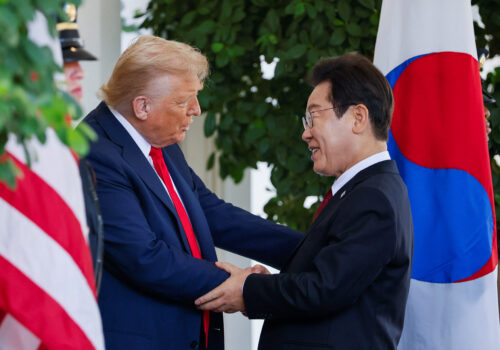
Five questions (and expert answers) about where the US-South Korea alliance goes from here

By Atlantic Council experts

The US and South Korean presidents met on Monday in Washington to discuss a range of bilateral issues, from security to shipbuilding.

Korea Nuclear Deterrence

Fast Thinking

Jun 22, 2025

How will Iran respond to US strikes on its nuclear program?

By Atlantic Council

Following the US strike on Iranian nuclear sites, Iran’s foreign minister said his country must respond. Atlantic Council experts look at Tehran’s options.

Conflict Iran

New Atlanticist

Jun 12, 2025

Experts react: Israel just attacked Iran’s military and nuclear sites. What’s next?

By Atlantic Council experts

Our experts shed light on Israel’s major attack against Iran targeting its nuclear facilities and its implications for the region.

Conflict Defense Policy

New Atlanticist

Jun 6, 2025

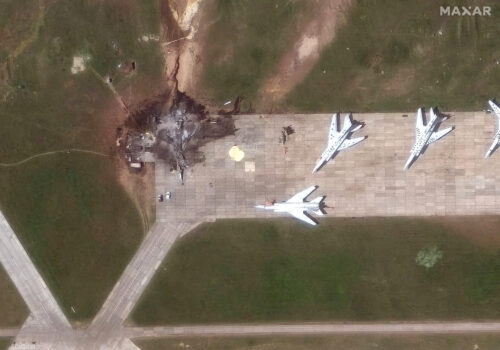
Ukraine’s drone strikes offer four big lessons for US nuclear strategists

By Mark J. Massa

Ukraine’s Operation Spiderweb should spur the US government to address strategic vulnerabilities that nuclear strategists have focused on for years.

Defense Policy National Security

Past events

In the news

In the News

Aug 21, 2024

McCue co-authors chapter in edited volume on US and Indian approaches to nuclear security challenges

By Atlantic Council

On August 13, 2024, Forward Defense Visiting Senior Fellow Lieutenant Colonel James McCue co-authored a chapter in a new book published by Springer titled The Challenges of Nuclear Security: U.S. and Indian Perspectives.

Arms Control Crisis Management

In the News

Jul 21, 2024

Hays and Massa in Forbes on the risk of a Russian nuclear detonation in space

By Atlantic Council

On July 21, Mark Massa and Peter Hays were quoted in Forbes on nuclear threats to space, drawing from a recent Forward Defense report

Europe & Eurasia Nuclear Deterrence

In the News

Jun 27, 2024

McCue quoted in the Economist regarding the damage of a potential Russian nuclear detonation in orbit

By Atlantic Council

On June 27, 2024, Forward Defense Visiting Senior Fellow Lieutenant Colonel James McCue was quoted in an article from the Economist regarding the damage a Russian nuclear detonation in orbit would cause. McCue stated that the result of such a detonation would be "satellite Armageddon."

Nuclear Deterrence Russia

In the News

Jun 25, 2024

Dean quoted in the Australian on AUKUS and nuclear energy debate

On June 25, IPSI nonresident senior fellow Peter Dean was quoted in the Australian, where he discussed how the political debate over the Coalition’s nuclear energy proposal could threaten bipartisan support for AUKUS and obtaining nuclear-powered submarines.

Australia Indo-Pacific

In the News

Jun 6, 2024

Chilton in DefenseNews on nuclear triad investment

By Atlantic Council

On June 5, Forward Defense distinguished fellow General Kevin Chilton, USAF (Ret.) published an article in DefenseNews on the need to continue forward with the nuclear triad modernization program, entitled "US security demands continued nuclear triad investment."

China Defense Policy

Subscribe to stay engaged

Sign up for updates from Forward Defense to hear the latest on the trends, technologies, and military challenges shaping tomorrow.


  • This field is for validation purposes and should be left unchanged.

Related experts

Forward Defense leads the Atlantic Council’s US and global defense programming, developing actionable recommendations for the United States and its allies and partners to compete, innovate, and navigate the rapidly evolving character of warfare. Through its work on US defense policy and force design, the military applications of advanced technology, space security, strategic deterrence, and defense industrial revitalization, it informs the strategies, policies, and capabilities that the United States will need to deter, and, if necessary, prevail in major-power conflict.