Nuclear strategy project

The Scowcroft Center is proud to play a central role in crafting an effective and nonpartisan strategic forces policy for the twenty-first century.

The Scowcroft Center’s namesake, General Brent Scowcroft, was the chairman of the 1983 Scowcroft Commission that established the foundation for US nuclear deterrence and arms control policy through the present day. As the United States enters a new era of strategic challenges, the Scowcroft Center’s Forward Defense program is proud to play a central role in crafting an effective and nonpartisan strategic forces strategy and policy for the twenty-first century.

The 2022 National Defense Strategy and Nuclear Posture Review caution that the United States will, for the first time in its history, face the challenge of simultaneously deterring two nuclear great powers, each with aggressive revisionist goals. Our Nuclear Strategy Project, within the Forward Defense program, focuses on the role of nuclear deterrence, nuclear strategy and employment, missile defense, and arms control in deterring conventional aggression and nuclear escalation against the United States, its allies, and partners.

Principal research areas

Must Reads
Report

Jan 4, 2025

‘First, we will defend the homeland’: The case for homeland missile defense

By Robert Soofer with contributions from Kari Anderson, James McCue, Tom Karako, Mark J. Massa, Alyxandra Marine, and Jonathan Rosenstein

A comprehensive analysis of U.S. homeland missile defense, addressing policies, security challenges, and strategies to counter threats from North Korea, China, and Russia.

China Defense Technologies

Reports & issue briefs

Issue Brief

Jun 18, 2026

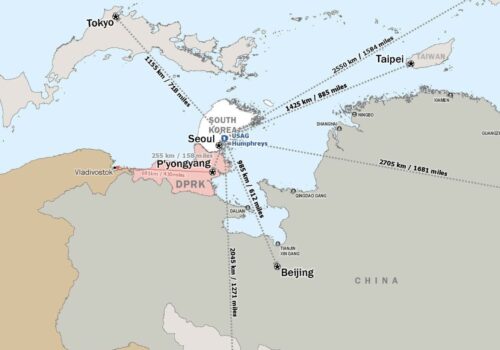
The case for a US Northeast Asia Command

By Christopher Lee, Ben Blane, and Markus Garlauskas

To maximize its deterrent and warfighting effectiveness in the Indo-Pacific region, the United States must reform its military command-and-control structure in Northeast Asia.

Arms Control East Asia

Issue Brief

May 21, 2026

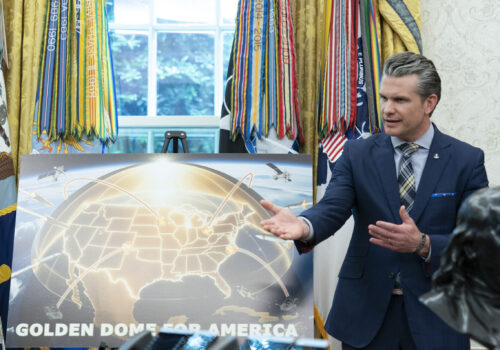
For homeland missile defense, think Golden Zones, not a Golden Dome 

By Ankit Panda

While the second Trump administration correctly diagnoses a more dangerous nuclear environment facing the country, a comprehensive defensive system is the wrong prescription. The risks of prompting adversary proliferation and stretching US resources thin are too high.

Defense Technologies Missile Defense

Issue Brief

May 21, 2026

Golden Dome is the missile defense the US needs

By Henry “Trey” Obering

The United States should pursue a comprehensive missile defense system to protect the homeland from advanced threats posed by China, Russia, and North Korea. Political will from the Trump administration and advances in technology make the idea of the long-discussed "dome" over the United States more feasible now than ever.

Missile Defense Security & Defense

Issue Brief

Mar 27, 2026

Deterrence in a two-peer world requires prudence

By Kingston Reif

Washington faces the challenge of preserving credible deterrence and reassuring allies against two potential nuclear peers—possibly acting together—without fueling dangerous instability or draining resources from other defense priorities. This will require a balanced approach that avoids counterproductive arsenal growth.

China Nuclear Deterrence

Issue Brief

Mar 27, 2026

Why US strategic nuclear forces must expand after New START

By Paul Amato

With the New START treaty's caps on the US nuclear force expired, the United States has an opportunity to increase and adapt its nuclear force to deter both Russia and China. Policymakers should seize it.

China Defense Policy

Commentary & quick analysis

Strategic Insights Memo

Jan 12, 2022

Strengthening the OSCE’s role in strategic stability

By Marina Favaro

Over the past year, the Scowcroft Center for Strategy and Security has hosted a private workshop with several international experts and officials to discuss how to strengthen the OSCE’s role in strategic stability. In this strategic insights memo, the Transatlantic Security Initiative advances a new understanding for policymakers regarding how emerging technologies should factor into forthcoming arms control regimes.

Arms Control Defense Technologies

Fast Thinking

Dec 10, 2021

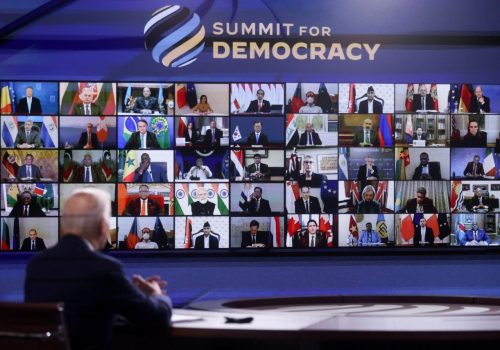
FAST THINKING: Biden just held the biggest gathering of democratic world leaders ever. What are the results?

By Atlantic Council

Our experts—former US government officials with frontline democracy experience—share their insights on what to make of the big event and what to expect next.

China International Norms

Fast Thinking

Nov 4, 2021

FAST THINKING: China’s stunning military buildup

By Atlantic Council

The People’s Liberation Army (PLA) could field one thousand nuclear warheads by 2030. What should the US do about it?

Arms Control China

Fast Thinking

Oct 18, 2021

FAST THINKING: What to do about China’s hypersonic weapons

By Atlantic Council

Should US defense officials be worried about the pace of Chinese military modernization? What could China do with such weapons? Our experts fire off their thoughts.

Arms Control China

New Atlanticist

Sep 15, 2021

Experts react: The US, UK, and Australia struck a nuclear submarine deal. What does it mean?

By Atlantic Council

The pact, known as AUKUS, is a clear challenge to China in the Indo-Pacific and a deepening of military ties among close allies of more than a century.

Australia Defense Industry

Past events

In the news

In the News

May 18, 2026

Marine published in the Bulletin of the Atomic Scientists on trilateral arms control

By Atlantic Council

On May 13, Forward Defense Associate Director and Resident Fellow Alyxandra Marine co-authored an article in the Bulletin of the Atomic Scientists, arguing that the United States should pursue trilateral arms-control arrangements with Russia and China. While near-term agreement is unlikely, Marine and her co-author, Matthew Kroenig, contend that negotiations could still advance US strategic […]

Arms Control China

In the News

May 18, 2026

Kroenig and Marine published in the Bulletin of the Atomic Scientists

By Atlantic Council

On May 13, Atlantic Council vice president and Scowcroft Center senior director Matthew Kroenig and Forward Defense associate director and resident fellow Alyxandra Marine published a piece in Bulletin of the Atomic Scientists, arguing that Washington should pursue trilateral arms control.

China Nuclear Deterrence

In the News

May 11, 2026

Kroenig published in Foreign Policy on Iran’s uranium enrichment

By Atlantic Council

On May 11, Atlantic Council vice president and Scowcroft Center senior director Matthew Kroenig published an article in Foreign Policy, arguing that Iran does not have a right to enrich uranium and that Trump should push for zero enrichment in perpetuity as part of any deal with Tehran.

Iran Nuclear Nonproliferation

In the News

Mar 25, 2026

Wilkening quoted in Indo-Pacific Defense Forum on hypersonic threats

By Atlantic Council

On March 25, Forward Defense nonresident senior fellow Dean Wilkening was quoted in an Indo-Pacific Defense Forum article, titled “Indo-Pacific allies join to counter hypersonic threats.” Wilkening discussed the impacts of hypersonic capabilities on air and missile defense systems, highlighting the capability enhancements needed to counter these threats.

Defense Technologies Indo-Pacific

In the News

Mar 16, 2026

Costa in the Washington Post on military readiness in Iran

By Atlantic Council

On March 16, Forward Defense Director Joe Costa published an article in the Washington Post on the impacts of the war in Iran on US military readiness. Writing alongside Ely Ratner of the Marathon Initiative, Costa argues that the threat to readiness runs deeper than depleted stockpiles—deferred maintenance, equipment cannibalization, and broken dwell-to-deploy thresholds threaten […]

China Defense Policy

Subscribe to stay engaged

Sign up for updates from Forward Defense to hear the latest on the trends, technologies, and military challenges shaping tomorrow.


  • This field is for validation purposes and should be left unchanged.

Related experts

Forward Defense leads the Atlantic Council’s US and global defense programming, developing actionable recommendations for the United States and its allies and partners to compete, innovate, and navigate the rapidly evolving character of warfare. Through its work on US defense policy and force design, the military applications of advanced technology, space security, strategic deterrence, and defense industrial revitalization, it informs the strategies, policies, and capabilities that the United States will need to deter, and, if necessary, prevail in major-power conflict.