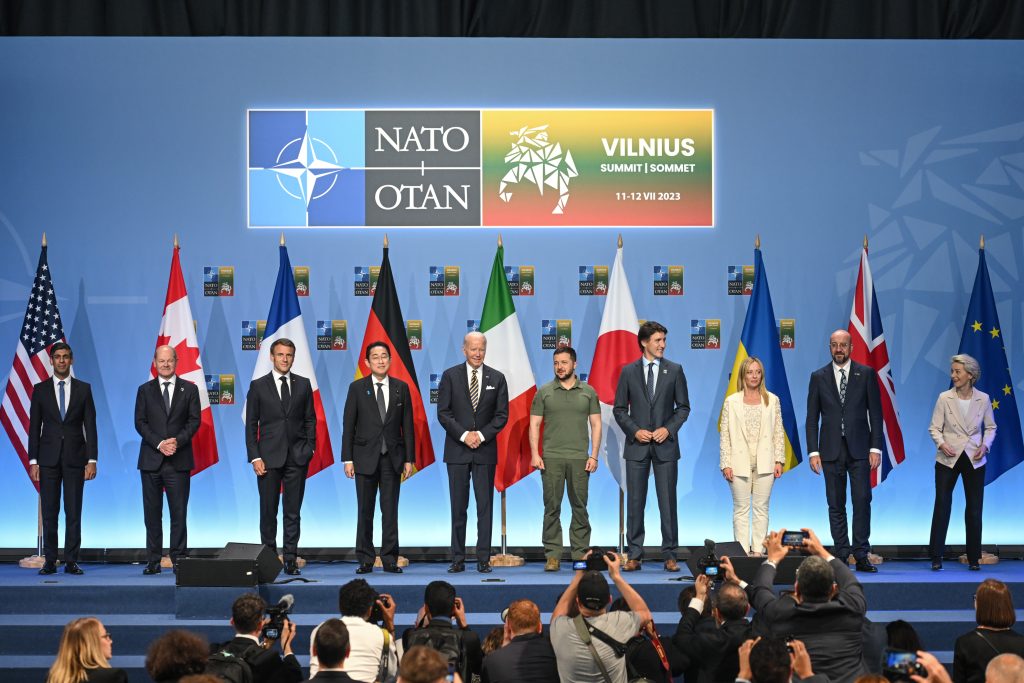
The leaders were backed by a NATO banner, but it wasn’t NATO doing the backing. Group of Seven (G7) leaders on Wednesday announced plans for long-term security commitments to Ukraine at the NATO Summit in Vilnius, Lithuania. The new framework seeks to create bilateral security commitments between individual G7 member states and Ukraine, providing security assistance, modern military equipment, and economic assistance “for as long as it takes.” This announcement comes a day after NATO released its communiqué, drawing criticism from Ukrainian President Volodymyr Zelenskyy and others because the Alliance did not establish a timetable for Ukraine to become a NATO member.
Below, our experts decode all the goings-on in Vilnius—and what they mean for Kyiv’s path to NATO membership, the war in Ukraine, Sweden’s forthcoming accession, the Alliance’s growing focus on China, and more.
Click to jump to an expert analysis:
Reactions from Wednesday, July 12
John Herbst: A step forward for Ukraine’s security, but not a large one
Anca Agachi: A mixed bag, but with signs of quiet progress
Daniel Fried: The G7 Joint Statement is no Article 5, but it’s a start
Hans Binnendijk: Vilnius was a bridge to next year’s NATO summit in Washington
Reactions from Tuesday, July 11
John Herbst: An uninspiring result for Ukraine
Daniel Fried: Allies make clear Ukraine is firmly in the transatlantic family
Shelby Magid: Calling out the ‘most significant and direct threat’—and its accomplice
Rich Outzen: A clear-eyed snapshot that meets the geopolitical moment
Andrew D’Anieri: The NATO-Ukraine Council is a net positive step, but also the ‘bare minimum’
David O. Shullman: The communiqué confirms NATO’s growing attention to Indo-Pacific security
A step forward for Ukraine’s security, but not a large one
There is significant overlap among the members of the G7, NATO, and the European Union (EU). Four of the G7 nations are in the EU and six are in NATO. It is therefore no surprise that the general approach of the three organizations to Moscow’s war on Ukraine share similar characteristics. All three organizations have actively supported Ukraine since Moscow’s aggression began in February of 2014, and much more so when it intensified in February of 2022. All assert Ukraine’s right to enjoy the peace and stability that should be provided by the liberal international order. With the United States in the lead in NATO and the G7, both organizations have provided significant support to Ukraine, ensuring that Russian President Vladimir Putin could not achieve his goal of establishing effective political control in the country.
At the same time, again with the United States’ decisive influence, the G7, like NATO, has avoided steps that might seem overly provocative to Moscow—a clear call for Ukraine’s victory against Moscow’s aggression or decisive steps that would lead to a faster Ukrainian victory. So the best way to look at the Joint Declaration of Support for Ukraine issued by the G7 on July 12 in conjunction with the NATO Summit in Vilnius is as a mostly US-influenced two-step.
The NATO Summit produced an uninspiring communiqué on the Ukraine-NATO relationship that moved only slightly beyond the language of the 2008 Bucharest NATO Summit. The G7 Declaration was timed to the NATO Summit because the question of Ukraine joining NATO is linked with the issue of security guarantees. Both are meant to address the difficult question of how an independent Ukraine can live in peace and security alongside a hostile Russia. So it is no surprise that the G7 statement is a step forward toward enhancing Ukraine’s security but not a very large one.
The declaration affirmatively states Ukraine’s right to choose its own course, join the West, and be free from intimidation and aggression. But it does not offer collective G7 action that might provide greater protection against future Kremlin provocations; instead, it encourages bilateral arrangements between Ukraine and individual G7 states. It places emphasis on the provision of weapons to Ukraine to make it a less appetizing target for a predatory Kremlin. This is a reasonable concept, but less effective than an actual guarantee by the G7 countries to respond forcefully to future Kremlin aggression. Yet even this step is undermined by the fact that all the G7 countries—with the possible exceptions of the United Kingdom and, perhaps now, France—have been reluctant to send Ukraine the more advanced weapons it needs to deliver that decisive blow to Russian forces on its territory.
Russian commentators have dismissed the NATO communiqué as a disappointment for Kyiv, but expressed some dissatisfaction with the G7 Declaration. Their real ire, though, is aimed at Paris, after the French decision to send SCALP long-range missiles to Ukraine. This underscores France’s differences with Washington, which is still unwilling to send Army Tactical Missile Systems (ATACMS). French President Emmanuel Macron’s boldness is welcome, but no substitute for strong US leadership.
—John Herbst is senior director of the Atlantic Council’s Eurasia Center. He served as US ambassador to Ukraine from 2003 to 2006.
A mixed bag, but with signs of quiet progress
Overall, the Vilnius summit stuck the landing, and to continue the metaphor, the gymnastic feat was about as tough as it gets. This was indeed a summit of unity, as US President Joe Biden had hoped, and the breakthrough regarding Sweden’s NATO accession especially contributed to that sense. The Alliance also successfully positioned itself as a global actor that understands that the security environment has fundamentally changed, and the European and Indo-Pacific theaters are inextricably linked. The attendance of the Asia-Pacific 4 (Australia, Japan, South Korea, and New Zealand) and language in the communiqué elevating the role of partners is crucial in this regard.
However, the summit’s results were mixed on a range of other issues. Despite high hopes and a strong moral argument, Ukraine was not offered the clear path and timeline it was hoping for to join the Alliance, even as its future in the Euro-Atlantic family was reconfirmed. This outcome, while not surprising, was also likely the best achievable outcome at the moment given Allied differences. This hints at a tough road for NATO in making the ambitious progress necessary by 2024, especially if Ukrainian battlefield advances slow down. Eastern flank reinforcements to brigade-level will only happen “where and when required,” and the language on China was modest in advancing proposals for action, as it was more intent on defining the challenge Beijing poses. The Alliance generally make the most important progress quietly, and here is where I saw encouraging signs: the focus on resilience and securing critical infrastructure; important mentions of Allied enablement and sustainment; and cooperation with the private sector and defense industry to deblock defense supplies.
While kicking the can down the road offers some time, Allies need to start to work with aplomb now to deliver. If anything, the NATO Summit in Washington in 2024 will be an even higher order to rise to—morally and strategically.
—Anca Agachi is an associate director and resident fellow for Transatlantic Security Initiative in the Scowcroft Center for Strategy and Security.
The G7 Joint Statement is no Article 5, but it’s a start
The G7 Joint Statement on Ukraine is out. It’s no Article 5 security guarantee. It’s a framework for negotiations of bilateral and G7 arrangements with Ukraine to provide military and economic assistance, as well as unspecified security commitments for that country. It includes a promise of consultations with Ukraine in case of a future Russian armed attack that could generate military and other forms of support. For its part, Ukraine commits in the statement to continue its democratic and rule of law transformation, as well as its military reforms. Notably, the statement makes clear that it is no substitute for NATO membership but is intended to help Ukraine while it pursues that goal.
Cynics can make a meal of the statement. It provides little beyond what G7 countries are already doing. But there is another way to look at it. The big strategic question that NATO, the G7, and the United States have faced is whether Ukraine is part of the transatlantic and European family and its institutions or whether it is part of a Kremlin sphere of domination. The Kremlin claims Ukraine as its own.There are many in Europe and the United States who tacitly (or overtly) agree and would cut a dirty deal with Moscow to that end.
Happily, that’s not where NATO and the G7 have come out. The NATO communiqué’s language on Ukraine could have been stronger and the G7 statement is no security guarantee. But they both rest on the premise that Ukraine is part of the European and transatlantic family. The details of how and when have yet to be worked out. The goal is clear: NATO membership for Ukraine. The G7 statement can serve as scaffolding for Ukraine while it works to get there.
—Daniel Fried is the Weiser Family distinguished fellow at the Atlantic Council and a former US ambassador to Poland.
Vilnius was a bridge to next year’s NATO summit in Washington
The NATO Summit in Vilnius was a success. But its success was limited, and it will be seen more as a bridging mechanism between last year’s Madrid summit and next year’s Washington summit. At Madrid, the allies agreed on the nature of the new threats and challenges emanating from both Russia and China. Madrid’s new Strategic Concept refocused the Alliance.
Vilnius was to be an implementation summit. And it was. It recorded progress in multiple areas, from enhanced deterrence to hybrid war to climate change. But it stopped short on several key issues like Ukraine’s membership, NATO’s role in the Indo-Pacific, and managing the nuclear weapons threat posed by Russia and, increasingly, China.
The Vilnius summit took place in the midst of Europe’s most destructive war in nearly eight decades and a US effort to rebalance its relationship with China. This resulted in a degree of caution. Unity formed around lowest common denominator solutions. During the coming year between Vilnius and Washington, the bridge created this week will hopefully be strengthened enough to bear the weight that the Alliance will need to carry next year.
The most successful element of the Vilnius summit was enhancing NATO deterrence along its front line with Russia, from the High North to the Mediterranean Sea. With Finland in and Sweden soon to be in, there is a solid line of defense against Russian aggression. There is no clearer evidence of Russia’s strategic failure. NATO’s New Force Model, agreed upon last year, will provide clarity for nations with regard to their specific wartime responsibilities and incentives to meet NATO’s 2 percent of gross domestic product defense spending floor. NATO’s forward presence in eight front line states needs further strengthening to include a continuous brigade-level presence in each. And the readiness and mobility initiatives need further attention.
The greatest disappointment at Vilnius was the inability to provide a more concrete path for Ukrainian membership after the war ends. But cautious steps were taken. The NATO-Ukraine Commission became a Council, giving Ukraine a stronger voice in NATO political affairs. The Council will be used to plan for future Ukrainian membership, which was again solemnly committed to “when allies agree and conditions are met.” This shortfall for Kyiv was somewhat offset by the G7 joint declaration of support for Ukraine, which pledges additional long-term security commitments and arrangements. Hopefully by the Washington summit, that path can be paved with more concrete.
—Hans Binnendijk is a distinguished fellow at the Atlantic Council’s Scowcroft Center for Strategy and Security.
Energy issues took a backseat in Vilnius communiqué, but loom large in NATO’s future
While the debate over membership (delayed for Ukraine, confirmed for Sweden) dominated the last-minute negotiations over the NATO Summit communiqué, the opening bulk of the document itself is rightly dedicated to reaffirming the traditional and newly relevant core tenets of NATO’s existence—collective defense, nuclear deterrence, and the production and logistics to achieve them. But about two-thirds of the way down, the communiqué turns to how the Euro-Atlantic security environment has shifted.
The war in Ukraine has reaffirmed that “emerging security challenges” (in NATO parlance) have arrived, from the weaponization of energy to the widespread “digitalization” of warfare and the importance of resilience.
Indeed, energy security and climate change are gaining renewed importance for the Alliance. Climate security issues are a personal priority of the secretary general, and a changing energy economy means that the pipeline politics of yesterday will look simple compared to the complex security implications of integrated power systems, critical digital infrastructure, supply chains for key inputs to transition, and the like. And while NATO wades into the tech innovation space with its own acceleration fund (DIANA), it has yet to grasp the power of military procurement for demonstrating, scaling, and standardizing technologies that will be key to mitigating emissions in the civilian space while also boosting military effectiveness. Meanwhile the energy transition itself will be a messy process, with pockets of volatility and economic mismatches that could directly impact political stability, popular support for a sustainable transition, and strategic relations.
The Vilnius summit is a turning point for many reasons, but perhaps the most fundamental for NATO as an institution is its shift from an internally focused bureaucracy with declining budgets fighting to justify its existence in the post-Cold War world, to one compelled to adopt a growth and ambition mentality. Where before it was simpler to ring-fence NATO’s military mission, concerns about climate change and strategic competition are imposing policy-driven global economic realignments. To fulfill its ambitions for leadership in that new environment, NATO needs the competence and reach to provide important security-related input to key decisions about infrastructure investment and managing new technology—and it needs to be convinced of its own relevance in those spaces.
—Phillip Cornell is a principal at Economist Impact and a nonresident senior fellow at the Atlantic Council Global Energy Center.
An uninspiring result for Ukraine
Talk about the eleventh hour! The NATO Summit communiqué was finally released at approximately 6:40 p.m. in Vilnius, rather late for a summit document. There was a good reason for this: clear disagreement between a large number of East European, Nordic, and some Western European allies on the one side and the United States and Germany on the other about how forthcoming the Alliance should be about Ukraine’s eventual membership in NATO. While the ad hoc coalition wanted clarity in hastening Ukraine’s membership, Washington and, to a lesser extent, Berlin were cautious. Given the weight Washington enjoys in NATO deliberations, this meant that the much larger number of allies could not get their preference. But given the importance of NATO unity, this meant that the United States and Germany had to move beyond their original position.
The end result was not quite inspiring. The communiqué notes that Ukraine no longer needs to meet a Membership Action Plan, and the NATO-Ukraine Commission will become a NATO Ukraine Council: small steps in the right direction. On the crucial membership issue, the communiqué states, “the Alliance will support Ukraine in making these reforms on its path towards future membership. We will be in a position to extend an invitation to Ukraine to join the Alliance when Allies agree and conditions are met.” This is not much movement beyond the 2008 Bucharest NATO Summit language noting that Ukraine would eventually be a member.
It was no surprise that a few hours before the communiqué appeared, Ukrainian President Volodymyr Zelenskyy tweeted his dissatisfaction: “It’s unprecedented and absurd when [a] time frame is not set neither for the invitation nor for Ukraine’s membership. While at the same time vague wording about ‘conditions’ is added even for inviting Ukraine.” This is somewhat sharp, but perhaps understandable from a man whose country is facing an aggression designed to destroy “Ukrainianness.”
While this denouement does not add luster to the Vilnius summit, there are other developments that make this a historic occasion. The main thing, of course, is the admission of Finland and Sweden to the Alliance. This greatly strengthens NATO security in the north. But also important is NATO finally recognizing that “the Russian Federation is the most significant and direct threat to Allies’ security and to peace and stability in the Euro-Atlantic area.” This is an important reminder that US and NATO support for Ukraine is not philanthropy, but the smart way to defend our vital interests. The communiqué also directly addresses the Belarus problem: “Belarus’ support has been instrumental as it continues to provide its territory and infrastructure to allow Russian forces to attack Ukraine and sustain Russia’s aggression. In particular Belarus, but also Iran, must end their complicity with Russia and return to compliance with international law.”
These two items portend a further strengthening of NATO policy against the Kremlin threat and in support of Ukraine. Vilnius also foreshadows what is to come in NATO dynamics and policy. The seventy-fifth anniversary of the Alliance will be celebrated at the NATO Summit next year in Washington DC. That event will give US President Joe Biden a chance to establish a legacy as an outstanding national security president. For that to occur, he will need to listen closely to the United States’ newly active East European allies and 1) provide Ukraine all the weapons it needs to defeat the Kremlin on the battlefield and 2) move beyond caution to hasten the anchoring of Ukraine in NATO.
—John Herbst is senior director of the Atlantic Council’s Eurasia Center. He served as US ambassador to Ukraine from 2003 to 2006.
‘Ambiguous’ ‘head-scratching and disappointing’ language about Ukraine’s NATO membership
The Vilnius summit is likely to be viewed as a landmark summit for two things that happened and two things that didn’t.
What did happen: The pending agreement by Turkey to ratify Sweden’s membership application will soon add a thirty-second ally to NATO’s ranks, making Vilnius, like Madrid before it, an enlargement summit. That every littoral Baltic Sea state, besides Russia, will be a member of the Alliance is a significant development for NATO’s defense of its northeastern flank. To that end, the adoption of some four thousand pages of classified regional plans for defense of NATO territory completes a shift, started in 2014 after Russia’s invasion of Crimea, to a deterrence-by-denial strategy absent since the waning days of the Cold War.
Missing from the Vilnius communiqué, however, is any clear pathway for Ukraine’s membership. Inside the geeky NATO universe, the upgrading of the NATO-Ukraine Commission to “Council” status and the removal of formal membership action plan requirements for Ukraine are significant developments. But neither packs a political punch, nor will either move be viewed as real progress on the membership question. In fact, communiqué language stating “we will be in a position to extend an invitation to Ukraine to join the Alliance when allies agree and conditions are met” is as ambiguous as the infamous Bucharest statement from 2008 promising that Ukraine “will become” a member of NATO. It is a head-scratching and disappointing formulation. Moreover, the bilateral security guarantees that were broadly promised in the runup to the summit were missing from the final statement. The combination of these things makes for an underwhelming package for Ukraine, though some small hope remains for better outcomes at tomorrow’s inaugural NATO-Ukraine Council meeting.
—Christopher Skaluba is the director of the Scowcroft Center’s Transatlantic Security Initiative and former principal director for European and NATO policy at the US Defense Department.
Allies make clear Ukraine is firmly in the transatlantic family
It might have and should have been stronger. Nevertheless, the NATO communiqué language on Ukraine’s accession to NATO puts Ukraine within, and not outside, the transatlantic family. The “when” and “how” of Ukraine’s accession to NATO have yet to be worked out but, critically, the Vilnius summit has decided the “whether” of Ukraine’s NATO membership in the affirmative–something that the 2008 Bucharest summit did only at a high level of generality. “We will be in a position to extend an invitation to Ukraine to join the Alliance when allies agree and conditions are met” is the key sentence from today’s communiqué. It’s weakened by the gratuitous qualifier “we will be in a position to” rather than a straightforward “we will extend an invitation.” Still, this offer—any offer—of an invitation to Ukraine is a step forward, and a big one compared to where the United States and most NATO member governments were even a few months ago.
Less noticed (and less debated) was the communiqué text that makes clear, without weakening qualifiers, that “we do not and will never recognize Russia’s illegal and illegitimate annexations, including Crimea.” That language, though it reaffirms long-held positions, helps kill the temptation by some to push Ukraine into surrendering its territory in exchange for a dubious “peace” on Putin’s terms.
While NATO has now set out the goal—Ukraine in the Alliance—much depends on continuing to provide robust military support to Ukraine to help it fight back, and win, on the battlefield. Paragraph twelve of the communiqué notes that allies at the summit agreed on a “substantial package of expanded political and practical support” for Ukraine. It doesn’t provide details, but hopefully they will be announced soon, either by NATO or separately by allies.
Zelenskyy and a number of NATO allies have pushed hard (and pushed the Biden administration) to get the most from this summit. They were right to do so. Now they need to consolidate their gains and prepare next steps, including for next year’s NATO Summit in Washington DC.
—Daniel Fried is the Weiser Family distinguished fellow at the Atlantic Council and a former US ambassador to Poland.
Calling out the ‘most significant and direct threat’—and its accomplice
The Vilnius summit communiqué rightly places the Russian Federation as the most significant and direct threat to allies’ security, peace, and stability in the Euro-Atlantic area due to Moscow’s illegal war of aggression in Ukraine, terrorism, war crimes, and horrific violations of international law and norms.
Just as Russia deserves to be so centrally acknowledged for its role as the critical threat to Euro-Atlantic security, Belarus deserves to be right beside it. Any disregard of the role Belarus plays as a threat to regional security and an accomplice to the unprovoked war in Ukraine would be a mistake. NATO smartly recognized the threat from Belarus, condemning Belarus’s instrumental support to the Russian war effort by allowing its territory and infrastructure to be used by Russian forces for attacks into Ukraine.
While the communiqué notes Belarus’s complicity in this aggression, it’s critical to remember these crimes are committed and abetted by the illegitimate regime of Alyaksandr Lukashenka. The dictator, desperately clinging to power, has driven Belarus deeper into the Kremlin’s clutches. NATO’s firm declaration of concern for the situation in Belarus is in part due to Lukashenka deepening the military integration between Russia and Belarus, potentially allowing the deployment of “so-called private military companies” to Belarus (the Wagner Group), as well as (perhaps too mildly put) “malign activities” without respect to human rights, fundamental freedoms, and international law; the Alliance’s declarations are an important signal and sign of hope that Belarus will not be forgotten in the international agenda.
While it is good to see the declaration about threats within Belarus itself, what will surely frustrate many in the democratic forces (along with their supporters), is that there is no acknowledgement that these actions are taken by an illegitimate regime, nor mention of the democratic forces rallying against these actions, against the war, and against any deployment of Russian nuclear weapons and nuclear-capable systems on Belarusian territory.
While the communiqué’s comments on Belarus could have been stronger, there is hope NATO leaders and experts in Vilnius have listened in on conversations featuring the democratically elected leader of Belarus and Lukashenka’s rival in the widely disputed 2020 election, Sviatlana Tsikhanouskaya, who has been boldly speaking in Vilnius in side-events calling for commitments to Belarus and reminding the world that the Lukashenka regime does not represent the Belarusian people.
—Shelby Magid is the deputy director of the Atlantic Council’s Eurasia Center.
A clear-eyed snapshot that meets the geopolitical moment
The communiqué presents a clear-eyed snapshot of the Alliance in an era of great power rivalry and strategic competition. Russia receives thorough and excoriating attention as the shatterer of peace and a continuing threat. China is called out for challenging the norms, interests, and security of the Alliance and its members. New and prospective members in the room or at the doorstep (Finland, Sweden, and on a farther horizon, Ukraine) were appropriately hailed, as were Asian partners Japan, Australia, New Zealand, and South Korea. NATO member Turkey will be pleased by paragraphs four and five, which appreciate Turkish support to Sweden’s accession process and mention Ankara’s preferred language on terrorism as a threat “in all its forms and manifestations” to the Alliance. Hard power, conventional deterrence, and readiness are key focal points, though emerging and nontraditional threats are treated as well. Surprisingly, energy security makes an appearance only in paragraph sixty-eight. All in all, though, the document shows energy, focus, and seriousness appropriate to the geopolitical moment.
—Rich Outzen is a nonresident senior fellow at the Atlantic Council IN TURKEY.
The NATO-Ukraine Council is a net positive step, but also the ‘bare minimum’
Much of the conversation immediately ahead of the NATO summit in Vilnius focused on whether the allies would take concrete steps toward Ukraine’s membership in the Alliance. On Sunday, Biden dumped cold water on Ukraine imminently joining NATO, but whispers in expert circles in Washington suggested that an intermediate initiative toward membership might make a splash at Vilnius. In fact, the communiqué itself caused barely a ripple: a new NATO-Ukraine Council that will formalize consultations between Brussels and Kyiv on Ukraine’s “aspirations for membership in NATO.”
A NATO-Ukraine Council is certainly a net positive step toward Ukrainian accession, but the fact that this was the centerpiece of the communiqué suggests it was the bare minimum step upon which allies could agree. The Alliance should have gone further and instead established a defense and deterrence partnership to provide Ukraine lethal aid and training (the renewed Comprehensive Assistance Package will help Ukraine become more interoperable with NATO, but provisions only five hundred million euros for nonlethal aid).
The signers also left open the question of when Ukraine will join the Alliance, writing only that Ukraine will be invited “when allies agree and conditions are met.” This ambiguity may help prevent Russia from blocking specific preconditions to Ukraine’s accession, but it could also create further indignation in Ukraine and in the Baltics if allies continue to disagree on whether Ukraine is “ready” for NATO.
Pressure will grow on the White House and Western European capitals to elucidate their conditions for Ukraine’s membership, at least in private channels, as Kyiv no doubt campaigns for an invitation at the 2024 NATO summit in Washington DC.
—Andrew D’Anieri is assistant director at the Atlantic Council’s Eurasia Center.
Summit statement shows continued disagreement about Ukraine ‘at the highest levels’ of NATO
For many, the July 11 communiqué was along the lines of what was expected coming out of the NATO Summit in Vilnius. For others, hope was high that NATO allies would rally around Ukraine and show some clear steps not just in terms of whether the country will eventually join NATO, but exactly how and exactly when. NATO allies didn’t (and couldn’t) go that far, which shows continued disagreement at the highest levels as to Ukraine’s future relationship with the military alliance.
But it’s not all bad news—NATO allies were able to reaffirm their statements in the 2008 communiqué that Ukraine’s future is, indeed, in NATO. The problem with vague language like this is that it kicks the can down the road. The communiqué language basically says that Ukraine can join when all allies agree and when conditions are met. That leaves a lot of room for interpretation. My sense is that in the future—whether it’s in a year at NATO’s seventy-fifth anniversary summit in Washington, or five years from now, or ten—NATO allies will come face to face with the undeniable truth that all allies might not ever be on the same page regarding Ukraine’s NATO membership. That’s a tough pill for many to swallow, but it might just be reality.
—Rachel Rizzo is a nonresident senior fellow at the Atlantic Council’s Europe Center.
The communiqué confirms NATO’s growing attention to Indo-Pacific security
While the communiqué naturally reflects NATO’s laser focus on the war in Ukraine and the proximate threat from Russia, it also confirms the Alliance’s renewed strength and growing attention to China and the broader Indo-Pacific region.
Much attention will understandably be paid to the communiqué’s hedging on Ukraine’s eventual NATO membership. But for China, this week’s summit underscores that the war unleashed by its friends in Moscow has single handedly revitalized NATO, which Beijing only recently had viewed (happily) as sinking into irrelevance. This development throws a large wrench into China’s plans to dismantle the US-led alliance network, carve out a sphere of influence in the Indo-Pacific, and transform the rules-based global order.
The document reiterates language in last year’s Strategic Concept on China’s threat to NATO’s “interests, security and values;” “malicious” hybrid and cyber operations; disinformation; and efforts to control key tech sectors, critical minerals, and supply chains. The communiqué also builds on last year’s warnings about China’s “deepening strategic partnership” with Russia to call on Beijing to abstain from all forms of support for Russia’s war against Ukraine—particularly the provision of any lethal aid.
The call for China to condemn Russia and adhere to the principles of the United Nations Charter—paired with a clear refusal to recognize Russia’s illegal annexations—throws cold water on any hopes that Beijing would be welcomed to facilitate peace negotiations based on Putin’s terms.
Beijing will be pleased that the document does not include a reference to the opening of a proposed NATO office in Japan, reflecting a lack of consensus on NATO’s role in Asia. But language on the importance of the Indo-Pacific to security in the Euro-Atlantic and specific praise for the contributions of the four Indo-Pacific countries whose leaders are present in Vilnius—Japan, South Korea, Australia, and New Zealand—reflect NATO’s growing recognition that the regions’ fortunes are linked. NATO cannot ignore the threat of war over Taiwan and, as NATO Secretary General Jens Stoltenberg recently put it, “China is watching to see the price Russia pays, or the reward it receives, for its aggression.”
—David O. Shullman is senior director of the Global China Hub at the Atlantic Council and former US deputy national intelligence officer for East Asia on the National Intelligence Council.
The Biden administration was ‘largely alone’ in blocking Ukraine’s roadmap to membership
NATO fell short of placing Ukraine onto a clear track to Alliance membership, but that cause for membership gained unambiguous momentum at the Vilnius summit. The assertion in the summit communiqué that “Ukraine’s future is in NATO” frustratingly provides no more clarity than the 2008 Bucharest declaration in which NATO first declared Ukraine “will become” a member of NATO. While the Alliance dropped the requirement for Ukraine to jump through the hoops of a membership action plan (MAP)—as was done for the fast-tracked accession of Finland and Sweden—the communiqué states that Ukraine must implement “additional democratic and security sector reforms that are required” which infers an unnecessary de jure MAP.
What we must not overlook or underestimate is the fact that allies brought to the Vilnius summit unprecedented support for Ukraine’s membership aspirations. The warmth with which Zelenskyy was greeted demonstrated how Ukraine is regarded as part of the transtatlantic community. While full allied consensus—a requirement in NATO decision-making—was not achieved, the Biden administration found itself largely alone blocking efforts to provide Ukraine that roadmap to NATO. Even Turkey’s President Recep Tayyip Erdogan asserted that “without a doubt, Ukraine deserves to be in NATO.”
The key now is to ensure that Ukraine defeats Russia’s invasion quickly and decisively, and to build on the expanded and significant allied support behind Kyiv’s membership aspirations, leveraging the fact that Ukraine today meets the requirements. These are mutually reinforcing goals. Their achievement will make Europe more secure and NATO more powerful. The progress made in Vilnius should make us all the more determined to secure Ukraine’s accession to NATO at the Alliance’s 2024 Washington summit.
—Ian Brzezinski is a senior fellow at the Atlantic Council and a former US deputy assistant secretary of defense for Europe and NATO policy.
Related Reading
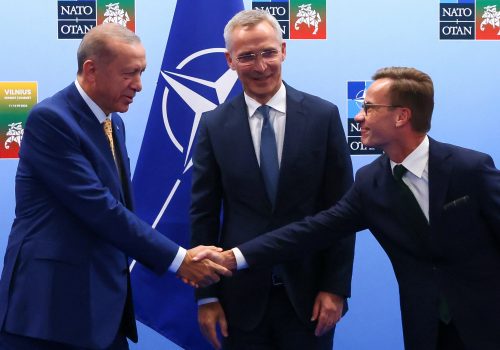
Image: The Leaders of the Group of Seven (G7), reaffirm our unwavering commitment to the strategic objective of a free, independent, democratic, and sovereign Ukraine, within its internationally recognized borders, capable of defending itself and deterring future aggression. at the 2023 NATO Summit seen next to the Main Media Center in Vilnius, Lithuania, on July 12, 2023.
