Content

New Atlanticist

Sep 15, 2020

Don’t believe the SWIFT China sanctions hype

By Brian O’Toole

A major Chinese state-owned bank, the Bank of China (BOC), in July urged its banks to switch away from SWIFT toward a domestic messaging system because of the threat of US sanctions. Don’t take the warning at face value however, as Beijing’s primary motivation is to promote its own domestic system, rather than any real fear of a SWIFT cut-off.

China Financial Regulation

New Atlanticist

Sep 14, 2020

New US Hong Kong tax treaty suspension sends important signal, despite the costs

By Barbara C. Matthews

Eliminating the favorable tax treatment and requiring “made in China” labels at least provide a visible and concrete mechanism to articulate objections regarding Chinese policy without exerting significant economic pain on the people of Hong Kong, China, or the United States

China Financial Regulation

Issue Brief

Sep 8, 2020

“One world, two systems” takes shape during the pandemic

By Hung Tran

The COVID-19 pandemic has exacerbated fragmentation of the postwar world order. Its most poignant manifestation is in an intensifying competition between the United States and China for political and strategic influence. In essence, the post-Cold War globalized economic order has gradually morphed into a “one world, two systems” configuration, edging toward a new Cold War.

China Digital Policy

New Atlanticist

Sep 8, 2020

Credit rating agencies could resolve African debt impasse

By Vasuki Shastry and Jeremy Mark

Credit rating agencies should offer a nuanced understanding of the unique needs of African nations. The G20 and global regulators have the power to persuade international investors that a little forbearance could save lives and livelihoods

Africa Financial Regulation

Event Recap

Sep 3, 2020

Expert panel responds to incidents of North Korean sanctions evasion in the DRC

By Africa Center

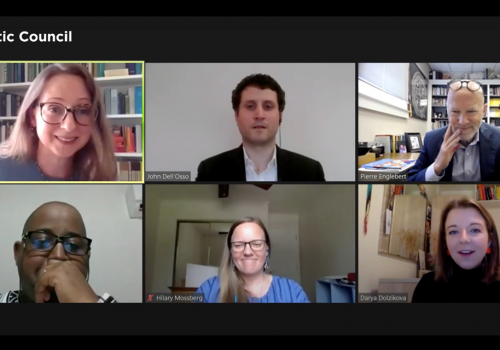
On Thursday, September 3, the Africa Center hosted a virtual panel to discuss the latest report published by The Sentry: Overt Affairs: How North Korean Businessmen Busted Sanctions in the Democratic Republic of Congo. The Sentry’s Director of Illicit Finance Policy Ms. Hilary Mossberg provided opening remarks alongside Africa Center Director of Programs and Studies Ms. Bronwyn Bruton, […]

Africa Corruption

New Atlanticist

Sep 3, 2020

The ‘Holding Foreign Companies Accountable Act’ may harm US tech leadership

By Tianjiu Zuo

There is certainly a case to be made for increased financial transparency from Chinese companies for the safety of US investors. But this may come at greater cost to US interests, with the United States becoming more discriminatory towards business, less competitive in emerging markets, and more susceptible to harmful economic retaliation.

China Financial Regulation

New Atlanticist

Aug 25, 2020

Advanced economies under pressure in the central bank digital currency race

By Barbara C. Matthews, Hung Tran

Advanced economy central banks are also actively engaged in CBDC research and development efforts. But as guardians of global reserve currencies, their approaches will necessarily be more deliberate and cautious than Beijing’s aggressiveness.

Digital Currencies Digital Policy

New Atlanticist

Aug 24, 2020

China’s Digital Currency Electronic Payment Project reveals the good and the bad of central bank digital currencies

By Hung Tran, Barbara C. Matthews

The development of the DCEP has revealed the significant advantages and potential drawbacks for both China’s digital currency project and the potential for widespread central bank digital currencies around the world.

China Digital Currencies

UkraineAlert

Aug 22, 2020

Top Ukrainian oligarch Ihor Kolomoiskiy faces growing international legal troubles

By Diane Francis

Ukrainian oligarch Ihor Kolomoiskiy is facing growing international legal troubles as a range of investigations into alleged corrupt practices at his former bank PrivatBank continue to gain momentum.

Corruption Financial Regulation

New Atlanticist

Aug 21, 2020

Unconventional monetary policy is not a free lunch in Europe or the United States

By Andrzej Rzońca and Grzegorz Parosa

The European Central Bank and the US Federal Reserve responded to the economic effects of the COVID-19 pandemic with a similar prescription to the one they used during the Global Financial Crisis (GFC), but this time they multiplied the dose.

Coronavirus European Union

Experts

Events