
Financial Sanctions and Economic Coercion

Financial sanctions and other forms of economic coercion have become policy tools of choice for the US government to deter illegal activity by international actors or to pressure governments into reversing actions that harm US interests. Yet these instruments and their potential pitfalls are often misunderstood. Restrictive economic measures such as financial sanctions, export controls, tariffs, and investment screening can play an important role in advancing certain policy objectives, but they risk being ineffective if misapplied or poorly implemented. Policymakers must also recognize the impact of economic statecraft on the private sector, which bears many of the compliance burdens and operational costs associated with these measures.

Energy Sanctions Dashboard

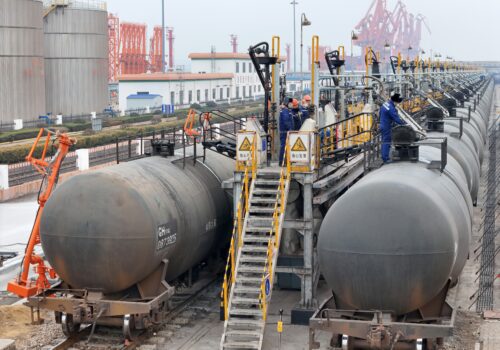
This dashboard focuses on US sanctions and restrictive measures placed on crude oil from Russia, Iran, and Venezuela—including the unintended consequences and the lessons learned.

Econographics

Apr 17, 2025

Russia Sanctions Database

By Kimberly Donovan, Maia Nikoladze, Lize de Kruijf

The Atlantic Council’s Russia Sanctions Database tracks the level of coordination among Western allies in sanctioning Russian entities, individuals, vessels, and aircraft, and shows where gaps still remain.

Eastern Europe Economy & Business

Recent analysis

Programs

At the intersection of economics, finance, and foreign policy, the GeoEconomics Center is a translation hub with the goal of helping shape a better global economic future.

Content

In the News

Apr 2, 2020

Slavin quoted in Al Jazeera on coronavirus in Iran

By Atlantic Council

Coronavirus Financial Sanctions and Economic Coercion

New Atlanticist

Apr 1, 2020

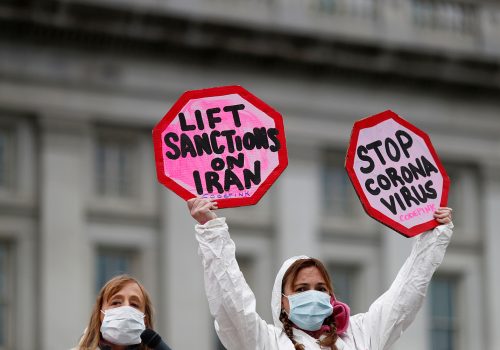
Reconciling sanctions and humanitarian need during COVID-19

By Brian O’Toole

As the world economy shuts down to try to contain the COVID-19 outbreak, the humanitarian collateral effects of sanctions become more pronounced and potentially deadly. But the argument that the United States should unilaterally roll back sanctions draws a false dichotomy; sanctions do not have to be suspended or rolled back for the United States to better address humanitarian concerns.

Cuba Financial Sanctions and Economic Coercion

In the News

Mar 24, 2020

Slavin quoted in Middle East Eye on how sanctions hinder Iran’s ability to address coronavirus

By Atlantic Council

Coronavirus Financial Sanctions and Economic Coercion

In the News

Mar 20, 2020

Dagres quoted in The Monocle on US policy vis-à-vis Iran in light of COVID-19

By Atlantic Council

Coronavirus Financial Sanctions and Economic Coercion

In the News

Mar 18, 2020

Slavin quoted in The Week on sanctions against Iran under coronavirus

By Atlantic Council

Coronavirus Financial Sanctions and Economic Coercion

In the News

Mar 17, 2020

Slavin in the American Conservative: Throttled by US sanctions, Iran struggles with the coronavirus

By Atlantic Council

Coronavirus Financial Sanctions and Economic Coercion

AfricaSource

Mar 16, 2020

Removing Sudan’s terrorism designation: Proceeding with caution

By Cameron Hudson

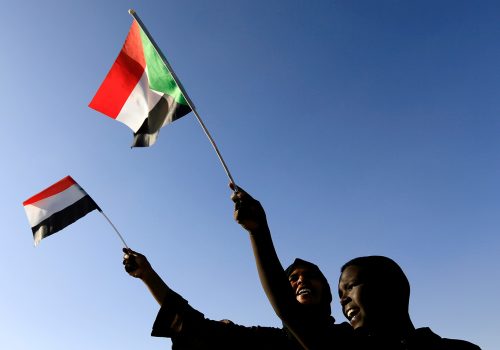
No aspect of US policy towards Sudan has garnered more scrutiny, from both inside and outside the country, than Sudan’s continued designation on the US State Sponsors of Terrorism list. But the issue itself—whether Sudan should remain on the list and what would be required to remove it—is vastly complicated.

Africa Democratic Transitions

Issue Brief

Mar 16, 2020

Pushing back against Russian aggression: Legislative options

By Daniel Fried, Brian O'Toole

US President Donald J. Trump’s administration has found it challenging to maintain a consistent position with respect to Russian President Vladimir Putin’s repression at home and aggression abroad.

Economy & Business Financial Sanctions and Economic Coercion

In the News

Feb 26, 2020

Dagres quoted in Middle Easy Eye on Iran’s ability to address the coronavirus spread

By Atlantic Council

Financial Sanctions and Economic Coercion Iran

IranSource

Feb 24, 2020

FATF blacklists Iran, but does it matter?

By Brian O’Toole

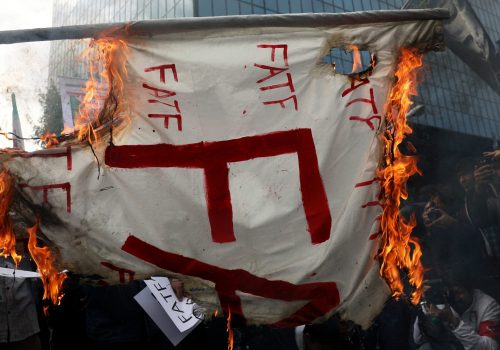
The decision to impose counter-measures by the Paris-based body signals something of an end to the group’s patience with Iran, especially by the European Union, after Tehran failed to follow through on the action plan it agreed upon with the FATF to address its deficiencies.

Financial Sanctions and Economic Coercion Iran

Experts