

Financial Sanctions and Economic Coercion

Financial sanctions and other forms of economic coercion have become policy tools of choice for the US government to deter illegal activity by international actors or to pressure governments into reversing actions that harm US interests. Yet these instruments and their potential pitfalls are often misunderstood. Restrictive economic measures such as financial sanctions, export controls, tariffs, and investment screening can play an important role in advancing certain policy objectives, but they risk being ineffective if misapplied or poorly implemented. Policymakers must also recognize the impact of economic statecraft on the private sector, which bears many of the compliance burdens and operational costs associated with these measures.

Energy Sanctions Dashboard

This dashboard focuses on US sanctions and restrictive measures placed on crude oil from Russia, Iran, and Venezuela—including the unintended consequences and the lessons learned.

Econographics

Apr 17, 2025

Russia Sanctions Database

By Kimberly Donovan, Maia Nikoladze, Lize de Kruijf

The Atlantic Council’s Russia Sanctions Database tracks the level of coordination among Western allies in sanctioning Russian entities, individuals, vessels, and aircraft, and shows where gaps still remain.

Eastern Europe Economy & Business

Recent analysis

Programs

At the intersection of economics, finance, and foreign policy, the GeoEconomics Center is a translation hub with the goal of helping shape a better global economic future.

Content

Issue Brief

Nov 9, 2018

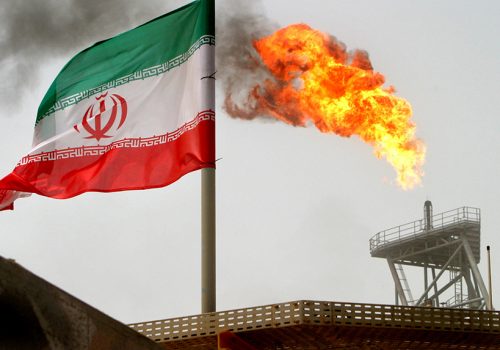
A road map of the re-imposed sanctions for Iran

By David Mortlock, Nikki Cronin

President Trump announced on May 8, 2018 that the United States would withdraw from the Joint Comprehensive Plan of Action (JCPOA) with Iran and the other P5+1 governments and re-impose nu- clear-related sanctions on Iran.

Financial Sanctions and Economic Coercion Iran

Issue Brief

Nov 9, 2018

A road map of the re-imposed sanctions for Iran

By David Mortlock, Nikki M. Cronin

President Trump announced on May 8, 2018 that the United States would withdraw from the Joint Comprehensive Plan of Action (JCPOA) with Iran and the other P5+1 governments and re-impose nu- clear-related sanctions on Iran.

Financial Sanctions and Economic Coercion Iran

New Atlanticist

Nov 8, 2018

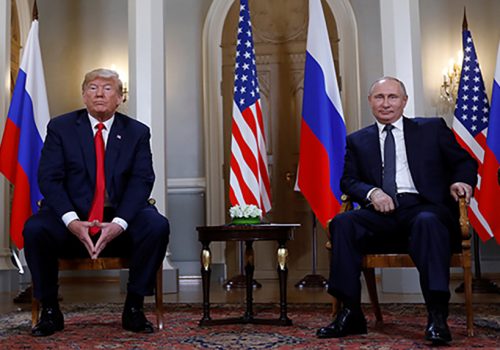
Skripal and beyond: The post-election Russia sanctions landscape

By Brian O'Toole

If the administration selects sanctions the Hill perceives as weak, or chooses to waive any serious impact, legislators probably would respond with a tougher combined sanctions bill than if the administration hits Russia hard.

Conflict Financial Sanctions and Economic Coercion

Issue Brief

Nov 8, 2018

US sanctions: Using a coercive and economic tool effectively

By David Mortlock, Brian O’Toole

In recent years, US economic and financial sanctions have become favored tools of US power, having been deployed to address threats as disparate as human-rights abuses, Iranian nuclear proliferation, Russian aggression, transnational criminal activity, and the deteriorating situation in Venezuela. The Barack Obama administration, and the George W. Bush administration before it, used sanctions to […]

Financial Sanctions and Economic Coercion

Issue Brief

Nov 8, 2018

US sanctions: Using a coercive and economic tool effectively

In recent years, US economic and financial sanctions have become favored tools of US power, having been deployed to address threats as disparate as human-rights abuses, Iranian nuclear proliferation, Russian aggression, transnational criminal activity, and the deteriorating situation in Venezuela.

Financial Sanctions and Economic Coercion

Event Recap

Nov 7, 2018

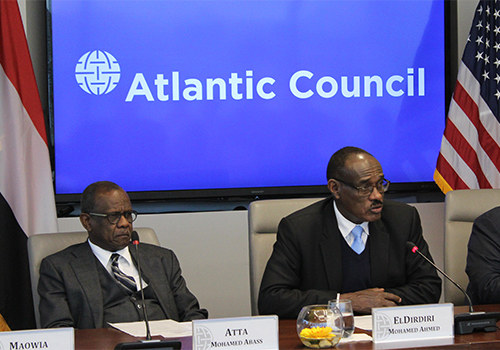
Roundtable with Sudan’s minister of foreign affairs

By Africa Center

On November 7, the Atlantic Council’s Africa Center hosted a roundtable discussion featuring H.E. Dr. ElDirdiri Mohamed Ahmed, minister of foreign affairs of the Republic of Sudan, on the state of US-Sudan relations, as well as recent efforts by his government to mediate peace in South Sudan and the Central African Republic. In his remarks, […]

Africa Conflict

New Atlanticist

Nov 5, 2018

The United States snaps back sanctions on Iran. Will they bite the government in Tehran?

By David A. Wemer

The newly reinstated sanctions will target Iranian shipbuilding and shipping, oil production and sales, and banking, among other sectors.

Financial Sanctions and Economic Coercion Iran

Issue Brief

Nov 5, 2018

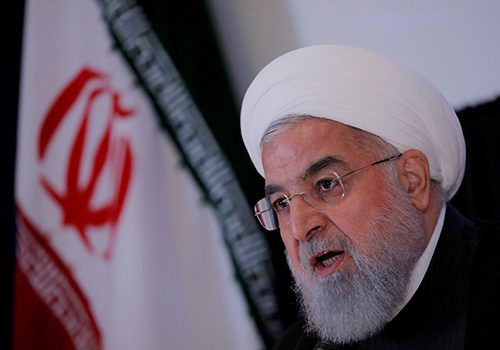
How Iran will cope with US sanctions

By Holly Dagres, Barbara Slavin

As a second and more punishing wave of US sanctions hits Iran, the Islamic Republic is dusting off an old playbook for circumventing such penalties and maintaining a crucial level of oil exports and other trade. A new issue brief by Holly Dagres and Barbara Slavin—How Iran Will Cope with US Sanctions—discusses the myriad techniques […]

Financial Sanctions and Economic Coercion Iran

Issue Brief

Nov 5, 2018

How Iran will cope with US sanctions

By Holly Dagres, Barbara Slavin

As a second and more punishing wave of US sanctions hits Iran, the Islamic Republic is dusting off an old playbook for circumventing such penalties and maintaining a crucial level of oil exports and other trade.

Financial Sanctions and Economic Coercion Iran

New Atlanticist

Nov 1, 2018

A look at the implications of reimposed US sanctions on Iran

By Brian O'Toole

The sanctions that snap back into place on November 5 largely mirror those that the Obama administration lifted in January 2016.

Financial Sanctions and Economic Coercion Iran

Experts