


Financial Sanctions and Economic Coercion

Financial sanctions and other forms of economic coercion have become policy tools of choice for the US government to deter illegal activity by international actors or to pressure governments into reversing actions that harm US interests. Yet these instruments and their potential pitfalls are often misunderstood. Restrictive economic measures such as financial sanctions, export controls, tariffs, and investment screening can play an important role in advancing certain policy objectives, but they risk being ineffective if misapplied or poorly implemented. Policymakers must also recognize the impact of economic statecraft on the private sector, which bears many of the compliance burdens and operational costs associated with these measures.

Energy Sanctions Dashboard

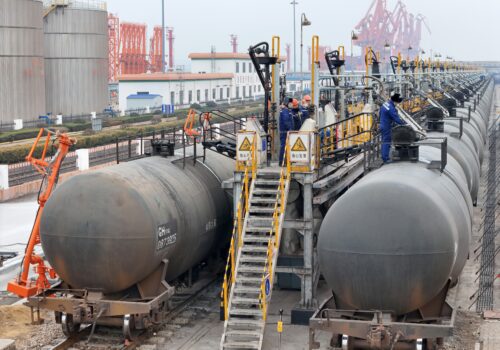
This dashboard focuses on US sanctions and restrictive measures placed on crude oil from Russia, Iran, and Venezuela—including the unintended consequences and the lessons learned.

Econographics

Apr 17, 2025

Russia Sanctions Database

By Kimberly Donovan, Maia Nikoladze, Lize de Kruijf

The Atlantic Council’s Russia Sanctions Database tracks the level of coordination among Western allies in sanctioning Russian entities, individuals, vessels, and aircraft, and shows where gaps still remain.

Eastern Europe Economy & Business

Recent analysis

Programs

At the intersection of economics, finance, and foreign policy, the GeoEconomics Center is a translation hub with the goal of helping shape a better global economic future.

Content

Event Recap

Jul 19, 2018

Oil and Iran: How renewed sanctions will affect Iran and world markets

By Global Business & Economics Program

On July 18, the Atlantic Council’s Future of Iran Initiative in the South Asia Center, Global Energy Center, and Global Business & Economics Program co-hosted a panel discussion on the likelihood and effect of renewed US sanctions on Iran.

Economy & Business Financial Sanctions and Economic Coercion

EconoGraphics

Jul 19, 2018

US Iran Sanctions Could SpOIL the Global Economy

By Ole Moehr

The Trump Administration’s “maximum pressure” approach against Iran to reduce Iranian crude oil exports to zero as soon as possible is expected to rattle markets and could undermine the credibility and effectiveness of US sanctions. This edition of the EconoGraphic outlines how re-imposed US sanctions against Iran will affect the global oil market, the price of oil, US consumers, and the American economy.

China Economy & Business

Event Recap

Jun 26, 2018

US Sanctions Options against North Korea if Diplomacy Succeeds or Fails

By Global Business & Economics Program

On June 26, the Atlantic Council’s Global Business & Economics Program, in partnership with the Center for a New American Security (CNAS), hosted a lunch roundtable discussion on US sanctions options against North Korea.

Economy & Business Financial Sanctions and Economic Coercion

Event Recap

May 25, 2018

Sanctions in the Trump Era: One Year In

By Global Business & Economics Program

On May 25th, the Atlantic Council’s Global Business and Economics Program together with the Millennium Leadership Program hosted a panel discussion with a delegation of high executives from Santander Bank. The discussion centered around how economic sanctions affect the banking sector and the priorities of the current administration in this area.

Economy & Business Financial Sanctions and Economic Coercion

EconoGraphics

May 18, 2018

US Sanctions’ Global Impact – A Case Study of RUSAL’s Supply Chain

By Ole Moehr

On April 6, 2018, the Trump Administration imposed stiff economic sanctions on 37 Russian oligarchs, oligarch-owned companies, Russian government officials, and state-owned companies.

Economy & Business Financial Sanctions and Economic Coercion

EconoGraphics

Apr 12, 2018

Africa Embraces the Promise of Free Trade

By Ole Moehr, Zachary Coles, and Alexatrini Tsiknia

Africa Embraces the Promise of Free Trade

Africa Economy & Business

EconoGraphics

Mar 20, 2018

Venezuela’s Cryptocurrency: Should OFAC Be Petrofied?

By Ole Moehr, Zachary Coles, and Alexatrini Tsiknia

Venezuela's Cryptocurrency: Should OFAC be Petrofied? The short answer is no.

Economy & Business Financial Sanctions and Economic Coercion

Report

Mar 19, 2018

Kremlin aggression in Ukraine: the price tag

By Anders Åslund

“Since the annexation, Russia has carried out extensive confiscation of public and private property, which it has referred to as ‘nationalization’ under Russian Federation legislation,” writes Dr. Anders Åslund, in Kremlin Aggression in Ukraine: The Price Tag, a new report by the Atlantic Council’s Eurasia Center. If Kyiv loses the occupied Crimea and Donbas forever, […]

Conflict Defense Policy

Event Recap

Mar 9, 2018

Sanctions in the Trump Era – One Year In

By Global Business & Economics Program

On Friday, March 9, the Atlantic Council’s Global Business and Economics Program, in cooperation with Georgetown University’s Institute of International Economic Law hosted a conference on Sanctions in the Trump Era – One Year In. The event was hosted in the context of the Global Business & Economics Program’s Economic Sanctions Initiative and focused on best practices of using sanctions as a foreign policy tool.

Economy & Business Financial Sanctions and Economic Coercion

Issue Brief

Mar 8, 2018

Sudan: Soft power, cultural engagement, and national security

By Tim Carney and Mary Carlin Yates

The third paper in the new Atlantic Council Sudan Task Force series, “Sudan: Soft Power, Cultural Engagement, and National Security” examines the importance of people-to-people engagement and its relevance to broader US strategic aims in Sudan. More than two decades of isolation have succeeded in funneling Sudan’s best and brightest to seek higher education and […]

Africa Democratic Transitions

Experts