

Financial Sanctions and Economic Coercion

Financial sanctions and other forms of economic coercion have become policy tools of choice for the US government to deter illegal activity by international actors or to pressure governments into reversing actions that harm US interests. Yet these instruments and their potential pitfalls are often misunderstood. Restrictive economic measures such as financial sanctions, export controls, tariffs, and investment screening can play an important role in advancing certain policy objectives, but they risk being ineffective if misapplied or poorly implemented. Policymakers must also recognize the impact of economic statecraft on the private sector, which bears many of the compliance burdens and operational costs associated with these measures.

Energy Sanctions Dashboard

This dashboard focuses on US sanctions and restrictive measures placed on crude oil from Russia, Iran, and Venezuela—including the unintended consequences and the lessons learned.

Econographics

Apr 17, 2025

Russia Sanctions Database

By Kimberly Donovan, Maia Nikoladze, Lize de Kruijf

The Atlantic Council’s Russia Sanctions Database tracks the level of coordination among Western allies in sanctioning Russian entities, individuals, vessels, and aircraft, and shows where gaps still remain.

Eastern Europe Economy & Business

Recent analysis

Programs

At the intersection of economics, finance, and foreign policy, the GeoEconomics Center is a translation hub with the goal of helping shape a better global economic future.

Content

Issue Brief

Mar 8, 2018

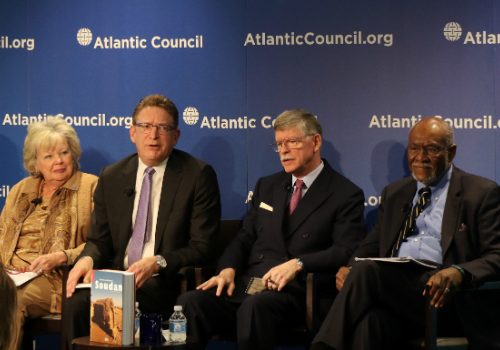
Sudan: Prospects for economic re-engagement

By Jeffrey Herbst

The second paper in the new Atlantic Council Sudan Task Force series, “Sudan: Prospects for Economic Re-engagement” examines the possibility of a new era of US economic cooperation with Sudan, including an opportunity for the United States to push for desperately needed economic reforms as part of wider US bilateral engagements efforts. Authored by Dr. […]

Africa East Africa

Event Recap

Mar 8, 2018

US-Sudan relations: what’s next?

By Africa Center

On Thursday, March 8, the Atlantic Council’s Sudan Task Force launched three new issue briefs that make recommendations for the next phase of a measured reengagement strategy for the United States with the Republic of the Sudan. The papers covered three critical, related areas: governance and political reform; economic reform and impediments to investment; and […]

Africa East Africa

Report

Mar 1, 2018

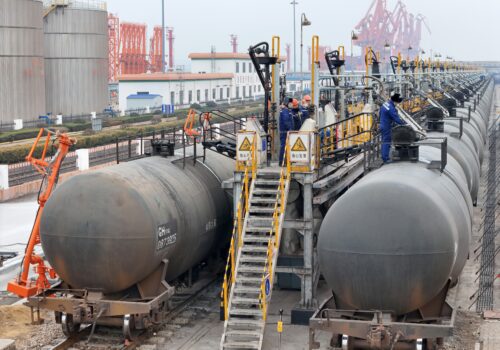
Impact of Sanctions on Russia’s Energy Sector

By Bud Coote

New US sanctions on Russia now being implemented by the administration were imposed in August 2017 and included additional sanctions on the energy sector—what is the the impact of US and European Union sanctions on Russia's energy sector, Moscow's strategy and actions to deal with energy-related sanctions, and some of the geopolitical and other implications of Russia's ability to cope with these sanctions?

Energy & Environment Financial Sanctions and Economic Coercion

EconoGraphics

Feb 6, 2018

Secondary Sanctions: A First Glance

By Ole Moehr

This edition of our EconoGraphic blog explains the difference between primary and secondary sanctions, outlines how secondary sanctions work, and uses a case study to demonstrate how the United States employs secondary sanctions in the real economy.

China Economy & Business

EconoGraphics

Nov 7, 2017

Multilateral Sanctions: Brexit Wrecks-it?

By Michael Farquharson & Ole Moehr

On October 3, 2017, the Atlantic Council hosted a conference with experts from the public and private sector to discuss the impact of Brexit on economic sanctions policymaking. The United Kingdom (UK) currently plays a considerable role crafting and implementing sanctions policy in the European Union (EU). Transatlantic cooperation and sanctions alignment are vital to ensure the effectiveness of this essential foreign policy tool.

Economy & Business European Union

Issue Brief

Oct 19, 2017

Aligning economic sanctions

By John Forrer

John Forrer's issue brief examines the challenges to aligning economic sanctions, with a focus on the economic sanctions on Russia in response to the annexation of Crimea.

Financial Sanctions and Economic Coercion

Issue Brief

Oct 19, 2017

Aligning economic sanctions

By John Forrer

As part of the Atlantic Council’s “Economic Sanctions Initiative,” the issue brief examines the challenges to aligning economic sanctions, with a focus on the economic sanctions on Russia in response to the annexation of Crimea. The author also explains why achieving well-aligned economic sanctions should be an important foreign policy objective: Well-aligned sanctions are more […]

Financial Sanctions and Economic Coercion

Event Recap

Oct 3, 2017

Economic Sanctions After Brexit: What Roles Should the Public and Private Sector Play?

By Global Business & Economics Program

On October 3, The Atlantic Council’s Economic Sanctions Initiative held a two-paneled public event entitled: Economic Sanctions After Brexit: What Roles Should the Public and Private Sector Play?

Economy & Business European Union

Issue Brief

Sep 29, 2017

The new Russia sanctions law: What it does and how to make it work

By Daniel Fried, Brian O’Toole

In “The New Russia Sanctions Law–What It Does and How to Make It Work,” authors Ambassador Daniel Fried, distinguished fellow at the Atlantic Council and former coordinator for sanctions policy at the US State Department, and Brian O’Toole, a nonresident senior fellow at the Atlantic Council, explain that Congress primarily adopted the law to block […]

Financial Sanctions and Economic Coercion Russia

EconoGraphics

Sep 25, 2017

Crude Awakening

By Ole Moehr

On August 2, 2017, US President Donald J. Trump signed into law H.R.3364, a new set of economic sanctions aimed primarily on Russia (with additional measures adopted against Iran and North Korea). Essential to the success of any sanctions regime is its alignment.

Economy & Business European Union

Experts