The Scowcroft Center’s namesake, General Brent Scowcroft, was the chairman of the 1983 Scowcroft Commission that established the foundation for US nuclear deterrence and arms control policy through the present day. As the United States enters a new era of strategic challenges, the Scowcroft Center’s Forward Defense program is proud to play a central role in crafting an effective and nonpartisan strategic forces strategy and policy for the twenty-first century.

The 2022 National Defense Strategy and Nuclear Posture Review caution that the United States will, for the first time in its history, face the challenge of simultaneously deterring two nuclear great powers, each with aggressive revisionist goals. Our Nuclear Strategy Project, within the Forward Defense program, focuses on the role of nuclear deterrence, nuclear strategy and employment, missile defense, and arms control in deterring conventional aggression and nuclear escalation against the United States, its allies, and partners.

Principal research areas

Must Reads
Report

Jan 4, 2025

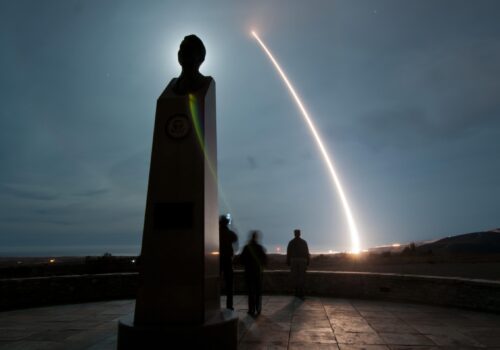
‘First, we will defend the homeland’: The case for homeland missile defense

By Robert Soofer with contributions from Kari Anderson, James McCue, Tom Karako, Mark J. Massa, Alyxandra Marine, and Jonathan Rosenstein

A comprehensive analysis of U.S. homeland missile defense, addressing policies, security challenges, and strategies to counter threats from North Korea, China, and Russia.

China Defense Technologies

Commentary & quick analysis
New Atlanticist

Sep 16, 2025

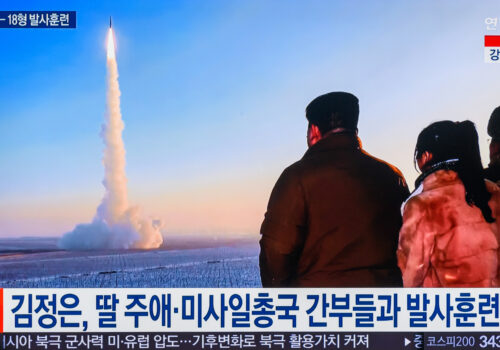
NATO has a gap in its airborne command and control. Here’s how to close it.

By David Julazadeh

As E-3 AWACS aircraft retire, and with new doubts about and delays with the E-7A aircraft set to replace them, the Alliance must take additional steps bridge the gap.

Europe & Eurasia
NATO

New Atlanticist

Aug 26, 2025

Five questions (and expert answers) about where the US-South Korea alliance goes from here

By Atlantic Council experts

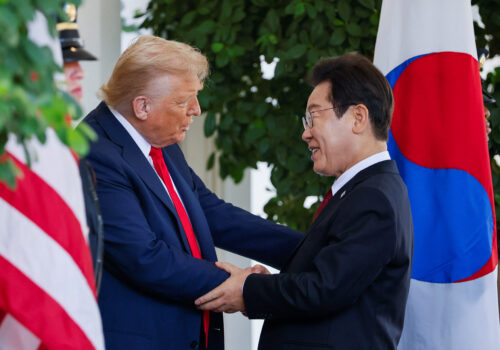
The US and South Korean presidents met on Monday in Washington to discuss a range of bilateral issues, from security to shipbuilding.

Korea
Nuclear Deterrence

Fast Thinking

Jun 22, 2025

How will Iran respond to US strikes on its nuclear program?

By Atlantic Council

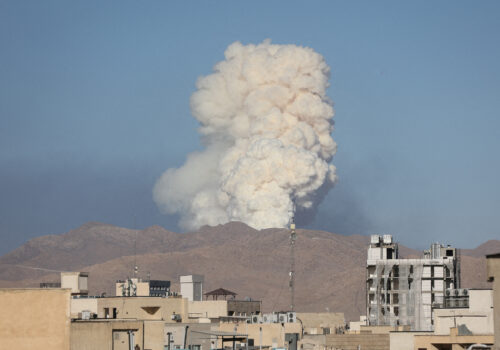
Following the US strike on Iranian nuclear sites, Iran’s foreign minister said his country must respond. Atlantic Council experts look at Tehran’s options.

Conflict
Iran

New Atlanticist

Jun 12, 2025

Experts react: Israel just attacked Iran’s military and nuclear sites. What’s next?

By Atlantic Council experts

Our experts shed light on Israel’s major attack against Iran targeting its nuclear facilities and its implications for the region.

Conflict
Defense Policy

New Atlanticist

Jun 6, 2025

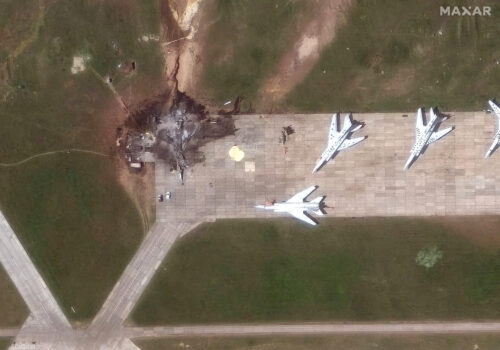
Ukraine’s drone strikes offer four big lessons for US nuclear strategists

By Mark J. Massa

Ukraine’s Operation Spiderweb should spur the US government to address strategic vulnerabilities that nuclear strategists have focused on for years.

Defense Policy
National Security

Reports & issue briefs

Report

Jan 21, 2026

Countering Russian escalation in space

By John Klein, Clementine G. Starling-Daniels

Current US space policy and acquisitions are inadequate to address the growing threats from Russia in space. The United States needs a more resilient space architecture, able to withstand major-power conflict—and Russia’s designs to place a nuclear weapon in orbit. Here are fifteen recommendations to make that happen.

China
Missile Defense

Issue Brief

Dec 22, 2025

Is extending the New START limits in the US national security interest?

By Greg Weaver

This issue brief will ask and answer the question of whether extending the New START limits is in the US national security interest.

Arms Control
Nuclear Deterrence

Issue Brief

Dec 22, 2025

Nuclear priorities for the Trump administration: A time to decide

By Matthew Kroenig, Jonathan Rosenstein

This report offers recommendations to the Donald Trump administration for policy and investment decisions that will shape this new era of strategic competition in the United States’ favor.

China
Missile Defense

Issue Brief

Aug 27, 2025

Navigating the new normal: Strategic simultaneity, US Forces Korea flexibility, and alliance imperatives

By Bee Yun Jo

The future of deterrence on the Korean Peninsula—and indeed, the wider Indo-Pacific region—will hinge on Seoul’s ability to reframe US force realignments not as unilateral disengagements but as catalysts for action.

Defense Policy
Korea

Issue Brief

Jul 24, 2025

Five pillars for deterring strategic attacks

By Mark J. Massa, Alyxandra Marine

As its highest priority, the Department of Defense must deter strategic attacks on the United States. A five-pillar strategy could guide efforts to prevent nuclear and nonnuclear threats while ensuring resilience and readiness against large-scale nuclear attacks on the US homeland.

Defense Policy
Defense Technologies

Past events

In the news

In the News

Sep 19, 2023

Cynkin appears on VOA “Washington Talk” weekly program

On September 16, IPSI nonresident senior fellow Thomas Cynkin appeared on VOA Korea’s weekly program, “Washington Talk,” regarding the recent meeting between Russian President Vladimir Putin and North Korean leader Kim Jong Un. He described the North Korean-Russian partnership as an “unholy alliance” and a “marriage of convenience,” particularly as it pertains to nuclear issues, […]

Arms Control
Indo-Pacific

In the News

Sep 15, 2023

Garlauskas appears as a guest on Brussels Sprouts

On September 15, Markus Garlauskas spoke on an episode of Brussels Sprouts, a transatlantic security-focused podcast. In this episode, titled “The New Authoritarian Axis: Russian Relations with North Korea and Iran,” Garlauskas discussed the recent Putin-Kim summit and the concerning implications of this developing relationship for containing North Korea’s WMD programs. He also addressed the […]

China
Indo-Pacific

In the News

Sep 14, 2023

Cynkin interviewed by VOA on recent Putin-Kim summit

On September 12, IPSI nonresident senior fellow Thomas Cynkin was quoted in VOA Korea for his insights on the recent Putin-Kim summit. He was also featured in broadcasts by VOA Korea on September 12 and VOA Russia on September 13, explaining that “this meeting is a reaction to the isolation that the two countries, Russia […]

Indo-Pacific
International Norms

In the News

Sep 13, 2023

Garlauskas quoted in War on the Rocks

On September 12, Markus Garlauskas’ analysis was referenced in War on the Rocks regarding his recently published report on simultaneous conflicts and limited nuclear attacks. In particular, the article cited one of the report’s key assertions: that “the likelihood of a two-front conflict is … worth serious consideration and accommodation.”

China
Crisis Management

In the News

Sep 12, 2023

Kroenig quoted in Haaretz on a potential US-Saudi-Israeli deal

By Atlantic Council

On September 8, Dr. Matthew Kroenig, Atlantic Council vice president and senior director of the Scowcroft Center, was quoted by Haaretz on a possible new agreement between the United States, Israel, and Saudi Arabia. He argues that President Biden should not let Saudi Arabia enrich uranium.

Nuclear Nonproliferation
Politics & Diplomacy

Subscribe to stay engaged

Sign up for updates from Forward Defense to hear the latest on the trends, technologies, and military challenges shaping tomorrow.


  • This field is for validation purposes and should be left unchanged.

Related experts

Forward Defense leads the Atlantic Council’s US and global defense programming, developing actionable recommendations for the United States and its allies and partners to compete, innovate, and navigate the rapidly evolving character of warfare. Through its work on US defense policy and force design, the military applications of advanced technology, space security, strategic deterrence, and defense industrial revitalization, it informs the strategies, policies, and capabilities that the United States will need to deter, and, if necessary, prevail in major-power conflict.