Nuclear strategy project

The Scowcroft Center is proud to play a central role in crafting an effective and nonpartisan strategic forces policy for the twenty-first century.

The Scowcroft Center’s namesake, General Brent Scowcroft, was the chairman of the 1983 Scowcroft Commission that established the foundation for US nuclear deterrence and arms control policy through the present day. As the United States enters a new era of strategic challenges, the Scowcroft Center’s Forward Defense program is proud to play a central role in crafting an effective and nonpartisan strategic forces strategy and policy for the twenty-first century.

The 2022 National Defense Strategy and Nuclear Posture Review caution that the United States will, for the first time in its history, face the challenge of simultaneously deterring two nuclear great powers, each with aggressive revisionist goals. Our Nuclear Strategy Project, within the Forward Defense program, focuses on the role of nuclear deterrence, nuclear strategy and employment, missile defense, and arms control in deterring conventional aggression and nuclear escalation against the United States, its allies, and partners.

Principal research areas

Must Reads
Report

Jan 4, 2025

‘First, we will defend the homeland’: The case for homeland missile defense

By Robert Soofer with contributions from Kari Anderson, James McCue, Tom Karako, Mark J. Massa, Alyxandra Marine, and Jonathan Rosenstein

A comprehensive analysis of U.S. homeland missile defense, addressing policies, security challenges, and strategies to counter threats from North Korea, China, and Russia.

China Defense Technologies

Reports & issue briefs

Issue Brief

Jun 18, 2026

The case for a US Northeast Asia Command

By Christopher Lee, Ben Blane, and Markus Garlauskas

To maximize its deterrent and warfighting effectiveness in the Indo-Pacific region, the United States must reform its military command-and-control structure in Northeast Asia.

Arms Control East Asia

Issue Brief

May 21, 2026

For homeland missile defense, think Golden Zones, not a Golden Dome 

By Ankit Panda

While the second Trump administration correctly diagnoses a more dangerous nuclear environment facing the country, a comprehensive defensive system is the wrong prescription. The risks of prompting adversary proliferation and stretching US resources thin are too high.

Defense Technologies Missile Defense

Issue Brief

May 21, 2026

Golden Dome is the missile defense the US needs

By Henry “Trey” Obering

The United States should pursue a comprehensive missile defense system to protect the homeland from advanced threats posed by China, Russia, and North Korea. Political will from the Trump administration and advances in technology make the idea of the long-discussed "dome" over the United States more feasible now than ever.

Missile Defense Security & Defense

Issue Brief

Mar 27, 2026

Deterrence in a two-peer world requires prudence

By Kingston Reif

Washington faces the challenge of preserving credible deterrence and reassuring allies against two potential nuclear peers—possibly acting together—without fueling dangerous instability or draining resources from other defense priorities. This will require a balanced approach that avoids counterproductive arsenal growth.

China Nuclear Deterrence

Issue Brief

Mar 27, 2026

Why US strategic nuclear forces must expand after New START

By Paul Amato

With the New START treaty's caps on the US nuclear force expired, the United States has an opportunity to increase and adapt its nuclear force to deter both Russia and China. Policymakers should seize it.

China Defense Policy

Commentary & quick analysis

New Atlanticist

Sep 16, 2025

NATO has a gap in its airborne command and control. Here’s how to close it.

By David Julazadeh

As E-3 AWACS aircraft retire, and with new doubts about and delays with the E-7A aircraft set to replace them, the Alliance must take additional steps bridge the gap.

Europe & Eurasia NATO

New Atlanticist

Aug 26, 2025

Five questions (and expert answers) about where the US-South Korea alliance goes from here

By Atlantic Council experts

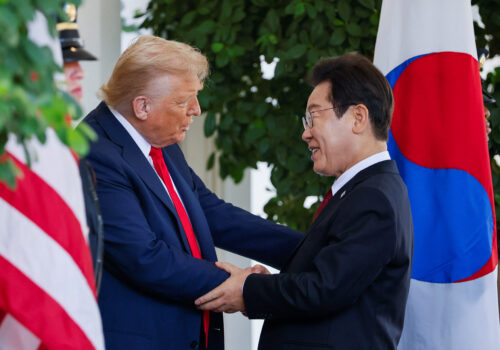
The US and South Korean presidents met on Monday in Washington to discuss a range of bilateral issues, from security to shipbuilding.

Korea Nuclear Deterrence

Fast Thinking

Jun 22, 2025

How will Iran respond to US strikes on its nuclear program?

By Atlantic Council

Following the US strike on Iranian nuclear sites, Iran’s foreign minister said his country must respond. Atlantic Council experts look at Tehran’s options.

Conflict Iran

New Atlanticist

Jun 12, 2025

Experts react: Israel just attacked Iran’s military and nuclear sites. What’s next?

By Atlantic Council experts

Our experts shed light on Israel’s major attack against Iran targeting its nuclear facilities and its implications for the region.

Conflict Defense Policy

New Atlanticist

Jun 6, 2025

Ukraine’s drone strikes offer four big lessons for US nuclear strategists

By Mark J. Massa

Ukraine’s Operation Spiderweb should spur the US government to address strategic vulnerabilities that nuclear strategists have focused on for years.

Defense Policy National Security

Past events

In the news

In the News

Mar 13, 2025

Soofer interviewed on War on the Rocks podcast about Trump’s ‘Iron Dome’

By Atlantic Council

On March 12, Forward Defense senior fellow Robert Soofer was interviewed by Ankit Panda, host of the “Thinking the Unthinkable” podcast on War on the Rocks. The episode discussed the Trump administration’s plan for an American “Iron Dome” and the questions it raises for US missile defense and the strategic vulnerability in the United States today.

China Defense Policy

In the News

Mar 11, 2025

Soofer quoted at National Institute for Public Policy symposium on nuclear and missile defense policy

By Atlantic Council

On November 20, 2024, Forward Defense senior fellow Robert Soofer gave remarks at a symposium on “Nuclear and Missile Defense Policy in the Second Trump Administration: What to Expect and What Should be Done” hosted by the National Institute for Public Policy. In the published notes from the symposium, Soofer was quoted on the unique […]

China Defense Policy

In the News

Mar 11, 2025

Chilton interviewed about the “Golden Dome” on Aerospace Advantage Podcast

By Atlantic Council

On March 8, Forward Defense distinguished fellow Kevin P. Chilton was interviewed on The Aerospace Advantage podcast by The Mitchell Institute for Aerospace Studies. In the episode, Chilton spoke on the realities of the “Golden Dome,” saying, “I’m 100 percent for it for the United States of America but I would say first things first. […]

China Defense Policy

In the News

Mar 7, 2025

Leaders of Hypersonics Capabilities Task Force author SpaceNews op-ed

By Atlantic Council

On March 6, Hypersonic Capabilities Task Force co-chairs Deborah Lee James, Ryan McCarthy, and lead author, Michael E. White, published an op-ed in SpaceNews entitled, “How the nation can make fielding hypersonic capabilities a national priority.” The article argues that the U.S. must urgently prioritize the development and deployment of hypersonic capabilities to counter growing […]

China Defense Policy

In the News

Feb 28, 2025

Soofer interviewed on NucleCast podcast about homeland missile defense

By Atlantic Council

On February 25 Forward Defense senior fellow Robert Soofer was interviewed by Dr. Adam Lowther, Strategic Advisor to the ANWA Deterrence Center, on the NucleCast podcast. In the episode, they discussed the evolving threats from countries like North Korea, Russia, and China, and the need for a robust missile defense strategy that reassures allies and deters adversaries.

China Defense Policy

Subscribe to stay engaged

Sign up for updates from Forward Defense to hear the latest on the trends, technologies, and military challenges shaping tomorrow.


  • This field is for validation purposes and should be left unchanged.

Related experts

Forward Defense leads the Atlantic Council’s US and global defense programming, developing actionable recommendations for the United States and its allies and partners to compete, innovate, and navigate the rapidly evolving character of warfare. Through its work on US defense policy and force design, the military applications of advanced technology, space security, strategic deterrence, and defense industrial revitalization, it informs the strategies, policies, and capabilities that the United States will need to deter, and, if necessary, prevail in major-power conflict.