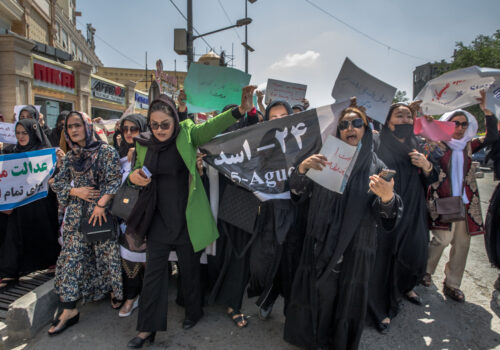
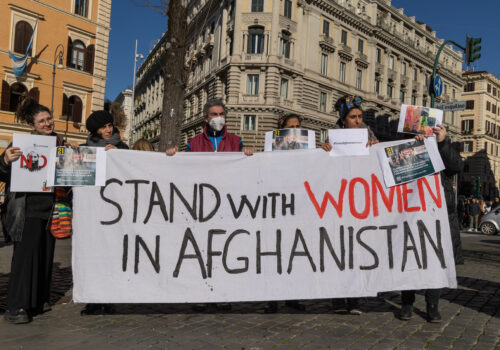
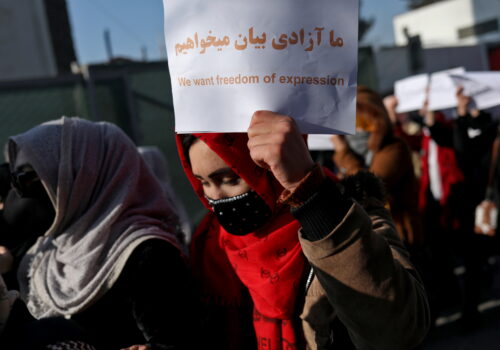
After the Taliban’s return to power on August 15, 2021, women in Afghanistan are treated as second-class citizens, systematically stripped of their rights. Over eighty decrees issued by the Taliban confine women to their homes and ban girls from attending school, turning Afghanistan into a prison for women and girls.

This gender apartheid is reinforced by new educational curricula and severe restrictions on women’s participation in every aspect of society. Women’s protests against these injustices have been met with harsh repression, including imprisonment, torture, and accusations of being influenced by foreign entities.

Inside the Taliban’s gender apartheid, a joint project of the Civic Engagement Project and the Atlantic Council’s South Asia Center, highlights the stories of women who have courageously resisted these injustices—women who have endured imprisonment and brutality for their peaceful demands for basic rights. By refusing to remain silent and shedding light on the violence they face, their testimonies serve as evidence in the fight for justice.

The women who have survived this regime are now calling for international recognition of the Taliban’s gender apartheid as a crime against humanity. This recognition would not only validate their suffering but could also challenge the Taliban’s grip on power and pave the way for transitional justice, offering a potential path to healing and justice for Afghan women and girls. 
The South Asia Center is the hub for the Atlantic Council’s analysis of the political, social, geographical, and cultural diversity of the region. ​At the intersection of South Asia and its geopolitics, SAC cultivates dialogue to shape policy and forge ties between the region and the global community.
Content

MENASource

Sep 8, 2021

It’s been twenty years since 9/11. The US Army still hasn’t learned to speak Arabic or Dari.

By Jon Tishman

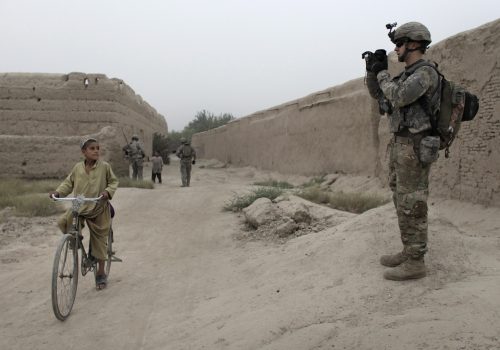
The August withdrawal ended close to twenty years of combat operations in Afghanistan, while the US aims to end seventeen years of combat mission in Iraq by the end of this year. After such lengthy conflicts, one might expect the US Army to be overrun with soldiers fluent in Arabic and Dari. Despite repeated deployments and enough time to educate current senior leaders in the ranks from grade school skills to bachelor’s degree-level, the overall rate of soldiers conversant in target languages remains abysmally low in combat arms, even among codified linguist positions.

Afghanistan
Iraq

In the News

Sep 7, 2021

Alam was quoted in CNBC News: “Fighting continues in Afghanistan’s Panjshir Valley as anti-Taliban resistance vows to hold out.”

By Atlantic Council

Afghanistan
Conflict

In the News

Sep 7, 2021

Akhtar with the Institute of Regional Studies Islamabad: “Afghanistan: What Next?”

By Atlantic Council

Afghanistan
South Asia

In the News

Sep 6, 2021

Wechsler quoted in the Asahi Shimbun on the future of counterterrorism after US withdrawal in Afghanistan

By Atlantic Council

Afghanistan
Conflict

In the News

Sep 6, 2021

Nasr quoted in Money Control on the emerging Biden doctrine

By Atlantic Council

Afghanistan
Conflict

In the News

Sep 6, 2021

Samad joins TRT World to discuss Panjshir

By Atlantic Council

Afghanistan
Conflict

In the News

Sep 5, 2021

Nasr quoted in The New York Times on the emerging Biden doctrine

By Atlantic Council

Afghanistan
Conflict

In the News

Sep 5, 2021

Nasr quoted in The Indian Express on the emerging Biden doctrine

By Atlantic Council

Afghanistan
Conflict

In the News

Sep 4, 2021

Ashford in The Week: The limits of power

By Atlantic Council

On September 4, Emma Ashford was quoted in the editor’s letter for the new edition of The Week, focusing on the Afghan withdrawal. “The U.S. had searing proof of that in Vietnam, but the shock of 9/11 created a national amnesia that the Bush administration exploited in trying to nation-build Afghanistan, and then, more recklessly, […]

Afghanistan
Conflict

In the News

Sep 4, 2021

Samad joins CGTN’s “The Heat” to discuss the Taliban government

By Atlantic Council

Afghanistan
Conflict

Experts