
Financial Sanctions and Economic Coercion

Financial sanctions and other forms of economic coercion have become policy tools of choice for the US government to deter illegal activity by international actors or to pressure governments into reversing actions that harm US interests. Yet these instruments and their potential pitfalls are often misunderstood. Restrictive economic measures such as financial sanctions, export controls, tariffs, and investment screening can play an important role in advancing certain policy objectives, but they risk being ineffective if misapplied or poorly implemented. Policymakers must also recognize the impact of economic statecraft on the private sector, which bears many of the compliance burdens and operational costs associated with these measures.

Energy Sanctions Dashboard

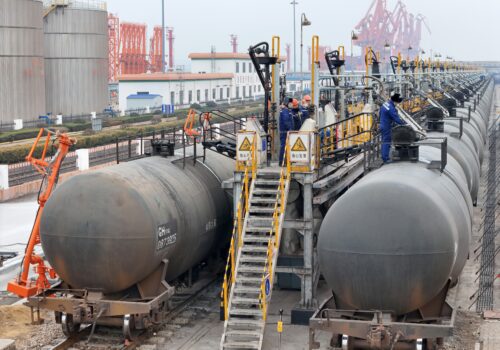
This dashboard focuses on US sanctions and restrictive measures placed on crude oil from Russia, Iran, and Venezuela—including the unintended consequences and the lessons learned.

Econographics

Apr 17, 2025

Russia Sanctions Database

By Kimberly Donovan, Maia Nikoladze, Lize de Kruijf

The Atlantic Council’s Russia Sanctions Database tracks the level of coordination among Western allies in sanctioning Russian entities, individuals, vessels, and aircraft, and shows where gaps still remain.

Eastern Europe Economy & Business

Recent analysis

Programs

At the intersection of economics, finance, and foreign policy, the GeoEconomics Center is a translation hub with the goal of helping shape a better global economic future.

Content

New Atlanticist

Dec 17, 2020

Sanctions against Turkey over Russian arms: Has the United States found a sweet spot?

By Daniel Fried

With its sanctions against Turkey's main defense-procurement entity, the United States may have found a sweet spot: sanctions strong enough to capture Turkish attention but not so sweeping as to shut down bilateral security and arms relations with a NATO ally.

Defense Industry Defense Technologies

In the News

Dec 15, 2020

Friedlander featured on Sanctions Space podcast about finance and economics in Foreign Policy

By Julia Friedlander

Listen here.

Financial Sanctions and Economic Coercion Macroeconomics

AfricaSource

Dec 14, 2020

What Sudan’s terror delisting really means

By Cameron Hudson

The announcement today that the forty-five day notification period to Congress had elapsed and Sudan was finally off the US State Sponsors of Terrorism list is historic. It validates the new direction of the country, which it was set upon nearly two years ago by nationwide, peaceful street protests. More importantly, it represents a definitive break with Sudan’s troubled past—the true end of the Bashir era, which began more than thirty years ago—and holds out the hope for a more prosperous future for all Sudanese. The weight of the moment cannot be understated.

Africa Democratic Transitions

New Atlanticist

Dec 10, 2020

The European Magnitsky Law—A milestone with a lot of potential

By Hagar Hajjar Chemali

The European Magnitsky Act has some limitations, but if implemented and enforced consistently, it has the potential to make a large impact in the global fight against human rights abuse because of the opportunity it creates for the United States and Europe to coordinate their efforts together.

European Union Financial Sanctions and Economic Coercion

New Atlanticist

Dec 7, 2020

US investors face half-baked Trump restrictions on Chinese securities

By Jeremy Mark

As the Trump administration tries to accelerate economic decoupling from China before leaving office, it has turned its attention to international finance by targeting investments in Chinese companies designated as threats to US national security. In that process, it is injecting uncertainty into markets by forcing investors to adjust to rapidly evolving restrictions.

China Financial Sanctions and Economic Coercion

In the News

Dec 2, 2020

Borghard in Modern War Institute: The economic aspects of great power competition

By Atlantic Council

Erica writes about the role of economic statecraft in great power competition and the dangers of the United States’ overreliance on economic power for coercive purposes. More about our expert

Defense Policy Economy & Business

In the News

Nov 27, 2020

Linscott in The Hindu: Putting trade ties on a new footing

By Atlantic Council

Americas Economy & Business

Report

Nov 17, 2020

Defending the United States against Russian dark money

By Anders Åslund, Julia Friedlander

Warfare has evolved and the United States now faces a major unconventional threat: Russia's estimated $1 trillion of dark money. With it, the Kremlin can wreak havoc if the US fails to act and recognize this national security threat for what it is.

Corruption European Union

New Atlanticist

Oct 29, 2020

Russia sanctions bite and remind us of the value of transatlantic unity

By Juha Rainne

Despite some early hesitation and Moscow’s attempts to discredit them, the sanctions are working. They have had an undeniable effect on the Russian economy, which Moscow cannot overlook in its decision-making.

Financial Sanctions and Economic Coercion Russia

In the News

Oct 26, 2020

Fontenrose quoted in CNBC on possible US sanction policies towards Iran under President-elect Biden

By Atlantic Council

Economy & Business Elections

Experts