

Financial Sanctions and Economic Coercion

Financial sanctions and other forms of economic coercion have become policy tools of choice for the US government to deter illegal activity by international actors or to pressure governments into reversing actions that harm US interests. Yet these instruments and their potential pitfalls are often misunderstood. Restrictive economic measures such as financial sanctions, export controls, tariffs, and investment screening can play an important role in advancing certain policy objectives, but they risk being ineffective if misapplied or poorly implemented. Policymakers must also recognize the impact of economic statecraft on the private sector, which bears many of the compliance burdens and operational costs associated with these measures.

Energy Sanctions Dashboard

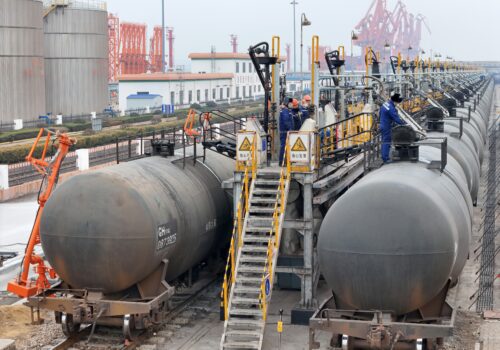
This dashboard focuses on US sanctions and restrictive measures placed on crude oil from Russia, Iran, and Venezuela—including the unintended consequences and the lessons learned.

Econographics

Apr 17, 2025

Russia Sanctions Database

By Kimberly Donovan, Maia Nikoladze, Lize de Kruijf

The Atlantic Council’s Russia Sanctions Database tracks the level of coordination among Western allies in sanctioning Russian entities, individuals, vessels, and aircraft, and shows where gaps still remain.

Eastern Europe Economy & Business

Recent analysis

Programs

At the intersection of economics, finance, and foreign policy, the GeoEconomics Center is a translation hub with the goal of helping shape a better global economic future.

Content

New Atlanticist

Sep 29, 2020

Tackling the China threat with economic statecraft

By David Mortlock

Decoupling the US and Chinese economies does little to address the more fundamental threat posed by China’s efforts to rewrite the global rulebook.

China Financial Regulation

New Atlanticist

Sep 28, 2020

The illusion of decoupling the semiconductor industry: Latest US restrictions on China short-sighted

By Jeremy Mark

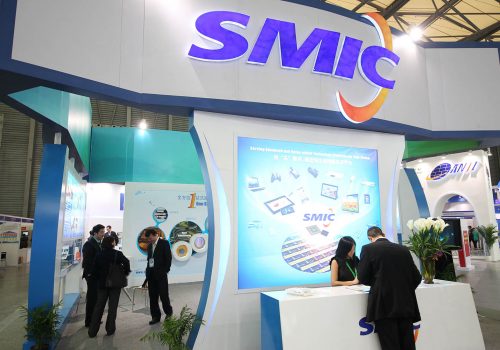
The action against SMIC, which reflects concerns about the use of US chip-making technology for military purposes and which follows steps put into effect on September 15 to choke off the supply of chips to Huawei Technologies Co., is likely to prove shortsighted. It will incur costs for US companies while failing to ensure them supply chain independence.

China Digital Policy

In the News

Sep 28, 2020

Busch Writes in The Hill on China Tariffs at the WTO

By Marc L. Busch

Read the full article here.

China Economy & Business

In the News

Sep 25, 2020

Hudson in Foreign Policy: The White House wants peace with Sudan. Congress wants Khartoum to pay.

By Atlantic Council

Africa Democratic Transitions

In the News

Sep 24, 2020

Herbst and Cagan in Morning Consult: Opposition to Nord Stream 2 sanctions is misguided

By Atlantic Council

Financial Sanctions and Economic Coercion Germany

BelarusAlert

Sep 18, 2020

Sanctions against Belarus must also target Russia

By Anders Åslund

The US and EU are preparing to impose sanctions on Belarus over the Lukashenka regime's violent crackdown on protests. To be effective, sanctions should also target Lukashenka's Russian allies.

Belarus Democratic Transitions

New Atlanticist

Sep 16, 2020

Experts react: Von der Leyen outlines vision for Europe’s post-COVID future

By Atlantic Council

Von der Leyen used her first State of the European Union Address to push European leaders to “make change happen by design—not by disaster or by diktat from others in the world.” Atlantic Council experts react to European Commission President Ursula von der Leyen’s speech and its implications for future EU policy.

Climate Change & Climate Action Coronavirus

New Atlanticist

Sep 15, 2020

Don’t believe the SWIFT China sanctions hype

By Brian O’Toole

A major Chinese state-owned bank, the Bank of China (BOC), in July urged its banks to switch away from SWIFT toward a domestic messaging system because of the threat of US sanctions. Don’t take the warning at face value however, as Beijing’s primary motivation is to promote its own domestic system, rather than any real fear of a SWIFT cut-off.

China Financial Regulation

New Atlanticist

Sep 14, 2020

Regulatory combat: Export controls as ammunition against national security threats

By Annie Froehlich

The Department of Commerce's actions could deliver a significant blow to Huawei, but they also merit attention for the resulting compliance challenges and burdens facing industry.

China Financial Sanctions and Economic Coercion

New Atlanticist

Sep 14, 2020

New US Hong Kong tax treaty suspension sends important signal, despite the costs

By Barbara C. Matthews

Eliminating the favorable tax treatment and requiring “made in China” labels at least provide a visible and concrete mechanism to articulate objections regarding Chinese policy without exerting significant economic pain on the people of Hong Kong, China, or the United States

China Financial Regulation

Experts