
Financial Sanctions and Economic Coercion

Financial sanctions and other forms of economic coercion have become policy tools of choice for the US government to deter illegal activity by international actors or to pressure governments into reversing actions that harm US interests. Yet these instruments and their potential pitfalls are often misunderstood. Restrictive economic measures such as financial sanctions, export controls, tariffs, and investment screening can play an important role in advancing certain policy objectives, but they risk being ineffective if misapplied or poorly implemented. Policymakers must also recognize the impact of economic statecraft on the private sector, which bears many of the compliance burdens and operational costs associated with these measures.

Energy Sanctions Dashboard

This dashboard focuses on US sanctions and restrictive measures placed on crude oil from Russia, Iran, and Venezuela—including the unintended consequences and the lessons learned.

Econographics

Apr 17, 2025

Russia Sanctions Database

By Kimberly Donovan, Maia Nikoladze, Lize de Kruijf

The Atlantic Council’s Russia Sanctions Database tracks the level of coordination among Western allies in sanctioning Russian entities, individuals, vessels, and aircraft, and shows where gaps still remain.

Eastern Europe Economy & Business

Recent analysis

Programs

At the intersection of economics, finance, and foreign policy, the GeoEconomics Center is a translation hub with the goal of helping shape a better global economic future.

Content

Event Recap

Sep 8, 2017

Former Deputy Director of the CIA on Russia, Venezuela and North Korea Sanctions

By Global Business & Economics Program

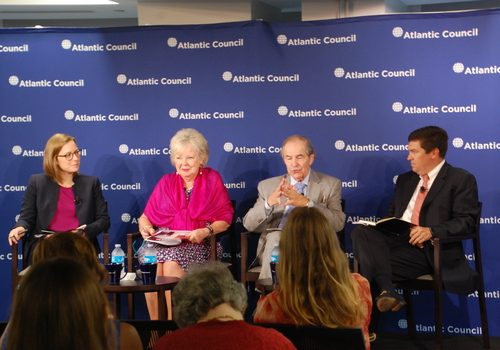
On September 11, the Atlantic Council’s Economic Sanctions Initiative and the Institute of International Economic Law (IIEL) at Georgetown Law hosted David S. Cohen, Former Deputy Director of the Central Intelligence Agency (CIA), to discuss Russia, Venezuela and North Korea sanctions in an interview with IIEL Faculty Director Chris Brummer.

Economy & Business Financial Sanctions and Economic Coercion

Report

Sep 1, 2017

Agent of Influence: Should Russia’s RT Register as a Foreign Agent?

By Elena Postnikova

The US Congress enacted the Foreign Agents Registration Act of 1938 (FARA) to ensure that the American people were aware when foreign governments funded media sources; at the time, their concerns focused on the Nazi regime in Germany. Today, this issue has resurfaced with concerns about the Russian propaganda outlet RT (formerly Russia Today). RT […]

Disinformation Elections

Event Recap

Jul 14, 2017

Report launch: Sudan: a strategy for re-engagement

By Africa Center

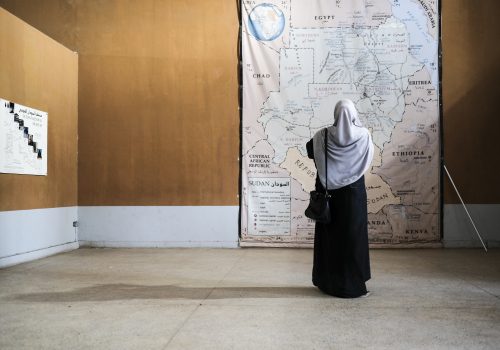
On July 14, 2017, the Atlantic Council’s Sudan Task Force launched its latest report, Sudan: A Strategy for Re-Engagement by Ambassador Mary Carlin Yates with Kelsey Lilley. Atlantic Council Vice President and Africa Center Director Dr. J. Peter Pham welcomed attendees and introduced the panel’s work. The panel, which included Task Force members Ambassador Mary […]

Africa East Africa

Report

Jul 14, 2017

Sudan: A strategy for re-engagement

By Mary Carlin Yates with Kelsey Lilley

Despite Sudan’s checkered diplomatic history with the United States, the Trump administration has an opportunity to recalibrate what could be a constructive relationship in a critical part of the world. In determining what a successful US-Sudanese relationship could look like, the administration has an opportunity to both serve US interests in Sudan and beyond and […]

Africa Civil Society

EconoGraphics

Jul 6, 2017

The Big Chill(ing effect)

By Samuel Weitzman

In March 2014, the United States and the European Union (EU) issued the first in a series of sanctions against the Russian Federation for its destabilization of Ukraine and annexation of Crimea. These restrictions, which initially focused on senior Russian government officials and private individuals, have expanded to include large corporations, financial institutions, and even entire economic sectors. In retaliation, Russia has adopted counter-sanctions of its own.

Economy & Business European Union

Issue Brief

Jun 14, 2017

Economic Sanctions: Sharpening a vital foreign policy tool

By John Forrer

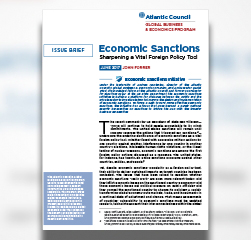
Despite the popularity of economic sanctions as a foreign policy tool, their ability to deliver sustained impacts on target countries is often called into question. In “Economic Sanctions–A Vital Foreign Policy Tool,” author John Forrer, associate research professor of strategic management and public policy at the School of Business at George Washington University, explains the […]

Financial Sanctions and Economic Coercion

Issue Brief

Jun 14, 2017

Economic Sanctions: Sharpening a vital foreign policy tool

By John Forrer

Despite the popularity of economic sanctions as a foreign policy tool, their ability to deliver sustained impacts on target countries is often called into question. In “Economic Sanctions–A Vital Foreign Policy Tool,” author John Forrer, associate research professor of strategic management and public policy at the School of Business at George Washington University, explains the […]

Financial Sanctions and Economic Coercion

EconoGraphics

Jun 9, 2017

A Vital Foreign Policy Tool

By Ole Moehr

This is the first EconoGraphic as part of our recently launched Economic Sanctions Initiative. The initiative aims to promote dialogue between the public and the private sector to investigate how to improve the design and implementation process of economic sanctions.

Economy & Business European Union

Issue Brief

May 24, 2017

The Kremlin’s gas games in Europe: Implications for policy makers

By Ilya Zaslavskiy

“In addition to concerns over corrupt business practices, Gazprom’s operations are particularly disconcerting as the Kremlin uses the company to exert control over the post-Soviet space while deepening European dependence on Russian gas,” Zaslavskiy argues in the issue brief.

Central Europe Eastern Europe

Issue Brief

May 24, 2017

The Kremlin’s gas games in Europe: Implications for policy makers

By Ilya Zaslavskiy

“Gazprom is one of the Kremlin’s main cash generators and international political tools. The company subsidizes Russia’s wars in Ukraine and Syria, as well as the Kremlin’s well-funded effort to undermine European unity through propaganda and support for anti-European parties,” writes Ilya Zaslavskiy in “The Kremlin’s Gas Games in Europe: Implications for Policy Makers,” a […]

Central Europe Eastern Europe

Experts