Nuclear Deterrence

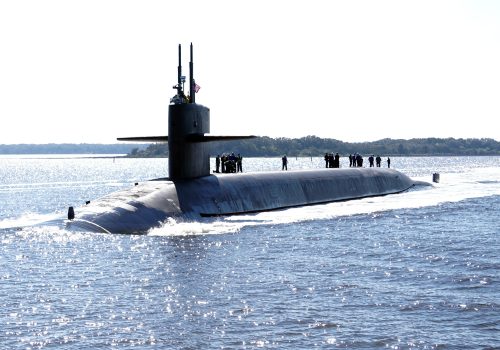
The specter of Russian tactical nuclear de-escalation strikes, more sophisticated Chinese ballistic-missile submarines, and intercontinental North Korean capabilities all raise the stakes for nuclear deterrence. US policy makers must decide which nuclear posture will allow the United States to credibly deter nuclear war while assuring its allies and partners across the globe.
Content
In the News

Aug 27, 2023

Garlauskas quoted in Nikkei during 2023 USSTRATCOM Deterrence Symposium

On August 26, Markus Garlauskas was quoted in Nikkei Asia for his statements during the 2023 USSTRATCOM Deterrence Symposium. He explained, “Despite the repeated signals from Russia that it may use tactical nuclear weapons in Ukraine, the most likely place where a nuclear conflict could take place is the Korean Peninsula.” His comments in this […]

Arms Control China

In the News

Aug 26, 2023

Garlauskas quoted globally on new report

This week, Markus Garlauskas’ commentary on the risks of simultaneous conflict and limited nuclear attacks in East Asia, recently published in his new longform report, have been featured in US publications RealClear Defense and Daily Press as well as across international media outlets, including Newtalk, Sky News, MGROnline, and Defence Connect.

China Crisis Management

New Atlanticist

Aug 18, 2023

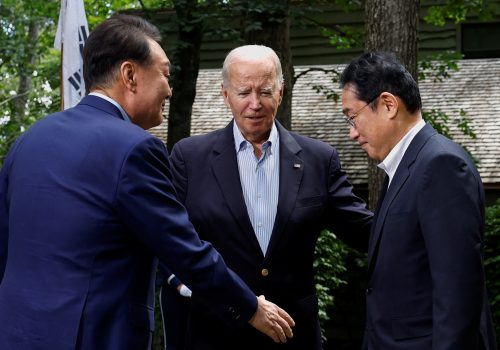
Experts react: The US-Japan-South Korea summit was ‘historic.’ But what did it accomplish?

By Atlantic Council experts

President Joe Biden, Prime Minister Fumio Kishida, and President Yoon Suk Yeol set forward a common security agenda at Camp David. Atlantic Council experts share their insights on what's next.

China East Asia

Report

Aug 16, 2023

The United States and its allies must be ready to deter a two-front war and nuclear attacks in East Asia

By Markus Garlauskas

This report highlights two emerging and interrelated deterrence challenges in East Asia with grave risks to US national security: 1) Horizontal escalation of a conflict with China or North Korea into simultaneous conflict; 2) Vertical escalation to a limited nuclear attack by either or both adversaries to avoid conceding.

Arms Control China

Issue Brief

Aug 16, 2023

Biases blind us to the risk of Chinese military intervention in Korea

By Jonathan Corrado

This paper examines the historical record of cognitive biases, focusing on the US intelligence community’s failure to forecast PRC intervention in the Korean War, despite collecting information and evidence indicative of that outcome.

Arms Control China

In the News

Aug 5, 2023

Soofer on Voice of America Korea discussing US-Korea-Japan security cooperation

By Atlantic Council

Rob Soofer speaks on trilateral security cooperation between US, Korea, and Japan to deter North Korea and China

Indo-Pacific Japan

New Atlanticist

Aug 3, 2023

Congress should fund the nuclear sea-launched cruise missile

By Robert Soofer and Walter B. Slocombe

The deployment of SLCM-Ns would send a clear message to adversary and ally alike that the United States maintains the resolve and capabilities to respond to any foe’s nuclear use.

Nuclear Deterrence Security & Defense

New Atlanticist

Jul 19, 2023

Experts react: South Korea embarks on a new nuclear era. How will it play out?

By Atlantic Council experts

US and South Korean officials just met in Seoul for the inaugural meeting of the Nuclear Consultative Group, a new bilateral platform to coordinate deterrence against a North Korean nuclear attack.

Crisis Management East Asia

In the News

Jul 16, 2023

Rich Outzen joins i24News to discuss the escalation in the Gulf

Maritime Security Middle East

New Atlanticist

Jul 11, 2023

Europe needs a nuclear deterrent of its own

By Jacques Lanxade, Denis MacShane, Margarita Mathiopoulos, and Klaus Naumann

Only a trilateral British, French, and German nuclear umbrella, combined with a US umbrella, all under the command and control of NATO, will be a credible deterrent for Russia.

Defense Policy Europe & Eurasia

Experts