The Cyber Statecraft Initiative works at the nexus of geopolitics, technology, and security to craft strategies to help shape the conduct of statecraft and to better inform and secure users. This work extends through the competition of state and non-state actors, the security of the internet and computing systems, the safety of operational technology and physical systems, and the communities of cyberspace. The Initiative convenes a diverse network of passionate and knowledgeable contributors, bridging the gap among technical, policy, and user communities.


Our work
The Atlantic Council Technology Programs comprises five existing efforts—the Digital Forensic Research Lab (DFRLab), the GeoTech Center, the Cyber Statecraft Initiative, the Democracy + Tech Initiative, and the Capacity Building Initiative. These operations work together to address the geopolitical implications of technology and provide policymakers and global stakeholders necessary research, insights, and convenings to address challenges around global technology and ensure its responsible advancement.

Team

Fellows

Publications

New Atlanticist

Jan 7, 2020

US-Iran in crisis: Strategic ambiguity and loud weapons in cyberspace

By Simon Handler, Katherine Wolff, Will Loomis

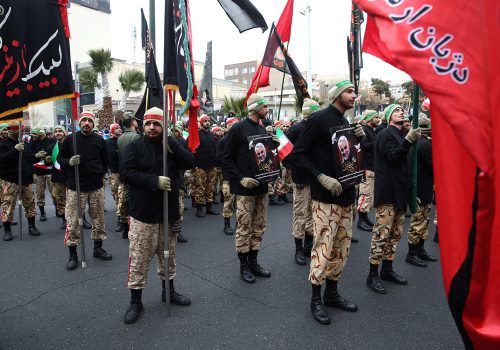
Iran’s government will feel the need to retaliate against the United States, but it does not wish to ignite a prolonged war with the United States. The regime’s near-term aim is to demonstrate to its domestic and regional constituencies that it has the capability and the resolve to avenge Soleimani’s killing and, more strategically, to drum up support for hardliners ahead of legislative elections next month. While Iran has a number of options available, its cyber toolkit not one to be overlooked.

Cybersecurity Iran

In the News

Jan 3, 2020

Herr quoted in Cheddar on Iranian threat to U.S. grid

By Atlantic Council

Cybersecurity Disinformation

Blog Post

Dec 16, 2019

Cyber 9-12: A training ground for future leaders

By Ben Ballard, Melanie Barlow, Jackie Faselt, and Andrew Seligson

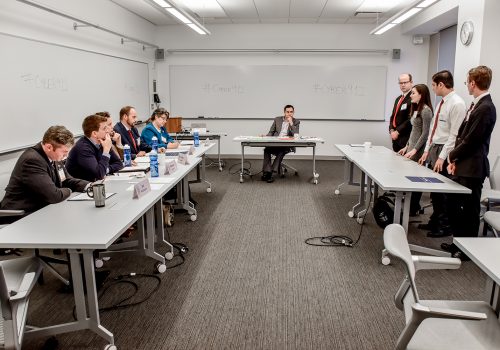
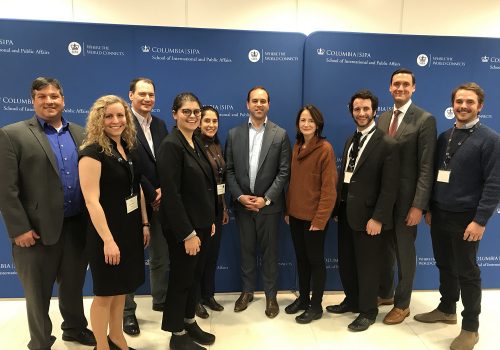
Given the rapidly changing threat environment, cybersecurity is both a grand puzzle and a Sisyphean task. This year’s New York Challenge, hosted at Columbia SIPA with a scenario co-developed by the Atlantic Council, SIPA, and New York City Cyber Command, was a fascinating blend of these challenges.

Cybersecurity

Press Release

Dec 11, 2019

Atlantic Council releases new report: Aviation cybersecurity: Scoping the challenge

By Atlantic Council

Report marks the first-ever global stakeholder survey on addressing cybersecurity issues in aviation sector WASHINGTON, DC – December 11, 2019 – Today, the Atlantic Council’s Cyber Statecraft Initiative, within the Scowcroft Center for Strategy and Security, launched a new report titled “Aviation Cybersecurity: Scoping the Challenge” and the results of the first-ever global survey on […]

Cybersecurity

Report

Dec 11, 2019

Aviation cybersecurity: Scoping the challenge

By Pete Cooper, Simon Handler, Safa Shahwan Edwards

The digital attack surface the aviation sector presents to its adversaries continues to grow in such a way that both managing risk and gaining insight on it remain difficult. With emerging technologies like machine learning and fifth-generation (5G) telecommunications seeing wider adoption—alongside electric vertical takeoff and landing (eVTOL), autonomous aircraft, and increased use of space—aviation-cybersecurity risk management is on the cusp of becoming more complex.

Cybersecurity Infrastructure Protection

Press Release

Dec 4, 2019

Atlantic Council’s Cyber 9/12 Strategy Challenge returns to London for its third year

By Atlantic Council

BT Tower to host the competition, as British Telecom returns as Strategic Partner WASHINGTON, DC – December 4, 2019 –  The Atlantic Council’s Cyber Statecraft Initiative is hosting the third annual Cyber 9/12 Strategy Challenge in London on February 17-18, 2020. The competition will once again take place at BT Tower with our 2020 Strategic […]

Cybersecurity

Issue Brief

Nov 22, 2019

What do we know about cyber escalation? Observations from simulations and surveys

By Benjamin Jensen and Brandon Valeriano

Do cyber operations alter how states respond to international crises in a way that creates incentives for decision makers to cross the Rubicon and use military force to settle disputes? This question is central to current cyber strategy debates and the idea of persistent engagement and defending forward in cyberspace. The answer is surprising: no. Based on the evidence, cyber operations offer a valuable escalatory offramp.

Cybersecurity

In the News

Nov 4, 2019

Handler in Nextgov: The zero-day war? How cyber is reshaping the future of the most combustible conflicts

By Atlantic Council

Israeli-Saudi security cooperation quietly incubated over mutual intolerance toward an expansionist Iran is blossoming into a gradually open relationship, with cyber at its heart. Bonds such as these, forged behind closed doors, provide options for de-escalatory approaches to regional conflict.

Cybersecurity Israel

Conflict, Risk, and Tech

Oct 28, 2019

The zero-day war? How cyber is reshaping the future of the most combustible conflicts

By Simon Handler

Conventional wisdom would suggest that scaled-up capabilities, growing competition, and the proliferation of malware across cyberspace presents a legitimate risk of escalation in state conflict, transcending the cyber domain toward the kinetic. However, recent history has shown that states have more often availed themselves of their offensive cyber arsenals to achieve surprisingly de-escalatory effects.

Cybersecurity Iran

New Atlanticist

Oct 9, 2019

How governments can use cyber tools irresponsibly to preserve power

By Safa Shahwan

The Kazakh case serves as an example of irresponsible cyber statecraft, when governments use cyberspace and technological tools to achieve specific political goals, placing the rights of citizens, as well as their political legitimacy, on the line.

Central Asia Cybersecurity

The Atlantic Council’s Cyber Statecraft Initiative, part of the Atlantic Council Technology Programs, works at the nexus of geopolitics and cybersecurity to craft strategies to help shape the conduct of statecraft and to better inform and secure users of technology.

Licensing CSI Graphics

All original graphics created by the Cyber Statecraft Initiative (CSI) are available for re-use under the following conditions:

  • Written permission must be granted by CSI.
  • Graphics may be copied and distributed in any medium or format in unadapted form only, for noncommerical purposes, and only so long as attribution is given.1Language based on Creative Commons CC BY-NC-ND 4.0
  • The attribution must reference the Cyber Statecraft Initiative and include a link to the content.
  • CSI cannot grant permission for the use of images or graphics licensed from third parties.