Afghanistan

Afghanistan has long struggled with instability, terrorism, and conflict. The withdrawal of US and NATO forces after twenty years of war leaves it at an even more perilous juncture. As the Taliban takes control of the country, the pressure is mounting on regional powers and the global community to help stabilize Afghanistan for the sake of their own interests as well as those of the Afghan people.

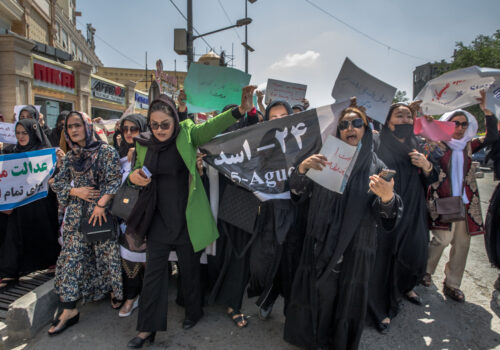
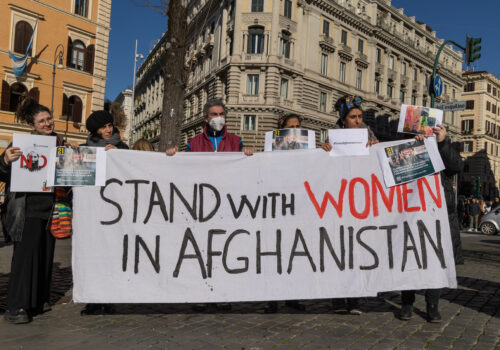
After the Taliban’s return to power on August 15, 2021, women in Afghanistan are treated as second-class citizens, systematically stripped of their rights. Over eighty decrees issued by the Taliban confine women to their homes and ban girls from attending school, turning Afghanistan into a prison for women and girls.

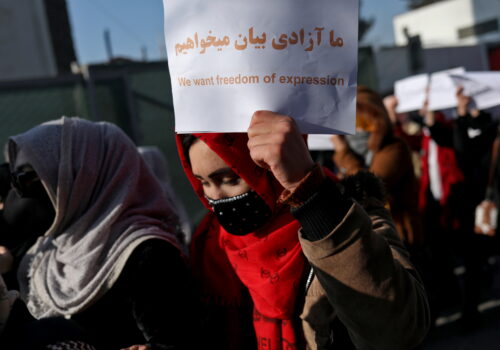
This gender apartheid is reinforced by new educational curricula and severe restrictions on women’s participation in every aspect of society. Women’s protests against these injustices have been met with harsh repression, including imprisonment, torture, and accusations of being influenced by foreign entities.

Inside the Taliban’s gender apartheid, a joint project of the Civic Engagement Project and the Atlantic Council’s South Asia Center, highlights the stories of women who have courageously resisted these injustices—women who have endured imprisonment and brutality for their peaceful demands for basic rights. By refusing to remain silent and shedding light on the violence they face, their testimonies serve as evidence in the fight for justice.

The women who have survived this regime are now calling for international recognition of the Taliban’s gender apartheid as a crime against humanity. This recognition would not only validate their suffering but could also challenge the Taliban’s grip on power and pave the way for transitional justice, offering a potential path to healing and justice for Afghan women and girls. 
The South Asia Center is the hub for the Atlantic Council’s analysis of the political, social, geographical, and cultural diversity of the region. ​At the intersection of South Asia and its geopolitics, SAC cultivates dialogue to shape policy and forge ties between the region and the global community.
Content

New Atlanticist

Apr 23, 2009

Optimism on Afghanistan

By James Joyner

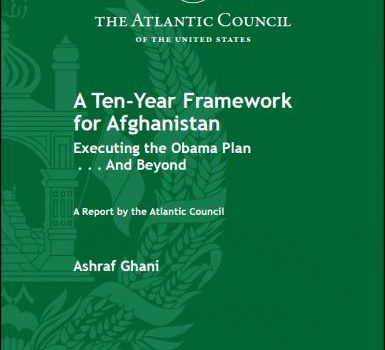
This afternoon, Ashraf Ghani, former Afghan finance minister and member of the Atlantic Council International Advisory Board and Strategic Advisors Group, unveiled his report “A Ten-Year Framework for Afghanistan: Executing the Obama Plan and Beyond.”

Afghanistan

Transcript

Apr 22, 2009

Ghani, Ashraf — Transcript

FREDERICK KEMPE:  Welcome to everyone.  For those of you who don’t know, I’m Fred Kempe, president and CEO of the Atlantic Council.  And I say that partly because we record, so it shows up, then, on the transcript, and people will then Google and – let me, first of all, tell you what an honor […]

Afghanistan Pakistan
AfghanistanReportCover

Report

Apr 22, 2009

Afghanistan report: A ten-year framework for the future

Describing the situation in Afghanistan and Pakistan as increasingly perilous, President Obama has committed his administration to enhancing the military, governance, and economic capacity of the two countries.  Chairman of the Institute for State Effectiveness and former Afghan Minister of Finance Dr. Ashraf Ghani outlines a medium-term framework for state-building in Afghanistan for the Atlantic Council […]

Afghanistan Politics & Diplomacy

New Atlanticist

Apr 17, 2009

NATO Supply Route Through Caucasus Needed

By Tamerlan Vahabov

Instability along the Afghanistan-Pakistan border is making alternative supply routes for NATO troops increasingly necessary.

Afghanistan NATO

Transcript

Apr 14, 2009

Transcript: Afghanistan, Pakistan, and Obama – Discussions on the New Strategy

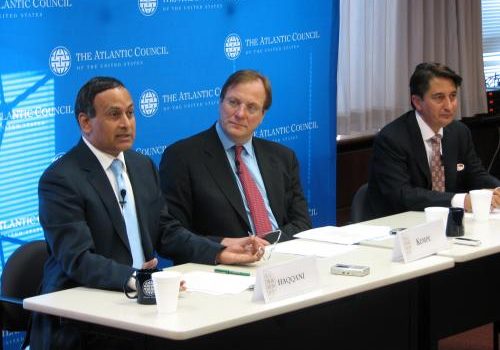
Transcript by Federal News Service, Washington, DC. FREDERICK KEMPE:  Gentlemen, you’ve attracted a crowd.  Good afternoon and welcome to this ambassadorial discussion at the Atlantic Council.  I’m Fred Kempe, president and CEO of the Atlantic Council.  We’re delighted to welcome Ambassador Husain Haqqani of the Embassy of Pakistan and Ambassador Said Jawad of the Embassy […]

Afghanistan Pakistan
AfPak Ambassadors

New Atlanticist

Apr 10, 2009

AfPak: One Theater, Two Countries

By James Joyner

The Obama administration has brought a new emphasis to its predecessor’s policy of treating the fight against militants in the Afghanistan-Pakistan border region as part of single theater.  As a joint Atlantic Council appearance of the two ambassadors makes clear, however, it would be wise to remember that they are in fact two countries.

Afghanistan Pakistan

New Atlanticist

Apr 7, 2009

Afghanistan after the NATO Summit: A Stronger Alliance or a Quick Fix?

By Valerie Nichols

NATO’s 60th Anniversary Summit ended with a cheerful photo-op and a pleased President Obama.  America’s NATO allies have pledged 5,000 more troops for Afghanistan and a lot of cash.  But is this a real contribution to bolstering the alliance or simply a vocal display of camaraderie?

Afghanistan NATO

New Atlanticist

Mar 30, 2009

Obama: Need to Refocus on Al Qaeda

By James Joyner

President Obama told CBS’ “Face the Nation” that the Bush administration had lost its focus in Afghanistan and that his team will “refocus attention on al Qaeda.”

Afghanistan

New Atlanticist

Mar 28, 2009

Obama’s Afghanistan Plan: What’s So New About It?

By James Joyner

President Obama’s new strategy for Afghanistan and Pakistan has won the backhanded praise of Hamid Karzai, who termed it “better than we were expecting.”  Gordon Brown has lauded the plan as well and called for NATO to do more.

Afghanistan NATO

New Atlanticist

Mar 27, 2009

New Afghanistan Plan: Still No Exit Strategy

By James Joyner

President Obama gave a speech this morning outlining his new strategy for Afghanistan and Pakistan, which served as the unveiling of a (slightly) more detailed white paper [PDF].

Afghanistan Pakistan

Experts