Atlantic Council blogs

Atlantic Council blogs provide short-form analyses from Council experts and a wider community of global voices on the world’s most important news stories.
View all
of our blogs
Subscribe to our
newsletters

Latest from across our blogs

New Atlanticist

Jan 8, 2020

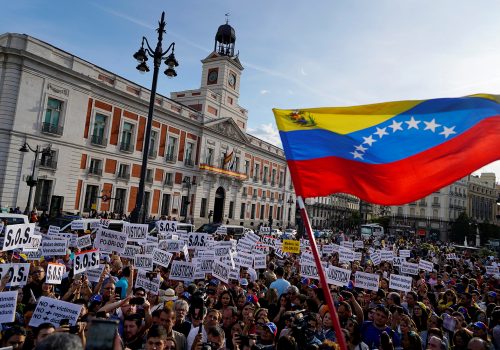
After Maduro’s latest ploy, what’s next for the Venezuelan opposition?

By Jasper Gilardi

"The images of Juan Guaidó and other democratically-elected members of the National Assembly being physically barred from entering the assembly building was visible proof of how far Nicolás Maduro is willing to go to deny any semblance of democracy in Venezuela," Jason Marczak says.

Civil Society Corruption

IranSource

Jan 8, 2020

Both the United States and Iran proved their points. Now they need to de-escalate tensions

By Robert Czulda

After Trump’s press conference, there are some good reasons to be optimistic and believe that both sides will remain restrained. However, on the other hand, in the Middle East restraint is very often seen not as a virtue, but as a sign of weakness which has to be exploited by one’s enemies.

Conflict Iran

New Atlanticist

Jan 8, 2020

De-escalation still possible after Iran’s missile retaliation

By Atlantic Council

Iran avoided a central US red line, and "therefore, the Trump administration will have the opportunity to test Iranian claims that they truly do not seek any further escalation," Will Wechsler says.

Conflict Iran

New Atlanticist

Jan 8, 2020

Iran’s missiles may have avoided the worst outcome

By Thomas S. Warrick

If there had been significant US casualties, the world would have awoken to the dawn of a regional war, because the Trump administration would have been compelled to attack the launch sites in Iran—and probably other targets in Iran, also. If the present news holds, the situation is slightly less dangerous, if still perilous.

Conflict Geopolitics & Energy Security

New Atlanticist

Jan 8, 2020

Washington and Tehran can step back – if they want to

By William F. Wechsler

After the January 8 Iranian missile attacks on Iraq, a successful tactical de-escalation requires both that the Iranian leadership intends for its military actions not to be escalatory and that the Trump administration perceives those actions as they were intended. In the absence of direct communications between the United States and Iran, however, the potential for misunderstanding and thus the risk of miscalculation remains high.

Conflict Geopolitics & Energy Security

New Atlanticist

Jan 7, 2020

US-Iran in crisis: Strategic ambiguity and loud weapons in cyberspace

By Simon Handler, Katherine Wolff, Will Loomis

Iran’s government will feel the need to retaliate against the United States, but it does not wish to ignite a prolonged war with the United States. The regime’s near-term aim is to demonstrate to its domestic and regional constituencies that it has the capability and the resolve to avenge Soleimani’s killing and, more strategically, to drum up support for hardliners ahead of legislative elections next month. While Iran has a number of options available, its cyber toolkit not one to be overlooked.

Cybersecurity Iran

New Atlanticist

Jan 7, 2020

With crisis over, Greek PM says Athens is ready “to punch above our weight”

By David A. Wemer

With its new robust regional and international role, Mitsotakis argued that Greece is a “very reliable and dependable partner” for the United States at a time of incredible global instability. With the dark days of economic crisis behind them, it is now time for Athens and Washington, he said “to set a new, more ambitious target in terms of what we can achieve.”

Greece Macroeconomics

MENASource

Jan 7, 2020

Israelis questioning US’ Middle East strategy after Soleimani strike

By Shalom Lipner

Of still greater consequence is what Trump resolves to do, or not do, in the weeks and months ahead. Israel and other Middle Eastern states have long entreated the US, with its advanced capabilities and global footprint, to lead the effort to bring Iran to heel.

Israel Politics & Diplomacy

IranSource

Jan 7, 2020

Hope for the Iran nuclear deal is not completely lost

By Kelsey Davenport

Iran’s fifth violation of the JCPOA is serious, but not necessarily a death blow to the nuclear deal. If Tehran acts with restraint and refrains from restarting particularly troublesome nuclear activities, there may be a narrow window for the P4+1 to preserve the deal.

Iran Nuclear Nonproliferation

New Atlanticist

Jan 7, 2020

The 11th hour transit deal is a relief for European energy consumers and a pivotal opportunity for Ukraine’s future energy strategy

By Olga Khakova

The Naftogaz agreement with Gazprom is a cautious win for Ukraine, the agreement buys time for the country to reform its energy sector, which will be critical for Ukraine’s energy security, regardless of future contracts with Gazprom.

Energy Markets & Governance Geopolitics & Energy Security