
Financial Sanctions and Economic Coercion

Financial sanctions and other forms of economic coercion have become policy tools of choice for the US government to deter illegal activity by international actors or to pressure governments into reversing actions that harm US interests. Yet these instruments and their potential pitfalls are often misunderstood. Restrictive economic measures such as financial sanctions, export controls, tariffs, and investment screening can play an important role in advancing certain policy objectives, but they risk being ineffective if misapplied or poorly implemented. Policymakers must also recognize the impact of economic statecraft on the private sector, which bears many of the compliance burdens and operational costs associated with these measures.

Energy Sanctions Dashboard

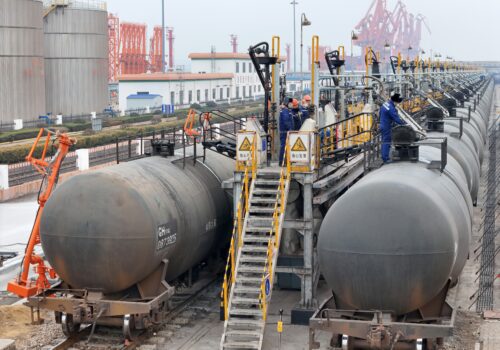
This dashboard focuses on US sanctions and restrictive measures placed on crude oil from Russia, Iran, and Venezuela—including the unintended consequences and the lessons learned.

Econographics

Apr 17, 2025

Russia Sanctions Database

By Kimberly Donovan, Maia Nikoladze, Lize de Kruijf

The Atlantic Council’s Russia Sanctions Database tracks the level of coordination among Western allies in sanctioning Russian entities, individuals, vessels, and aircraft, and shows where gaps still remain.

Eastern Europe Economy & Business

Recent analysis

Programs

At the intersection of economics, finance, and foreign policy, the GeoEconomics Center is a translation hub with the goal of helping shape a better global economic future.

Content

Event Recap

Dec 8, 2016

Rethinking Eritrea

By Africa Center

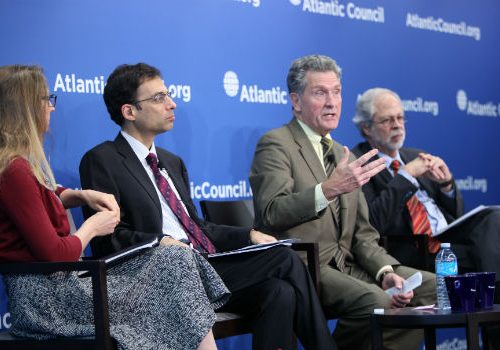
On Thursday, December 8, the Atlantic Council’s Africa Center launched two new publications on Eritrea. The first, Eritrea’s Economy: Ideology and Opportunity, authored by fragile states expert Seth Kaplan, examines the nexus between the ideology of Eritrea’s leadership and the country’s struggling economy. The second, Eritrea: Coming In from the Cold, authored by Africa Center […]

Africa East Africa

Report

Dec 7, 2016

Eritrea’s economy: Ideology and opportunity

By Seth Kaplan

Eritrea is often in the news for all the wrong reasons: its high rates of migration to Europe (it has sent more refugees to Europe in recent years than any other African nation), its conflicts with neighboring Ethiopia and Djibouti, and controversy over its mandatory and indefinite national service conscription program. Human rights activists, in […]

Africa East Africa

Issue Brief

Dec 7, 2016

Eritrea: Coming in from the cold

By Bronwyn Bruton

Eritrea has long been stigmatized as a regional “spoiler” by Washington, and despite little evidence of wrongdoing, the country remains under Security Council sanctions for supporting terrorist groups in Somalia. Now is the time to rethink that relationship, argues Atlantic Council Africa Center Deputy Director Bronwyn Bruton in a new issue brief entitled “Eritrea: Coming […]

Africa Civil Society

Issue Brief

Dec 7, 2016

Eritrea: Coming in from the cold

By Bronwyn Bruton

trea has long been stigmatized as a regional “spoiler” by Washington, and despite little evidence of wrongdoing, the country remains under Security Council sanctions for supporting terrorist groups in Somalia.

Africa Civil Society

Report

Dec 6, 2016

Evaluating Western Sanctions on Russia

By Sergey Aleksashenko

It has been more than two years since the European Union (EU) and the United States imposed economic sanctions on Russia for its aggression in Ukraine. For some of the measures that is time enough to evaluate effectiveness. “The sanctions’ greatest achievement is that they have been an important demonstration of transatlantic unity. Still, there […]

Conflict Defense Policy

EconoGraphics

Sep 30, 2016

Myanmar: Post-Sanctions Landscape

By Filippos Letsas

On the occasion of Myanmar’s State Counselor Aung San Suu Kyi’s recent visit to the United States (U.S.), President Obama announced that executive sanctions on Myanmar would soon be lifted. This will grant Myanmar greater access to the U.S. market and encourage U.S. companies to invest in the country. Trade between the two countries remains at relatively low levels (i.e. $225 million in 2015), with U.S. investment to Myanmar accounting for only 0.2% of the country’s Foreign Direct Investment (FDI).

Economy & Business Financial Sanctions and Economic Coercion

EconoGraphics

Jun 1, 2016

Not The Time to Falter: Economic Sanctions Against Russia

By Alvaro Morales Salto Weis

As the European Union (EU) prepares to unanimously extend its economic sanctions on Russia when they expire on July, it is a good opportunity to take a closer look. After Russia´s illegal annexation of Crimea and interference in Eastern Ukraine, the U.S. and the EU enacted economic sanctions in a coordinated manner, which were followed by other Allies and partners like Canada and Australia.

Economy & Business Europe & Eurasia

Issue Brief

May 11, 2016

Congo blues: Scoring Kabila’s rule

By Pierre Englebert

Across Africa, leaders are tinkering with term limits and prolonging their tenures. In an increasingly unstable Central African region, Joseph Kabila, President of the Democratic Republic of the Congo (DRC), appears poised to be the next African leader to sidestep the relinquishing of power and the election of his successor, constitutionally mandated for November 2016. […]

Africa Civil Society

Issue Brief

Apr 4, 2016

Securing Ukraine’s energy sector

By Anders Åslund

2015 brought important reforms to Ukraine, particularly in the energy sector. What are the the promises kept and broken by the Post-Maidan government in Ukraine?

Energy & Environment Energy Markets & Governance

EconoGraphics

Jan 21, 2016

Feeling the Oil Crunch

By Global Business and Economics

Oil prices have fallen to their lowest since 2003, sitting under $30 a barrel in recent days. Declining expectations of global growth plus the addition of post-sanction Iranian supply don’t spell a substantial price recovery in the immediate future. Under this new market realities, oil-exporting countries come in different form to weather the storm.

Economy & Business Financial Sanctions and Economic Coercion

Experts