
Financial Sanctions and Economic Coercion

Financial sanctions and other forms of economic coercion have become policy tools of choice for the US government to deter illegal activity by international actors or to pressure governments into reversing actions that harm US interests. Yet these instruments and their potential pitfalls are often misunderstood. Restrictive economic measures such as financial sanctions, export controls, tariffs, and investment screening can play an important role in advancing certain policy objectives, but they risk being ineffective if misapplied or poorly implemented. Policymakers must also recognize the impact of economic statecraft on the private sector, which bears many of the compliance burdens and operational costs associated with these measures.

Energy Sanctions Dashboard

This dashboard focuses on US sanctions and restrictive measures placed on crude oil from Russia, Iran, and Venezuela—including the unintended consequences and the lessons learned.

Econographics

Apr 17, 2025

Russia Sanctions Database

By Kimberly Donovan, Maia Nikoladze, Lize de Kruijf

The Atlantic Council’s Russia Sanctions Database tracks the level of coordination among Western allies in sanctioning Russian entities, individuals, vessels, and aircraft, and shows where gaps still remain.

Eastern Europe Economy & Business

Recent analysis

Programs

At the intersection of economics, finance, and foreign policy, the GeoEconomics Center is a translation hub with the goal of helping shape a better global economic future.

Content

In the News

May 14, 2022

Slavin joins AlHurra to discuss the diplomatic obstacles facing Iran and the US amidst nuclear talks

By Atlantic Council

Arabic Economy & Business

In the News

May 13, 2022

Slavin joins Voice of America to the US-Iran nuclear deal

By Atlantic Council

Americas Financial Sanctions and Economic Coercion

In the News

May 13, 2022

Slavin quoted in Al Jazeera on the diplomatic implications of US blacklisting of Iran’s Islamic Revolutionary Guard Corps on US-Iran nuclear talks

By Atlantic Council

Financial Sanctions and Economic Coercion Iran

In the News

May 13, 2022

Mohseni-Cheraghlou interviewed by CBC News on Russia halting of gas exports to Poland and Bulgaria, and what it could mean for EU economies

Watch the full interview here.

Economy & Business Europe & Eurasia

BelarusAlert

May 11, 2022

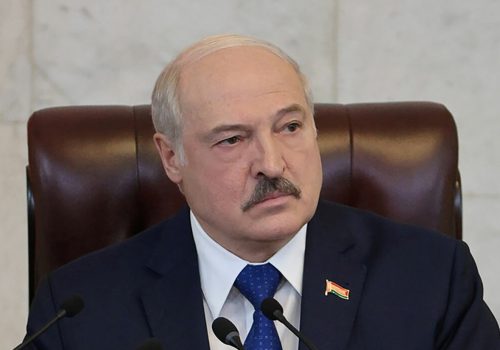
The Belarusian dictator’s dilemma

By Brian Whitmore

Belarus dictator Alyaksandr Lukashenka appears to recognize that Vladimir Putin's Ukraine War is going disastrously wrong and is desperate to distance himself but he remains completely dependent on the Kremlin.

Belarus Conflict

In the News

May 10, 2022

Slavin quoted in Al Monitor on developing Iran-Saudi relations and it’s impact on nuclear talks

By Atlantic Council

Financial Sanctions and Economic Coercion Iran

EconoGraphics

May 9, 2022

Global Sanctions Dashboard: Russia and beyond

By Charles Lichfield, Maia Nikoladze, Sophia Busch and Castellum.AI

Checking the pulse of the Russian economy; Africa’s illicit gold trade, North Korea’s missile tests, and recent cyber sanctions.

Africa Conflict

In the News

May 9, 2022

Kumar quoted in S&P Global on how CBDCs can minimize sanction evasion

Read the full article here

Digital Currencies Digital Policy

Britain Debrief

May 8, 2022

#BritainDebrief – Which Western leaders have done enough for Ukraine? A Debrief from Kira Rudik

By Ben Judah

Senior Fellow Ben Judah interviews Kira Rudik, member of the Ukrainian Parliament and leader of the Voice Party, about which of Ukraine's allies have helped the most.

Arms Control Central Europe

UkraineAlert

May 6, 2022

Countering the Kremlin: America must not wait for European unity

By Olexander Scherba

Vladimir Putin's ongoing invasion of Ukraine marks the culmination of Russia’s long campaign to corrupt Europe. The EU condemns the war while at the same time sponsoring it, writes Olexander Scherba.

Conflict Corruption

Experts