Scowcroft Center Commentary, Analysis, & Reports

Explore the Scowcroft Center for Strategy and Security’s latest insights, commentary, articles, media hits, and in-depth reports

All commentary & analysis

Dispatches

Jun 22, 2026

The Ankara summit is an opportunity for NATO to ramp up engagement with its southern neighborhood

By Jason Davidson, Matt Trunkey

The Alliance can use the upcoming summit in Turkey to advance four policies that will help it increase its security along its south.

Europe & Eurasia Maritime Security

Timely Commentary & Analysis

Jun 21, 2026

Braw in The Sunday Post on ‘phoney’ conflict with Russia

By Elisabeth Braw

On June 21, Transatlantic Security Initiative senior fellow Elisabeth Braw was mentioned in an article by The Sunday Post discussing whether NATO is already at war with Russia.

Europe & Eurasia Security & Defense

Issue Brief

Jun 18, 2026

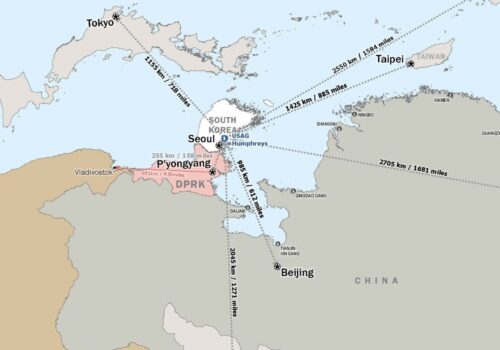
The case for a US Northeast Asia Command

By Christopher Lee, Ben Blane, and Markus Garlauskas

To maximize its deterrent and warfighting effectiveness in the Indo-Pacific region, the United States must reform its military command-and-control structure in Northeast Asia.

Arms Control East Asia

Timely Commentary & Analysis

Jun 18, 2026

Braw in DW News on the disappearance of Anatol Kotau

By Elisabeth Braw

On June 18, Transatlantic Security Initiative senior fellow Elisabeth Braw was interviewed by DW News to discuss the disappearance of Lukashenko critic, Anatol Kotau, in Russian territorial waters.

Europe & Eurasia Security & Defense

Dispatches

Jun 17, 2026

NATO’s southern flank is exposed. Portugal can help fortify it.

By Randi Charno Levine

The Alliance was not designed to focus only on its easter flank. Vulnerabilities to NATO’s south are accumulating faster than strategy is adapting.

Maritime Security NATO

Timely Commentary & Analysis

Jun 17, 2026

Braw in Financial Times on the threat of private subsea cables

By Elisabeth Braw

On June 17, Transatlantic Security Initiative senior fellow Elisabeth Braw published an article in Financial Times on how American hyperscalers are creating a national security risk for other countries be building their own subsea cables.

Europe & Eurasia Maritime Security

Timely Commentary & Analysis

Jun 17, 2026

Braw in Foreign Policy on the effects of the uncertainty of the Iran ceasefire on shipping

By Elisabeth Braw

On June 17, Transatlantic Security Initiative senior fellow Elisabeth Braw published an article in Foreign Policy on how the uncertainty of the Trump administration’s ceasefire in Iran has not alleviated the constraints on shipping through the Strait of Hormuz.

Maritime Security Middle East

Timely Commentary & Analysis

Jun 16, 2026

Braw in [Re]Group on how a new United Nations Secretary General will inherit the problem of protecting undersea infrastructure

By Elisabeth Braw

On June 16, Transatlantic Security Initiative senior fellow Elisabeth Braw was featured on [Re]Group to discuss what a new United Nations Secretary General can do to protect critical undersea infrastructure.

Critical Infrastructure Policy

Timely Commentary & Analysis

Jun 16, 2026

Braw in France24 on a joint British-French mission to restart shipping in the Strait of Hormuz

By Elisabeth Braw

On June 17, Transatlantic Security Initiative senior fellow Elisabeth Braw was mentioned in France 24 about a joint British-French mission to help restart shipping in the Strait of Hormuz.

Maritime Security Middle East

Dispatches

Jun 12, 2026

The United States needs more amphibious ships at the ready

By Caleb Eames, Amy Cowley

A combined Amphibious Ready Group and Marine Expeditionary Unit bring a tremendous capability, but only if there are enough ships available.

Maritime Security Security & Defense

AfricaSource

Jun 12, 2026

Somalia is the dark horse in US defense and economic strategy

By Maureen Farrell, Rose Keravuori

US policymakers have long viewed Somalia primarily through a counterterrorism lens. But as major maritime supply routes come under strain, its position along key sea lanes is reshaping its geopolitical relevance—and external actors like Turkey are already moving to capitalize.

Africa Security & Defense

In the News

Jun 12, 2026

Kroenig interviewed on BBC on Iran negotiations

By Atlantic Council

On June 11, Atlantic Council vice president and Scowcroft Center senior director Matthew Kroenig was interviewed on BBC about ongoing negotiations with Iran.

Iran Politics & Diplomacy

Dispatches

Jun 11, 2026

Don’t wait for a disaster to develop strong US counter-drone capabilities

By Peter Gautier

Security around the World Cup only underscores the need for wider efforts to ensure safety against the increasing risks from drones.

Drones Security & Defense

Issue Brief

Jun 11, 2026

To stop Chinese dual-use battery dominance, the United States and South Korea need to team up

By Joseph Webster, Alvin Camba, Emily E. Kim

Should China establish a global monopoly across battery supply chains, the military, strategic, and commercial implications for the US-ROK alliance will be profound.

China Critical Minerals
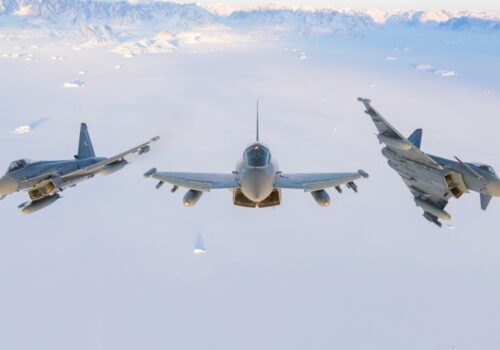
Cover Credit: NATO. German Air Force Eurofighter Typhoons fly over a remote stretch of Iceland while training with the Swedish Air Force as part of NATO’s Arctic Sentry activity. Arctic Sentry is a NATO vigilance activity aimed at enhancing security in the north, helping to make the Alliance safer. As part of this initiative, Sweden deployed a detachment of six Gripens to Keflavik Air Base to safeguard Icelandic airspace against threats or intrusions. Their deployment is also part of NATO’s Iceland Air Policing mission, marking the first time Sweden has led an air policing mission since joining NATO two years ago as its 32nd member. During their deployment, fighters from the Royal Danish Air Force and the German Air Force joined them for integration training. Situated in the middle of the North Atlantic, Iceland plays a vital role in helping Allies maintain situational awareness in the High North. Photo courtesy of the German Air Force.

Report

Jun 10, 2026

The future of NATO’s deterrence in the air domain

By Edward Brady

European NATO member states need to prepare to deter, and if necessary, defeat Russia—with less US support. When it comes to airpower, here are the actions European states need to take in the short, medium, and long term. 

Defense Policy Europe & Eurasia

Dispatches

Jun 9, 2026

NATO allies need a plan for addressing threats below the threshold of war

By Elisabeth Braw

NATO can gather allies to share best practices and also coordinate responses, even if the Alliance does not respond to subthreshold attacks itself.

Europe & Eurasia NATO

Timely Commentary & Analysis

Jun 5, 2026

Braw in UtilityWeek on Russian attacks on subsea infrastructure

By Elisabeth Braw

On June 5, Transatlantic Security Initiative senior fellow Elisabeth Braw was mentioned in an article by UtilityWeek discussing Russian attacks on British subsea infrastructure.

Europe & Eurasia Maritime Security

Podcast

Jun 5, 2026

The Matrix (1999)

By the Bipartisan Commission on Biodefense

In this episode of The Biollywood Podcast, the Director of the Bipartisan Commission on Biodefense at the Atlantic Council, Dr. Asha M. George, Associate Director for Research, J.T. O'Brien, and Associate Director for Government Relations and Policy, Robert Bradley, discuss the 1999 film, The Matrix, and its implications for the convergence of artificial intelligence and biological science.

In the News

Jun 4, 2026

Saab published in the Financial Times on Gulf support for Ukraine

By Atlantic Council

On June 4, Forward Defense nonresident senior fellow Bilal Saab published an article in the Financial Times, discussing the benefit of a counter-drone defense partnership between the Gulf states and Ukraine. He argues this partnership would benefit Gulf states by integrating advanced Ukrainian drone defense technology into existing systems and provide Ukraine with much-needed capital.  

Defense Policy Security & Defense

Dispatches

Jun 2, 2026

How will the Iran war change the US role in the world?

By Matthew Kroenig, Markus Garlauskas, and Beth Sanner

Atlantic Council experts weigh in on whether the United States should “pivot” its attention away from the Middle East and toward the Indo-Pacific.

China Indo-Pacific

Newsletter

Stay connected with us by signing up for our weekly newsletter “The Strategist” to be notified of all upcoming events, new publications, recent media hits, and exclusive updates within the Scowcroft Center:
The Scowcroft Center for Strategy and Security works to develop sustainable, nonpartisan strategies to address the most important security challenges facing the United States and the world.