Oil & Gas

Even in a more carbon-conscious world, oil and gas will continue to play a significant role in the global energy system. From petrochemicals to power generation, oil and gas technologies will be a central player in the “dual challenge” of meeting increased energy demand and the need for low-carbon energy, making oil and gas still critical for international trade, investment, and geopolitics.

Recent analysis

Programs

The Global Energy Center develops and promotes pragmatic and nonpartisan policy solutions designed to advance global energy security, enhance economic opportunity, and accelerate pathways to net-zero emissions.

Events

Global Energy Forum

Jan 11, 2020

Climate commitments needed to head off threats of volatility and instability

By Adal Mirza

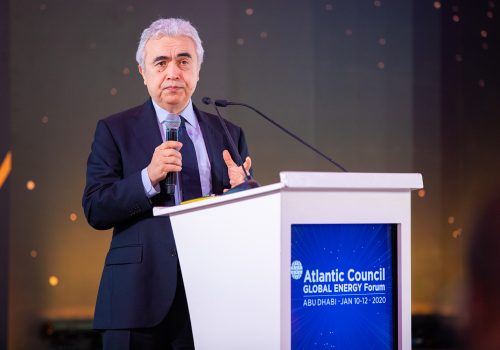
A widening gap between perceptions and reality of the global energy markets could increase volatility as governments, policy makers, and industries struggle to tackle climate change, according to Fatih Birol, the executive director of the International Energy Agency.

Climate Change & Climate Action Energy Markets & Governance

Global Energy Forum

Jan 9, 2020

International grid integration: Efficiencies, vulnerabilities, and strategic implications in Asia

By Phillip Cornell

In order to meet growing global demand for electricity, and in response to an increase in renewables, power networks and markets are evolving and becoming increasingly interconnected. South and Southeast Asia have already had some success with interconnections, and China’s vision and Belt and Road Initiative loom large in the region, but there are geopolitical concerns to contend with. Could a US model manage these concerns? What is the state of regional power markets in Asia and investment in regional grid infrastructure, and what responses are we already seeing to emerging trends?

Climate Change & Climate Action Energy Markets & Governance

Global Energy Forum

Jan 9, 2020

Energy sector diversification: Meeting demographic challenges in the MENA region

By Bina Hussein

The Middle East and North Africa (MENA) region is projected to experience significant demographic growth by 2050, growth which will have to be met with commensurate economic expansion and job opportunities, or the region will risk an increase in political instability. To meet this challenge, countries in the region must diversify their economies beyond the energy sector and expand their energy sector beyond hydrocarbons. What are the key trends that MENA countries will have to contend with, what is already being done, and what further steps should be taken?

Energy Markets & Governance Energy Transitions

Content

EnergySource

Mar 26, 2020

Stimulus bill’s lack of funding for the SPR and clean energy is a lose-lose for the country

By Randolph Bell

Not including $3 billion for purchase of crude for the Strategic Petroleum Reserve (SPR) or support for clean energy initiatives in the soon-to-be passed $2 trillion stimulus package is a missed opportunity and a lose-lose for US energy security and leadership on climate action.

Coronavirus Energy Markets & Governance

New Atlanticist

Mar 26, 2020

Dual demand and supply shocks have created historic oil crisis, IEA executive director says

By David A. Wemer

Dramatically lower oil demand due to the coronavirus pandemic and an emerging supply glut caused by the failure of major oil producers to cut production has slammed the global oil market with a crisis “unique in history,” according to Dr. Fatih Birol.

Climate Change & Climate Action Energy Markets & Governance

AfricaSource

Mar 25, 2020

Tough times ahead for African oil producers

By Luke Tyburski

The precipitous decline in oil prices related to the coronavirus pandemic will have significant economic knock-on effects in Africa. Central African producers look to be the most vulnerable, but the shocks will be felt everywhere.

Africa Angola

New Atlanticist

Mar 23, 2020

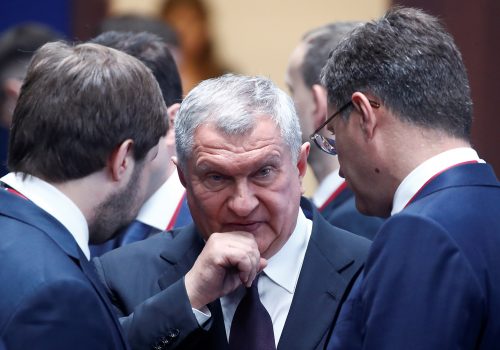
Russia is out of control: The dangerous Mr. Sechin

By Anders Åslund

Russia is out of control. All of a sudden, it has launched an oil price war, even though it is unrealistic that the Kremlin can defeat Saudi Arabia and the United States in such a contest. Saudi Arabia’s population is one-fifth of Russia’s, while holding equivalent international currency reserves. The United States is still a net oil importer, meaning that its economy benefits from low oil prices. Russia, by contrast, is a major oil exporter and is utterly dependent on high oil prices.

Corruption Oil and Gas

In the News

Mar 17, 2020

Cohen in Forbes: Central Asia needs a financing solution to low oil prices

By Atlantic Council

Central Asia Energy & Environment

EnergySource

Mar 12, 2020

Oil market meltdown?

By John Soughan

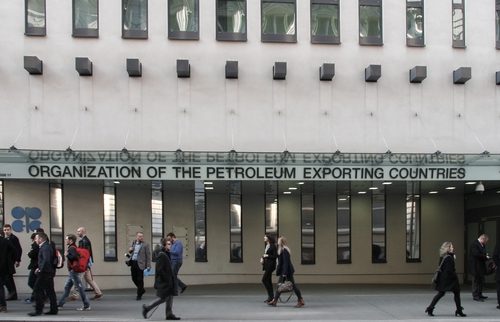
Over the weekend of March 7–8, the breakdown of the previous oil production agreement between Russia and Saudi Arabia led to the broader collapse of the arrangement between OPEC and OPEC+. What will the rift will mean for the global oil market?

Coronavirus Energy Markets & Governance

Event Recap

Mar 11, 2020

Atlantic Council press call: Oil market meltdown: Price wars, coronavirus, and energy geopolitics

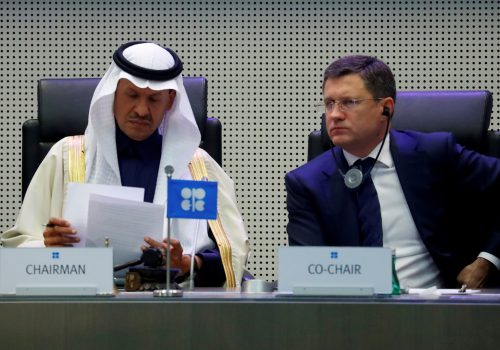
Last week’s breakdown of OPEC+ meetings in Vienna has turned a demand side driven decline in oil prices caused by the impacts of Coronavirus into an oil price war between two oil producing giants, with US shale production the ostensible target. If the standoff continues, however, the price war might ultimately do more harm to the Saudi and Russian economies. With increasing uncertainty about the depth of Coronavirus’ impact on global growth, the price war might also contribute to a sharp decline in the global economy. Helima Croft, David L. Goldwyn, Jean-Francois Seznec, Anders Aslund, and Randolph Bell discuss ongoing market volatility, the origins of the crisis, what’s next for US shale, and the implications of it all for energy and geopolitics
Coronavirus Energy & Environment

In the News

Mar 10, 2020

Katz quoted in Marketplace on oil prices and production

By Atlantic Council

Energy & Environment Energy Markets & Governance

New Atlanticist

Mar 9, 2020

Saudi Arabia and Russia feud over coronavirus oil response: Will everyone lose?

By David A. Wemer

"While Russia’s decision last week not to support OPEC’s proposal for a production cut and the subsequent oil price war—which as of publishing has pushed Brent crude down more than 9 percent—is surely part of the larger story of the economic impacts of the coronavirus outbreak, it is actually better understood as a geopolitical story about how US energy production growth has strengthened the United States’ international posture, which in turn has reshaped a number of global relationships," Randolph Bell says.

Coronavirus Energy Markets & Governance

In the News

Mar 6, 2020

Cohen in Forbes: OPEC+ talks collapse sending crude prices to 2017 lows

By Atlantic Council

Energy & Environment Oil and Gas

Experts

Events