About the center

The Rafik Hariri Center for the Middle East examines the barriers preventing many people in the region from reaching their fullest potential. Our work also highlights success stories of individuals and institutions who overcame significant challenges in pursuit of social, economic, and political progress. Inspired by these examples, we delineate practical and implementable policy recommendations that policymakers in the United States, Europe, and the Middle East can implement to unleash the region’s economic and human potential.

Featured commentary & analysis
Featured in-depth research & reports
Leadership

Subscribe to get the latest analysis straight to your inbox

Events

We convene the most important stakeholders on issues of primary concern to the transatlantic community when it comes the Middle East and North Africa, from senior US and Middle East government officials to civil society activists and budding entrepreneurs.

Past events

Content

SyriaSource

Jan 17, 2019

The influence of domestic politics on foreign policy in Syria

By Emily Burchfield

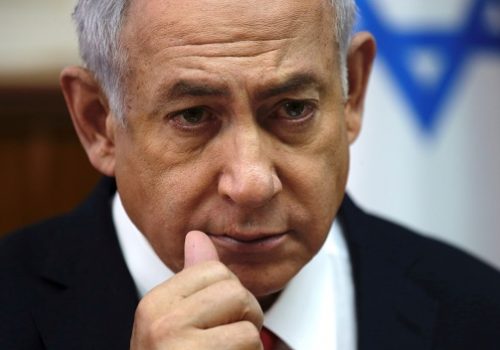
On January 13, Prime Minister Benjamin Netanyahu announced that Israeli forces attacked Iranian weapons warehouses in Damascus the day prior, confirming similar reports by Syrian state media. What is unusual about Netanyahu’s statement is not the content—indeed, Israeli officials previously acknowledged carrying out hundreds of strikes on thousands of Iranian targets in Syria—but the context. The announcement broke with a “policy of ambiguity” under which Israel refuses to claim responsibility immediately after a specific attack; the rationale being to safeguard against potential retaliation. 

Israel Syria

SyriaSource

Jan 15, 2019

Can anything be salvaged?

By Frederic C. Hof

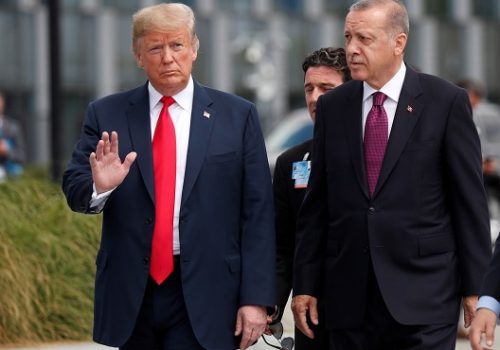
President Trump’s impulsive “out of Syria” tweet of December 19, 2018 may have sacrificed high value, low cost American leverage in eastern Syria for precisely nothing.  Russian, Iranian, and Assad regime alarm that the West would work with local Syrians in areas liberated from ISIS (ISIL, Daesh, Islamic State) to create the long-awaited governance alternative to Bashar al-Assad, family, and friends have all-but-evaporated. 

Syria

SyriaSource

Jan 11, 2019

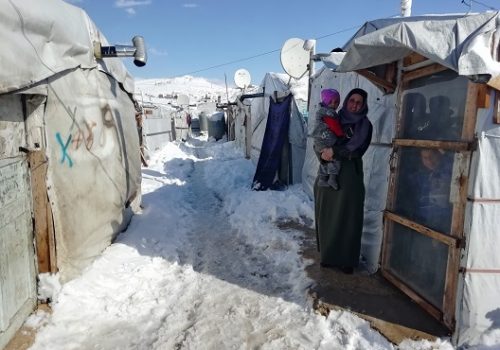
Winter storm in Arsal, Lebanon devastates vulnerable Syrian refugee communities

By Mohammad Abdulssattar Ibrahim, Tom Rollins, and Madeline Edwards from Syria Direct

A winter storm currently sweeping across the region has hit Lebanon hard, leaving tens of thousands of Syrian refugees in the country without proper assistance and shelter. While flooding has inundated and destroyed informal tent settlements dotting the fields and countryside of the Beqaa Valley—a mostly flat, agricultural lowland with Lebanese mountains to the west and the Syrian-Lebanese border to the east—conditions have been particularly poor in northeastern Lebanon’s Arsal region.

Middle East Syria

MENASource

Jan 10, 2019

Exploiting the achievements of the Libyan political agreement

By Karim Mezran and Wolfgang Pusztai

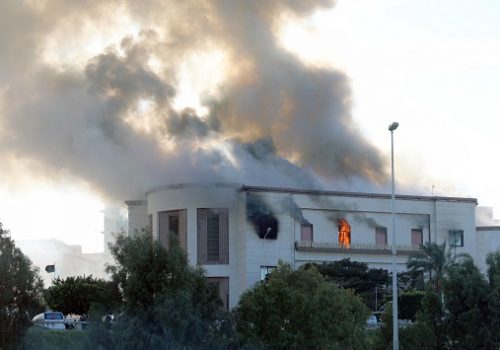
The conference on Libya held in Palermo, Italy last November saw neither the rising of a new dawn in terms of security and political consensus nor the development of a strong agreement around a well-defined plan.

Libya

SyriaSource

Jan 2, 2019

Slowing down the train

By Frederic C. Hof

One thing to be learned from the uproar following the recent out-of-Syria presidential tweet is that “ready, aim, fire” makes just as much sense in government as it does on the firing range. By most accounts, US President Donald Trump is now where he should have been two weeks ago: in the “ready” phase, consulting with his national security team on the implementation of a strategy aimed at killing ISIS (ISIL, Daesh, Islamic State) in Syria and keeping it dead by preventing the pseudo-caliphate’s chief recruiting officer—Bashar al-Assad—from taking over liberated eastern Syria.

Syria

MENASource

Dec 26, 2018

Looking back: Our top five blog posts of 2018

By MENASource

As we bid adieu to 2018, we look back at the events of a challenging year both domestically and abroad. Below are our most viewed articles hitting on pressing issues. In case you missed them, read our biggest hits of 2018. 

SyriaSource

Dec 21, 2018

Our greatest hits for 2018

By SyriaSource

As we look back at the tumultuous year for Syria in 2018, it's sadly ending with the withdrawal of US troops and an unclear US-Syria policy moving forward. The implications of this policy are likely far reaching. Time will tell what the damage will be and how the conflict will continue to evolve. Below we have listed our top viewed articles of the year. By far, the most viewed is the one penned by our outgoing director, Ambassador Frederic C. Hof as he moved on to other scholarly pursuits teaching at Bard College. Thankfully, he's continued writing and our viewers and center are grateful for it. 

Syria

SyriaSource

Dec 21, 2018

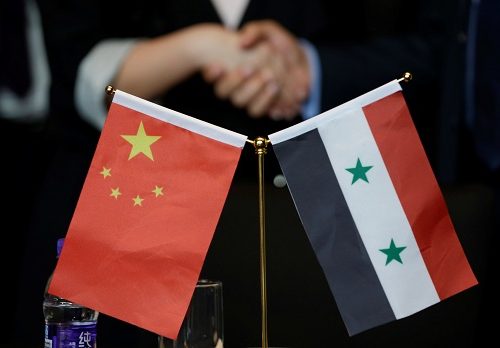
Chinese strategic engagement with Assad’s Syria

By Dan Hemenway

Canada moved to extradite Meng Wanzhou, the top financial officer for China’s global tech giant Huawei, on December 1, 2018 to the United States. The arrest, while closely linked to the ongoing US-China trade dispute and Western fears of Huawei as a Chinese espionage tool, was triggered by allegations that the company concealed payments from Iran in violation of sanctions.

Syria

SyriaSource

Dec 21, 2018

With US withdrawal, EU left alone to manage the Syrian crisis

By Mona Alami

The defeat of the last Islamic State (ISIS) stronghold in Syria concomitant with the sudden US announcement of troops withdrawal from the northeast; leaves Europe in a tight spot. In recent years, EU governments have spent billions to mitigate the repercussions of the refugee wave resulting from the Syrian war while working towards normalization with the regime on a fair transition process.

Syria

Rebuilding Syria

Dec 20, 2018

Act in haste, repent at leisure

By Frederic C. Hof

An American president impetuously overrules his national security team with a sudden decision on Syria; one that pleases the Kremlin, undermines US policy, and damages his own credibility. Essentially unmoored to the national security apparatus over which he presides, the president—strongly influenced by the views of a foreign leader—thinks he knows best in any event. […]

Syria