
Economy & Business

The US must lead with allies or risk becoming a bystander in a reshaped international financial system. As the global economy struggles to recover from COVID-19 and rising powers like China assert economic influence, this mission is critical to the long-term prosperity of the United States and its allies. Strong collaboration between the public and private sectors can help revitalize open markets for the twenty-first century.

Programs

At the intersection of economics, finance, and foreign policy, the GeoEconomics Center is a translation hub with the goal of helping shape a better global economic future.

Featured Analysis
In-Depth Research

Read the latest from the GeoEconomics Center
Content

GeoTech Cues

Sep 24, 2025

Global perspectives on AI and digital trust ahead of the Swiss e-ID referendum

By Coley Felt

Both artificial intelligence and digital identity systems are increasingly shaping the future of how governments approach inclusion, equity, security, and interoperability in the digital age.

Artificial Intelligence Digital Policy

MENASource

Sep 24, 2025

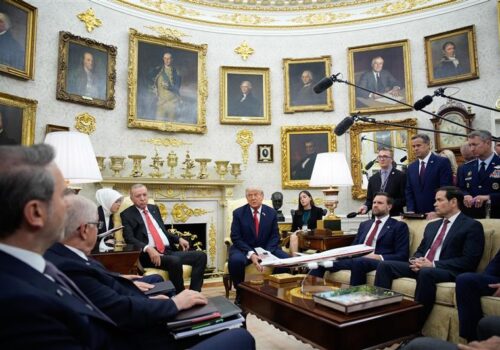
Is a new era of Turkey-Syria economic engagement on the horizon?

By Ömer Özkizilcik and Levent Kemal

The convergence of Turkey's and the Gulf's economic strategies in Syria presents an opportunity for Washington.

Democratic Transitions Middle East

Report

Sep 23, 2025

The critical minerals boom is an opportunity to integrate public health into mining operations

By Connor Gregory, Ciara M. Weets, and Rebecca Katz

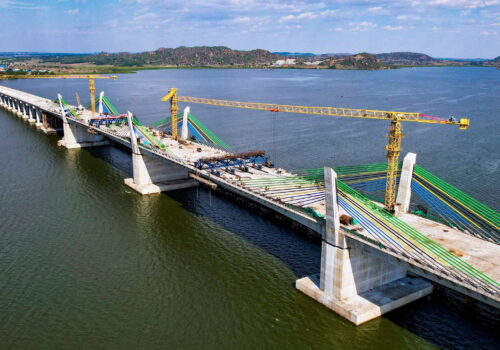
Africa is central to the global push for cleaner energy, including the continent's stocks of critical minerals that power green-energy technologies. But a race to extract more minerals poses public health risks, from the occupational hazards miners suffer to new disease outbreaks in mining camps. There’s a better course for investors and African governments.

Africa Critical Minerals

Issue Brief

Sep 22, 2025

Expanding Syria’s multilateral development bank engagement

By Basil Kiwan

Estimates of Syria’s post-civil war cost of rebuilding range from $250 billion to $400 billion. To help finance reconstruction and development, Syria’s transitional government should expand its partnerships with international financial institutions (IFIs) and multilateral development banks (MDBs), as these institutions can play a key role in mobilizing global capital.

Economy & Business Financial Sanctions and Economic Coercion

New Atlanticist

Sep 19, 2025

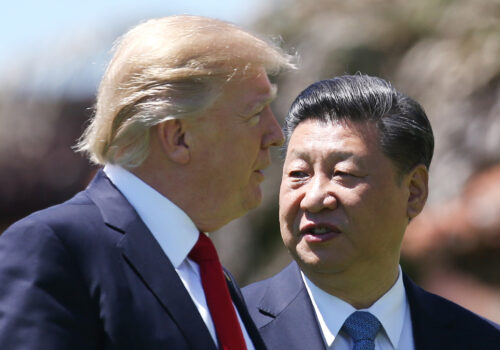
The EU won’t tariff China and India to please Trump. But it is working on a counteroffer.

By Charles Lichfield

European Commission President Ursula von der Leyen announced a nineteenth package of sanctions against Russia on September 19.

Conflict European Union

New Atlanticist

Sep 19, 2025

The economic roots of Nepal’s uprising—and what it means for the region

By Rudabeh Shahid, Nischal Dhungel, and Shakthi De Silva

The pattern of regime collapses in Nepal, Bangladesh, and Sri Lanka over the past few years suggests a region-wide crisis of governance linked to economic despair.

Bangladesh Corruption

New Atlanticist

Sep 19, 2025

Five charts that show the challenge of countering Mexico’s criminal organizations

By Aaron Kolleda

Washington's broader campaign to eliminate criminal organizations is a challenging one, since these organizations have become so deeply embedded in Mexico.

Economy & Business Financial Crimes & Illicit Trade

New Atlanticist

Sep 19, 2025

Where does the US-Brazil relationship go after Bolsonaro’s conviction?

By Ricardo Sennes, Valentina Sader

Former Brazilian President Jair Bolsonaro was found guilty of attempting a coup and sentenced to twenty-seven years and three months in prison.

Brazil Politics & Diplomacy

MENASource

Sep 19, 2025

Snapback sanctions threaten to further derail Iran nuclear deal hopes

By Rob Macaire

Now would be the best time for the West to negotiate a deal with Iran—but snapback sanctions threaten a derailing into further confrontation.

Financial Sanctions and Economic Coercion Iran

Issue Brief

Sep 19, 2025

Secure supply chains for the US run through its closest neighbors

By Jose Manuel Restrepo and Martin Cassinelli

Central America and the Dominican Republic are emerging as key partners for US economic security. Strengthening rule of law, workforce skills, and trade frameworks can secure lasting, mutually beneficial economic integration.

Americas Caribbean

Experts

Events