

Financial Sanctions and Economic Coercion

Financial sanctions and other forms of economic coercion have become policy tools of choice for the US government to deter illegal activity by international actors or to pressure governments into reversing actions that harm US interests. Yet these instruments and their potential pitfalls are often misunderstood. Restrictive economic measures such as financial sanctions, export controls, tariffs, and investment screening can play an important role in advancing certain policy objectives, but they risk being ineffective if misapplied or poorly implemented. Policymakers must also recognize the impact of economic statecraft on the private sector, which bears many of the compliance burdens and operational costs associated with these measures.

Energy Sanctions Dashboard

This dashboard focuses on US sanctions and restrictive measures placed on crude oil from Russia, Iran, and Venezuela—including the unintended consequences and the lessons learned.

Econographics

Apr 17, 2025

Russia Sanctions Database

By Kimberly Donovan, Maia Nikoladze, Lize de Kruijf

The Atlantic Council’s Russia Sanctions Database tracks the level of coordination among Western allies in sanctioning Russian entities, individuals, vessels, and aircraft, and shows where gaps still remain.

Eastern Europe Economy & Business

Recent analysis

Programs

At the intersection of economics, finance, and foreign policy, the GeoEconomics Center is a translation hub with the goal of helping shape a better global economic future.

Content

In the News

May 19, 2020

Hudson joins the World to discuss recent US Supreme Court ruling on Sudan and compensation for victims of the 1998 embassy bombings

By Atlantic Council

Africa Democratic Transitions

New Atlanticist

May 14, 2020

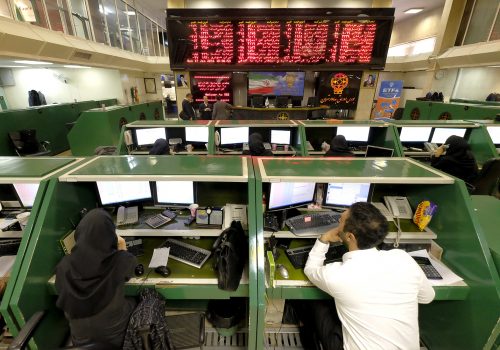
Iran’s stock market: Growth in the midst of a recession?

By Sara Bazoobandi

Given the overall economic conditions in Iran (i.e. low growth, production and consumption) maintaining the growth of the stock exchange will be challenging both for the companies and the government.

Financial Sanctions and Economic Coercion Iran

Issue Brief

May 11, 2020

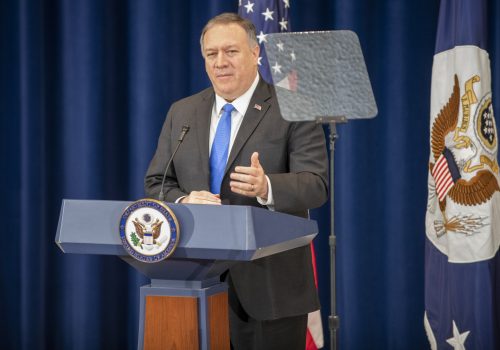
Trump’s JCPOA withdrawal two years on: Maximum pressure, minimum outcomes

By David Mortlock

Two years ago, US President Donald J. Trump walked into the White House Diplomatic Reception Room and announced his intention to withdraw the United States from the Joint Comprehensive Plan of Action (JCPOA). The Trump administration reimposed sanctions on Iran and has adopted a policy of “maximum pressure” to compel Iran to change its behavior […]

Economy & Business Financial Sanctions and Economic Coercion

UkraineAlert

May 4, 2020

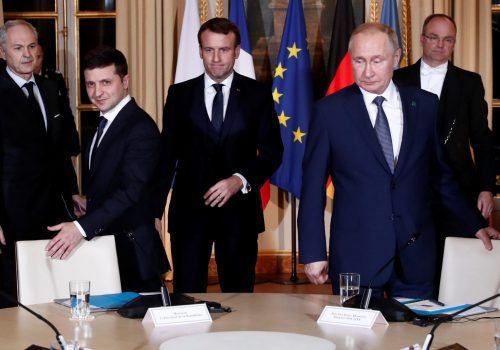
A serious but flawed look at peace in the Donbas

By John E. Herbst

The conflict in the Donbas cannot be solved by Ukraine and Russia alone, but the West must not unconditionally accept a "Russian consensus" to achieve it.

Conflict European Union

EnergySource

Apr 20, 2020

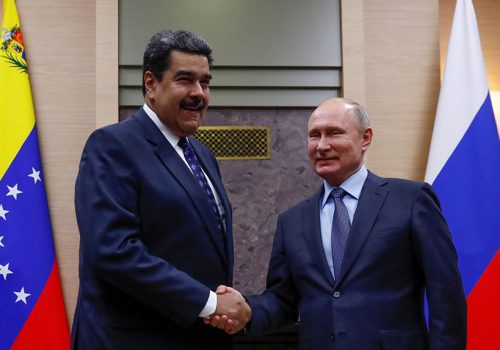
Containing Russian influence in Venezuela

By David L. Goldwyn and Andrea Clabough

The Russian government has been instrumental in preserving the Maduro regime, despite years of intense domestic and international pressure favoring a democratic transition, providing the regime invaluable diplomatic leverage, security personnel, and material, as well as an economic lifeline. The US strategy for a democratic Venezuela must recognize these realities and focus on containing Russian influence in Venezuela, as it cannot end it.

Economy & Business Financial Sanctions and Economic Coercion

In the News

Apr 11, 2020

Hudson in allAfrica: Sudan’s revolution one year after the fall of the dictatorship

By Atlantic Council

Africa Democratic Transitions

In the News

Apr 8, 2020

Jamil in The National Interest: America Must Lead on Sanctions Relief for Coronavirus-Stricken North Korea

By Atlantic Council

Coronavirus East Asia

New Atlanticist

Apr 6, 2020

The case for public health sanctions

By Michael Greenwald

Public health sanctions should be deemed just as significant of a national security priority as sanctions against Iran and North Korea. In a globalized world, a territory’s poor public health standards or purposeful concealment of information about pandemic activity is practically an act of war against the rest of the world. As such, it makes sense that this negligence warrants economic sanctions consequences on par with those used to punish terror finance violations.

Coronavirus Financial Sanctions and Economic Coercion

In the News

Apr 6, 2020

Herbst joins Ambassadors Pifer and Taylor in NPR op-ed with ideas on ending war in Ukraine

By Atlantic Council

Eurasia Center Director John Herbst joined Ambassadors Steven Pifer and William Taylor, all former US ambassadors to Ukraine, to write an op-ed, published by NPR, outlining how the coronavirus crisis may be an opportunity to end the war in Ukraine

Conflict Coronavirus

New Atlanticist

Apr 6, 2020

Lift Iran sanctions, but hit back hard if necessary

By Frederic C. Hof

Only by suspending sanctions explicitly and across-the-board can the United States make a critical point directly to the people of Iran: Americans care about your health and well-being, even as your rulers suffocate you with breathtaking incompetence, bottomless corruption, and an appetite for violent aggression that wastes vital resources for the benefit of the lowest political lifeforms in the Arab world.

Coronavirus Financial Sanctions and Economic Coercion

Experts