

Financial Sanctions and Economic Coercion

Financial sanctions and other forms of economic coercion have become policy tools of choice for the US government to deter illegal activity by international actors or to pressure governments into reversing actions that harm US interests. Yet these instruments and their potential pitfalls are often misunderstood. Restrictive economic measures such as financial sanctions, export controls, tariffs, and investment screening can play an important role in advancing certain policy objectives, but they risk being ineffective if misapplied or poorly implemented. Policymakers must also recognize the impact of economic statecraft on the private sector, which bears many of the compliance burdens and operational costs associated with these measures.

Energy Sanctions Dashboard

This dashboard focuses on US sanctions and restrictive measures placed on crude oil from Russia, Iran, and Venezuela—including the unintended consequences and the lessons learned.

Econographics

Apr 17, 2025

Russia Sanctions Database

By Kimberly Donovan, Maia Nikoladze, Lize de Kruijf

The Atlantic Council’s Russia Sanctions Database tracks the level of coordination among Western allies in sanctioning Russian entities, individuals, vessels, and aircraft, and shows where gaps still remain.

Eastern Europe Economy & Business

Recent analysis

Programs

At the intersection of economics, finance, and foreign policy, the GeoEconomics Center is a translation hub with the goal of helping shape a better global economic future.

Content

EconoGraphics

Dec 5, 2018

Trade Disrupted: US and China Need More Than a Truce

By Ole Moehr

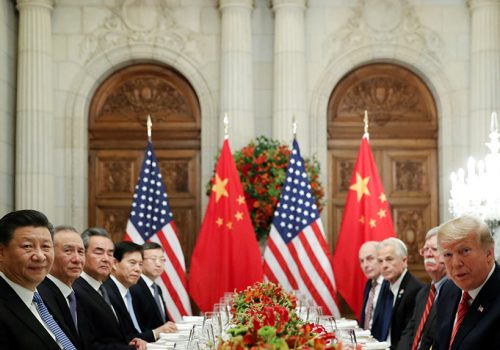
At this year’s G20 summit in Buenos Aires, the trade dispute between China and the United States took center stage. Chinese President Xi and his US counterpart President Donald Trump agreed to avoid further escalations of the ongoing bilateral trade war for the next 90 days. The temporary deal does not assuage the escalatory measures already taken, leaving the existing tariffs in place. This edition of the EconoGraphic explores how the brewing trade conflict is impacting manufacturing supply chains, soybean cargo routes, and trade flows of liquefied petroleum gas (LPG) among the United States, China, and the rest of the world.

China Economy & Business
TrumpXiDinnerFeature

New Atlanticist

Dec 2, 2018

Trump, Xi reach trade war truce… for now

By Ashish Kumar Sen

“China is extremely focused on building its economy of the future and will certainly try to take advantage of President Trump’s obsession with rebuilding the industries of the past,” said Atlantic Council nonresident senior fellow Jamie Metzl.

China Economy & Business

New Atlanticist

Nov 29, 2018

Trump administration’s new Nicaragua sanctions strategically target the top

By Samantha Sultoon

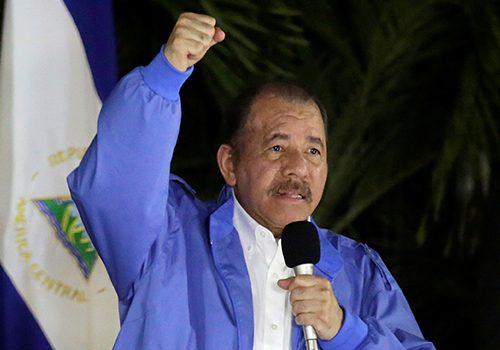
The new Nicaragua sanctions executive order (EO) is strategically scoped to expand the previous US sanctions actions taken in December and June under the Global Magnitsky human rights abuse and corruption authority.

Financial Sanctions and Economic Coercion Human Rights

Event Recap

Nov 27, 2018

Iran sanctions, OPEC and Trump: where are oil markets moving?

By Ellen R. Wald

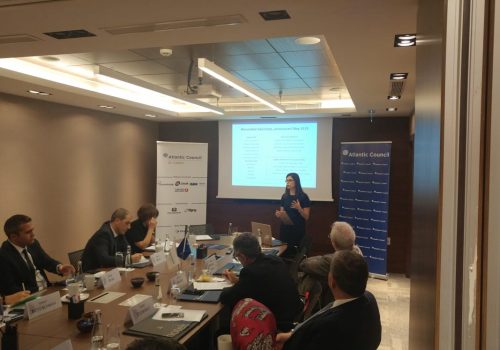
On Tuesday, November 27, in Istanbul, the Atlantic Council IN TURKEY hosted Atlantic Council Global Energy Center Nonresident Senior Fellow Ellen R. Wald for a talk entitled “Iran Sanctions, OPEC and Trump: Where Are Oil Markets Moving?” to a roundtable that featured a discussion about the likely impact of the new U.S. sanctions on Iran and […]

Energy Markets & Governance Financial Sanctions and Economic Coercion

New Atlanticist

Nov 26, 2018

Beware the lure of sanctions for Russia’s latest aggression

By Brian O'Toole

While sanctions may be useful to threaten Russia to rectify this situation, any imposition of them needs to be more strategically deployed—ideally with the EU—and lifted only for more strategic gains, vice resolution of this specific incident.

Conflict Financial Sanctions and Economic Coercion

New Atlanticist

Nov 26, 2018

Another Ukraine crisis tests US resolve

By Mark David Simakovsky

The United States should also work quickly and quietly to engage both the Russian and Ukrainian governments on the incident, warning them of the risks of further provocations and the need to find a way to ensure full and responsible Ukrainian access to its cities on the Sea of Azov.  

Financial Sanctions and Economic Coercion Maritime Security

Issue Brief

Nov 20, 2018

Global Magnitsky sanctions: Raising the human rights and anti-corruption bar

By Samantha Sultoon

GloMag sanctions offer a targeted response to human rights violations and corruption, but have far-reaching implications for international businesses.

Financial Sanctions and Economic Coercion

New Atlanticist

Nov 15, 2018

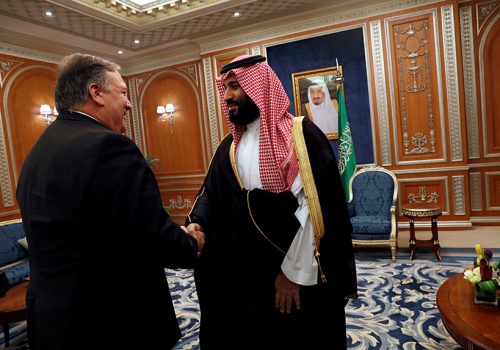
Treasury right to sanction Saudis in response to Khashoggi killing

By Samantha Sultoon

Treasury’s use of the GloMag sanctions authority exemplifies precisely what that authority was created for—it is a targeted action intended to punish specific targets without broader negative implications. 

Financial Sanctions and Economic Coercion Saudi Arabia

New Atlanticist

Nov 15, 2018

United States sanctions seventeen Saudi officials over Khashoggi murder

By Ashish Kumar Sen

“While sanctions are an important way of sending a message, they are also a blunt instrument that authoritarian leaders find ways to work around," said Richard LeBaron, a non-resident senior fellow with the Atlantic Council's Rafik Hariri Center for the Middle East.

Financial Sanctions and Economic Coercion Human Rights

Inflection Points

Nov 11, 2018

Trump’s test on Iran: Turning disruption to progress

By Frederick Kempe

Without minimizing the other challenges, my wager is that the Iran issue may become the Trump administration’s most defining foreign policy challenge over the coming two years, viewed alongside North Korea as part of a dual effort to counter rogue regimes.

Financial Sanctions and Economic Coercion Iran

Experts